
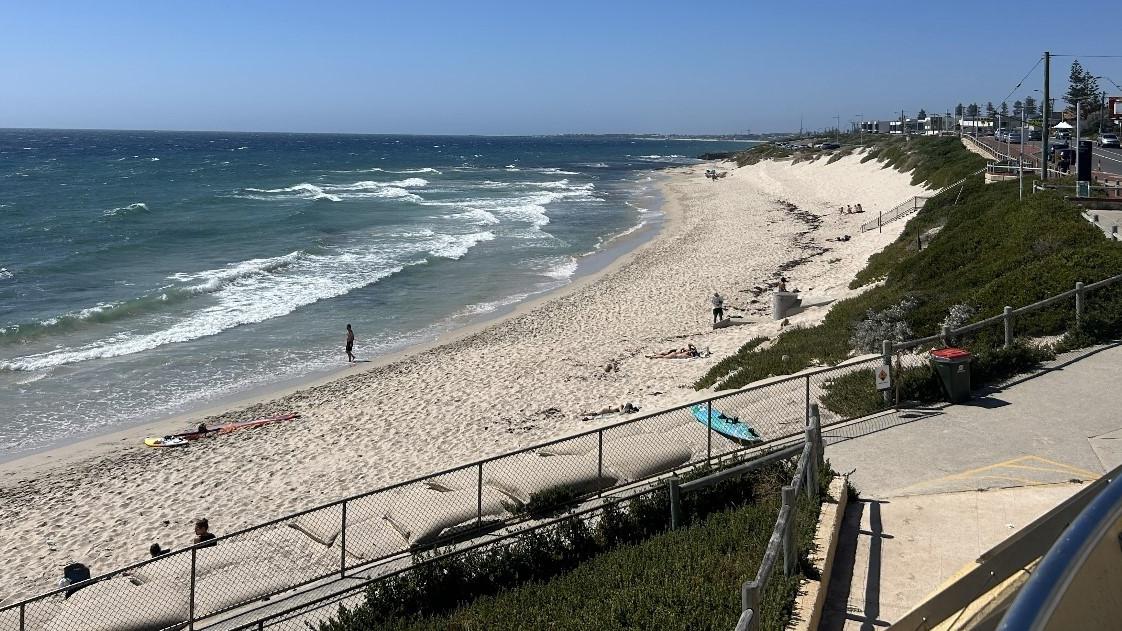
An artificial reef could be installed off Mettams Pool in North Beach as part of the City of Stirling’s long-term plan to halt ongoing erosion at the popular spot, as the ocean continues to eat away at the shoreline and creep closer to West Coast Drive.
An investigation commissioned by the city into more permanent coastal adaptation options has identified a submerged artificial reef as one of the leading long-term solutions to stabilise the coastline, in addition to ongoing sand replenishment work.
It also identified a low-crest vertical wall to be investigated further.
Based on the study, a report from city administration is recommending that the city undertake further investigation and develop the two preferred adaptation options at the beaches, along with ongoing sand replenishment to maintain the shoreline.
The city said the submerged breakwater would act as a multipurpose artificial reef, designed to reduce wave energy and limit erosion, and it could enhance swimming, surfing and snorkelling conditions.
The report noted the addition of a seawall could “provide essential protection” for West Coast Drive and the shared path.
Just metres from the road, Mettams Pool is classified as one of WA’s coastal erosion hotspots.
A report released by the City of Stirling in 2023 found that Mettams and Watermans Bay are at extreme risk of coastal erosion as early as 2045 if immediate action is not taken to address the impacts of rising sea levels along the Stirling coastline.
Initial construction of the reefs, including sand replenishment, is estimated at $8.9 million, with 50 years of maintenance projected to cost $12.5m.
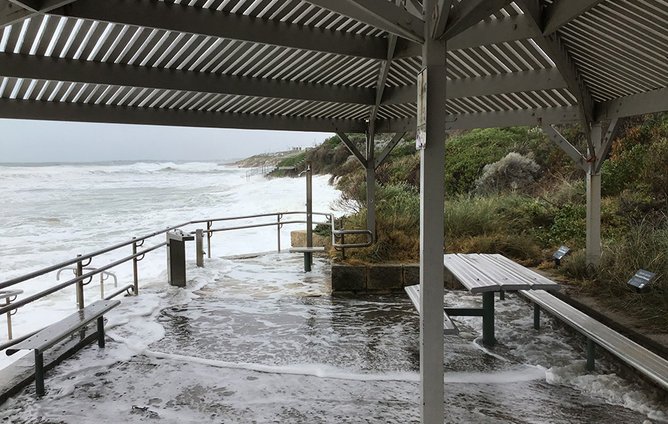 Camera IconThe Mettams Pool Gazebo during a storm in 2020. Credit: City of Stirling
Although the most costly of all options assessed, they believe the reef could have the greatest impact, with officials estimating it could reduce annual sand loss from around 1200 cubic metres to 700 cubic metres.
However, officials admit more investigation is needed to fully understand the reef’s design, costs, and potential impacts on the beach and local marine environment.
“Due to the high-level nature of the current study, the complexity of the site and underdeveloped concept design, there exists a relative lack of understanding of the costs, benefits, impacts, and outcomes of this option,” the report states.
“Further investigations are required to better understand what size and shape reef would provide coastal protection benefits, and what impacts such a design would have on the existing amenity and benthic habitat.”
Estimates put the construction of a low-crest seawall, including sand replenishment works, at $2.8m, with 50-year maintenance costs projected at $11.6m.
City officers said during severe erosion events, the wall would have the capacity to limit eroded volumes from the south section of the beach.
“(The seawall) is recommended for consideration because it is practical, relatively affordable and offers protection to assets that will be essential in the coming decades,” the report states.
“While seawalls have not been favourable amongst the community, this option is relatively discreet compared to previous proposals and joins two existing sea walls at the gazebo and the amenities block.
“The cost estimates are high-level but are considered reliable due to confidence in the design.”
The city said erosion pressure at Watermans Bay was considered “far less critical” than at Mettams Pool, so detailed work on coastal protection at Watermans had been deferred until 2027-28, aiming for completion by 2030.
The long-term coastal protection report comes as the city once again begins transferring more than 5000 cubic metres of sand from Trigg Beach to Mettams Pool to replenish the shoreline.
Known as sand nourishment, the works help build a buffer dune to reduce beach erosion during the winter storm season.
The sand is being sourced from Trigg Beach, as a natural accumulation at the upper back of the beach provides an “ideal source” to replenish Mettams Pool without disrupting the surf break.
Sand is being moved through the Saunders Street carpark in Trigg, with most of the work carried out at night to reduce public impact.
The works, which began on Sunday, March 22, are scheduled to finish by April 1.
The city’s recommendation on the coastal adaptation options was discussed by the Stirling Community and Resources Committee last Tuesday night, and is expected to go before the council for a vote on Tuesday, March 31.
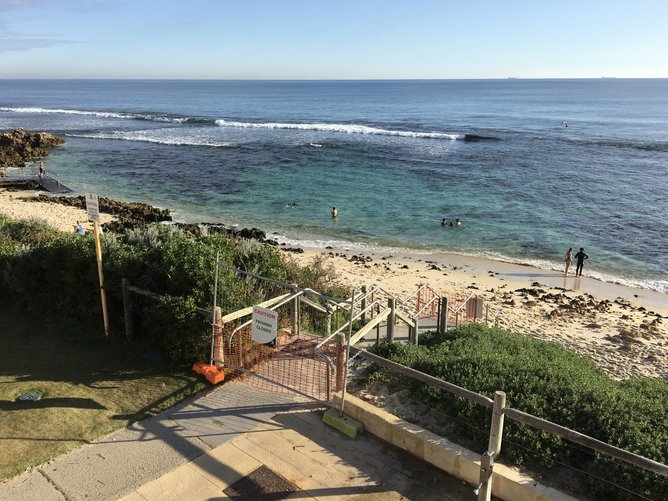 Camera IconSand replenishment works are often required at Mettams Pool due to erosion. Credit: Justin Bianchini