

A Bondi nanny accused of torture and kidnapping for the Chilean Pinochet regime will make her last-ditch effort to prevent extradition to Chile this morning.
A two-day hearing has been set for Justice Michael Lee to consider a final appeal by Adriana Rivas, who was arrested in Chile in 2007 on aggravated kidnapping charges, but fled to Australia in 2011 while on bail.
Chilean prosecutors allege 72-year-old Ms Rivas was involved in the kidnapping, interrogation and disappearances of seven victims of the Pinochet regime in the 1970s, which Ms Rivas denies.
Prosecutors say a former servant at the infamous Simon Bolivar Barracks has testified Ms Rivas was involved in kidnapping and allegedly played a major role in interrogating victims during gruesome torture sessions at what has been described as an “extermination centre” of the Pinochet regime.
The former servant, whose testimony has led to the arrests and convictions of several Pinochet agents, told ABC Foreign Correspondent in 2014 that Ms Rivas had beaten and applied electricity to detainees, and held recording devices close to their mouths while confessions were extracted.
Adriana Rivas worked for the Pinochet dictatorship’s secret police in the 1970s, though she denies involvement in its abuses. (El Pacto de Adriana)
Previously unreported emails have also revealed an officer at the Australian embassy may have played a role in Ms Rivas’s escape to Australia.
In an email to the then-housing minister in 2012, Ms Rivas described how an Australian consular official had “helped me all the way” to leave Chile, and that she had informed the official “about my decision to leave Chile”.
The Department of Foreign Affairs said it had no record showing consular officials knew of Ms Rivas’s intention to breach bail or that they assisted her to depart Chile for Australia.
Greens senator David Shoebridge said the department had not been forthcoming.
“We have Ms Rivas in her own writing describing how the embassy in Chile was aware of her intention to breach bail and to exit the country,” Senator Shoebridge said.
“When we placed that directly to DFAT, we got effectively a deflection … there is obviously an obligation for DFAT to give full and frank disclosure to the Australian community, particularly the Chilean Australian community.”
The Pinochet dictatorship’s National Intelligence Directorate was a secret police force designed to eliminate political dissidents, responsible for the execution of more than 2,000 Chileans and the torture of tens of thousands more between 1973 and 1990.
Prisoners were subjected to electric shocks, waterboarding, sexual abuse and cruel, experimental forms of torture.

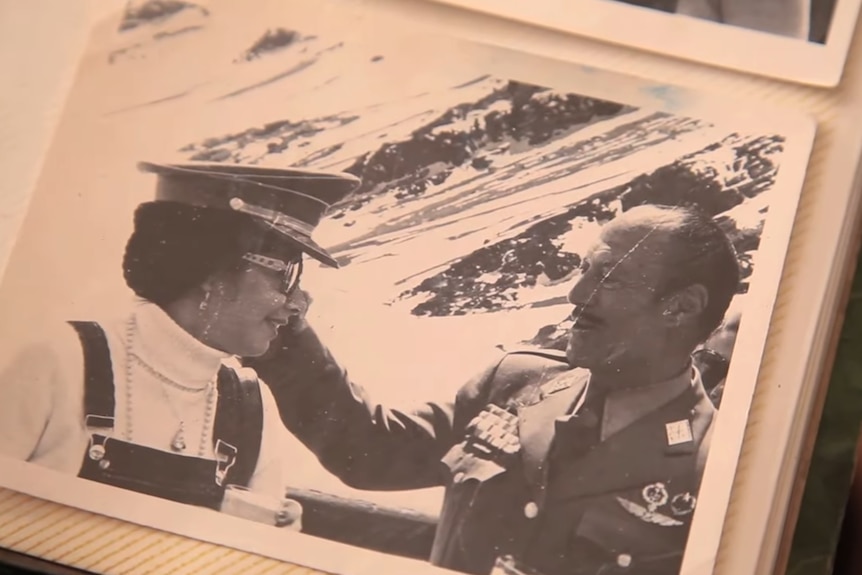
Adriana Rivas with General Manuel Contreras, the former head of the the National Intelligence Directorate, Chile’s secret police during the dictatorship of General Augusto Pinochet. (ABC News)
Chile formally requested the extradition of Ms Rivas in 2014, and she has been in detention awaiting removal since 2019.
‘Fugitive’ for 16 years
Ms Rivas worked for the Pinochet regime from 1973 to 1977, according to her 2012 communications with the then-federal housing minister, before moving to Australia in 1978.
When Chile first formally requested her extradition in 2014, Ms Rivas denied the charges against her and, in an interview with SBS, defended the use of torture in Chile as necessary at the time.
In that same year, then-shadow attorney general Mark Dreyfus said in a statement to the House of Representatives that Ms Rivas was a “fugitive from justice” whose case must be resolved.
“It is almost impossible to overstate the seriousness of the allegations made against Ms Rivas,” he said.
“I hope the government will move swiftly to ensure that justice is done by doing everything possible to return Adriana Rivas to Chile to face the trial from which she fled.”
Since then, Ms Rivas has spent years fighting her extradition through a number of appeals processes.
Adriana Navarro, a lawyer for the Australian families of several victims of the regime, said justice had been denied for some family members, who have died while waiting for Ms Rivas to face court in Chile.
“It [has taken] much longer than what we expected,” Ms Navarro said.
“The final decision to send her to Chile was made by the attorney-general in 2024, so this last attempt by Ms Rivas to object to it has lasted close to two years now. That’s just far too long.
“Even when one understands the complexities of the law, these matters should really proceed much faster.
“Sometimes delay means you don’t get any justice. In the case of the families of my clients, some of the spouses for example have passed away, and some of the children of the victims have passed away.”
Ms Navarro said the extradition request has become one of the longest-running in Australia’s history.
She added that the Pinochet regime’s crimes had been a harm against the whole of Chile, and in order to heal, the community needed to see reparation and the prosecution of those liable.
Senator Shoebridge said after the two-day hearing, the government should no longer entertain any further attempts by Ms Rivas to delay her extradition.
“There’s this incredible frustration the community has that this has taken decades and decades for someone to face justice, someone who has been accused of the most horrific crimes still hasn’t faced justice,” Senator Shoebridge said.
“This case is one of inexplicable delay, inexplicable delay inside the bureaucracy before matters are put before the minister.

David Shoebridge said DFAT had not been forthcoming about what, if any, assistance was provided to Ms Rivas. (ABC News: Matt Roberts)
Senator Shoebridge said people should be entitled to exercise their legal rights, but there must also be justice for the community.
“I hope that they resolve in an order so that this individual will return to Chile to face justice, but what I would also hope is that there is a resolve from Australian authorities to ensure this is the end of the road, no more stays, no more years and months and months waiting for resolution,” Senator Shoebridge said.
Ms Rivas may appeal Justice Lee’s decision for a review by the full court of the federal court, though that process is typically resolved quickly.
While Ms Rivas could seek leave to appeal to the High Court, she abandoned a previous attempt to do so, and lawyers have questioned what point of law of national importance would justify a High Court appeal.