
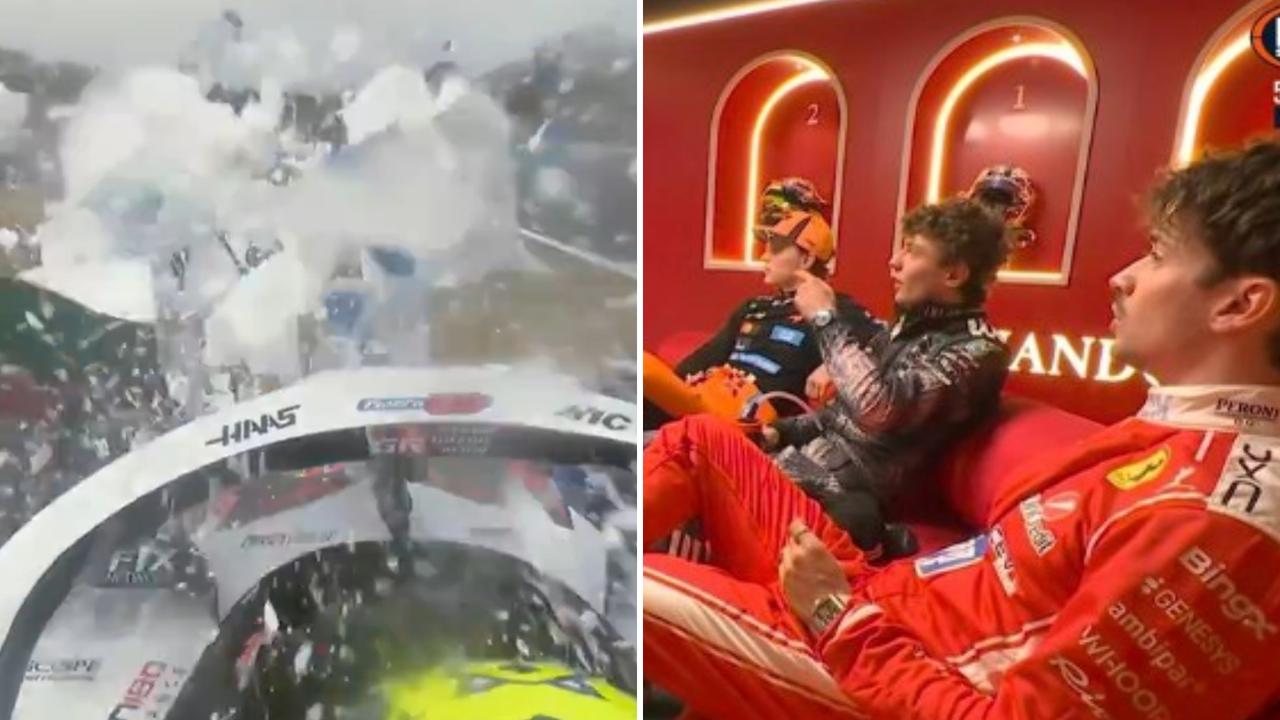
A sickening crash at the Japanese Grand Prix for Oliver Bearman, who limped away from his smashed-up Haas having sustained a 50 g impact, has added further heat to F1’s new regulations over safety concerns.
Bearman left the road at 308 kilometres per hour attempting to avoid what would have been an aeroplane accident with Franco Colapinto.
Fox Sports, available on Kayo Sports, is the only place to watch every practice, qualifying session and race in the 2026 FIA Formula One World Championship™ LIVE in 4K. New to Kayo? Join now and get your first month for just $1.

The Briton was chasing the Argentine for 17th place out of the hairpin. As he rounded turn 12, Colapinto’s rear lights flashed red twice, signifying he was out of battery.
Bearman, meanwhile, was holding down his boost button.
The speed delta was suddenly a monstrous 50 kilometres per hour — enormous for two drivers at full throttle.
Bearman swung left in equal parts to try to make a move and to avoid a crash, but he ended up on the grass, where he lost control of the car and triggered the smash.
It was exactly the sort of incident many in the sport had feared would be inevitable this season.
In Australia, Charles Leclerc infamously declared that the large speed differentials were akin to deploying the “mushroom” in iconic video game Mario Kart.
Watching the Bearman crash in the Japan cooldown room, Oscar Piastri was reminded of his words.
“I finally see what you mean now about the mushroom,” Piastri said to Leclerc.
“It’s pretty accurate.”
READ MORE
TALKING POINTS: ‘Best Oscar we’ve seen’: Piastri truth to send Lando chills
RACE REPORT: Brilliant Piastri robbed of Japan win after epic first-corner move
‘NEVER GOT TO SEE’: Unlucky Piastri ponders alternate reality and issues McLaren rally call
The 2026 engine doesn’t work like a regular racing motor because it is constantly charging and discharging the battery in a way that materially impacts power output. When a driver presses the boost button, they have access to 750 kilowatts. When they run out of battery, they have just 400 kilowatts, and depending on where they are around the track, some of that power could be directed to charging the battery, creating an even bigger disparity.
And because every power unit manufacturer charges and discharges the battery differently — that is, charge and deploy at different parts of the track — and because some are just more powerful or more efficient than others, the manifestation of these sorts of closing speeds are unpredictable. It’s not as if every car is charging, discharging and running empty at the same parts of the track.
Drivers react to the crash in the Japan cooldown room.Source: FOX SPORTS
“We’ve been warning them about this happening,” Carlos Sainz, a director of the Grand Prix Drivers Association, told Sky Sports. “These kinds of closing speeds and these kinds of accidents were always going to happen, and I’m not very happy with what we’ve had up until now.
“I was so surprised when they [the FIA] said, ‘No, we will sort out qualifying and leave the racing alone, because it’s exciting’.
“As drivers, we’ve been extremely vocal that the problem is not only qualifying, it’s also racing, and we’ve been warning that this kind of accident was always going to happen.
“Here we were lucky there was an escape road. Now imagine going to Baku or going to Singapore or going to Vegas and having this kind of closing speeds and crashes next to the walls.
“We, as the GPDA, warned the FIA these accidents are going to happen a lot with this set of regulations, and we need to change something soon if we don’t want them to happen.
“I hope it serves as an example and the [FIA and FOM] listen to the drivers and not so much to the teams and people that said the racing was okay, because the racing is not okay.”
It was significant that Sainz spoke up on behalf of the drivers, most of whom, for the most part, have stepped back from heavily criticising the rules.
Charles Leclerc, for example, was more equivocal, saying drivers have to learn to be conscious of their lines when they are down on power.
‘F*** our luck!’ – Russell CRACKS it | 00:30
Team bosses have been similar, with some speaking out less strongly than others, which raises the spectre of rule changes becoming political. The frontrunning teams, for example, are less likely to face this sort of problem given they’re racing fewer cars in the leading group.
McLaren boss Stella, though, has been talking about this risk since pre-season testing, and he said it would be moved to the top of the list during crunch regulation meetings in April.
“We don’t want to wait for things to happen to put actions in place,” he said. “Today something happened.
“We have a responsibility to put in place the actions that, especially from a safety point of view, should be implemented.
“I don’t think a simple solution exists, but we have the expertise, the engineers, the variables to put in place some actions.
“I think this will be something that will be looked at in the meetings that will happen during the break between FIA, the teams and F1.
“This should jump at the top of the agenda.”
Formula 1 has a month to thrash out this issue, but in a sport of such high stakes, sometimes words are easier than action.