
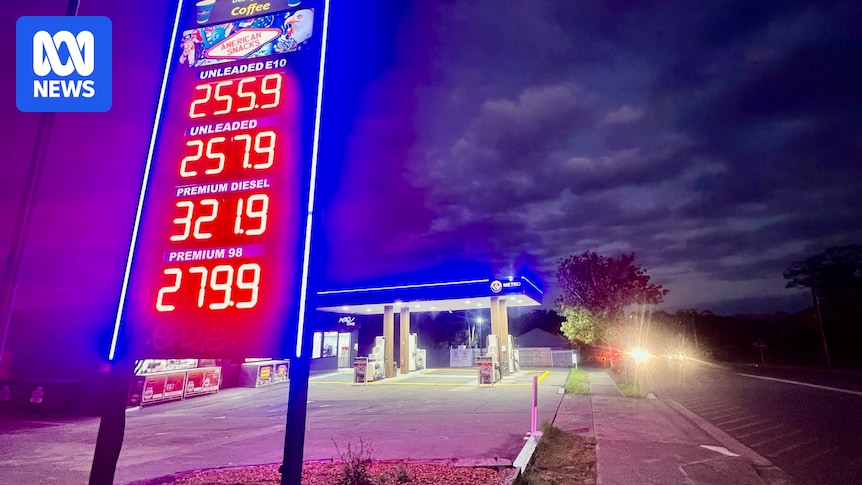
Following a meeting of the national cabinet, Prime Minister Anthony Albanese announced a cut to the fuel excise.
This means Australians are set to see some relief at the petrol pump.
Here’s everything you need to know.
What is a fuel excise?
An excise is a type of indirect tax levied on specific goods produced, manufactured or sold within a country such as fuel or tobacco.
A fuel excise is a flat sales tax levied by the Australian government on petrol and diesel at the bowser.
The price is indexed and adjusted twice each year in line with inflation.
With the tax temporarily cut in half, the 53 cent-a-litre charge will fall by 26.3 cents for three months — until June 30.
“We’re making fuel cheaper today because we understand that Australians are under serious pressure,” Albanese said.
Opposition Leader Angus Taylor claimed credit for the tax relief.
“Australian families and small businesses will pay less for fuel because the Coalition led, and the government followed,” he said.
The heavy vehicle road user charge — about 32 cents a litre — will also be reduced to zero for three months, in a bid to support truck drivers.
How much cheaper will fuel be?
The federal government announced a 50 per cent cut to the fuel excise.
That means motorists will save 26.3 cents a litre when they fill up their tank.
For a 65-litre tank, the savings will be about $19.
A driver filling a 50-litre tank will save about $14.
However, if global prices keep rising, retail prices could climb again too.
Loading…When will petrol prices go down?
The excise cut will come into effect on Wednesday, April 1.
But that doesn’t mean you’ll see a drop in prices at the bowser straight away.
Energy Minister Chris Bowen said that’s because retailers need to first sell the stock they purchased at the higher price.
“The fuel in the tank at the service station might have been there for days. They’ve already paid the tax,” Mr Bowen said.
“So please, if you turn up tomorrow and the price hasn’t gone down, they’re just waiting for the new petrol with the lower tax to come in.”
Treasurer Jim Chalmers said consumers should expect the fuel excise cut to take “somewhere between maybe one and two weeks” for the full benefit to flow through.
A report by the Australian Competition and Commission in 2022, when the fuel excise was halved as Russia invaded Ukraine, showed the excise cut had been passed on to retail prices at the vast majority of petrol stations after six weeks.
Why is fuel so expensive?
The Middle East war is disrupting oil and gas flow through the Strait of Hormuz, one of the world’s most important energy choke points.
About a fifth of global energy trade normally passes through the strait.
Iran’s stranglehold on the thoroughfare has sent the price of Brent crude soaring, hitting $US115 a barrel over the weekend. Before the war, it was about $US70 a barrel.
That cost has been passed onto the consumer and Australia is especially exposed because it imports about 90 per cent of its fuel.
According to the NRMA, Australia’s biggest sources of refined products are South Korea, Singapore, Malaysia, Taiwan and Brunei. These countries get their oil mostly from the Middle East.
Australia and Singapore have made a joint commitment to continue the trade of fuels (our LNG for their petrol and diesel).
The average price of petrol in Australia has risen to $2.53 a litre as of Sunday, up from around $2.09 when the war began over a month ago, according to the Australian Institute of Petroleum.
Diesel has passed $3.10 a litre in nearly every capital city around the country.
Will the fuel excise cut increase inflation?
It could.
The fuel excise cut will cost the Australian taxpayer $2.55 billion, and economists have warned it could further increase inflation.
This could pressure the Reserve Bank to lift interest rates at the next meeting in May, and so on.
Fuel price cut likely to come with ‘sting in the tail’, economists warn
After Monday’s national cabinet meeting, Chalmers was asked if inflation could reach 10 per cent.
He said he hasn’t seen a number as high as that in his department’s modelling. But, he said 5 per cent was a conservative estimate.
For context, the Consumer Price Index (CPI) rose 3.7 per cent in February, down 0.1 per cent from the previous month. The data does not capture the energy price spike caused by the US and Israel’s war with Iran, which began on February 28.
How many petrol stations are out of fuel?
On March 31, Energy Minister Chris Bowen provided an update on how many petrol stations across Australia were without fuel.
New South Wales: 247 without diesel, 61 don’t have any stockQueensland: 77 without diesel, 39 without regular unleaded petrolVictoria: 82 without diesel, 40 without unleadedWestern Australia: 18 without diesel, 14 without unleadedSouth Australia: 20 without diesel, 13 without unleadedTasmania: eight without diesel and 15 have one or more grades unavailableNorthern Territory: five without diesel, four without unleadedACT: five without diesel, two without unleaded
With increased demand, more people are rushing to fill up their vehicles — some even hoarding fuel — which is leading to shortages across the country.
How many days of petrol does Australia have left?
As of March 30, Australia’s fuel reserves are at the following levels:
39 days worth of petrol30 days of diesel30 days of jet fuel
All fuel shipments through to May have been secured, meaning supply remains at pre-conflict levels despite service stations experiencing localised shortages.
Loading…