
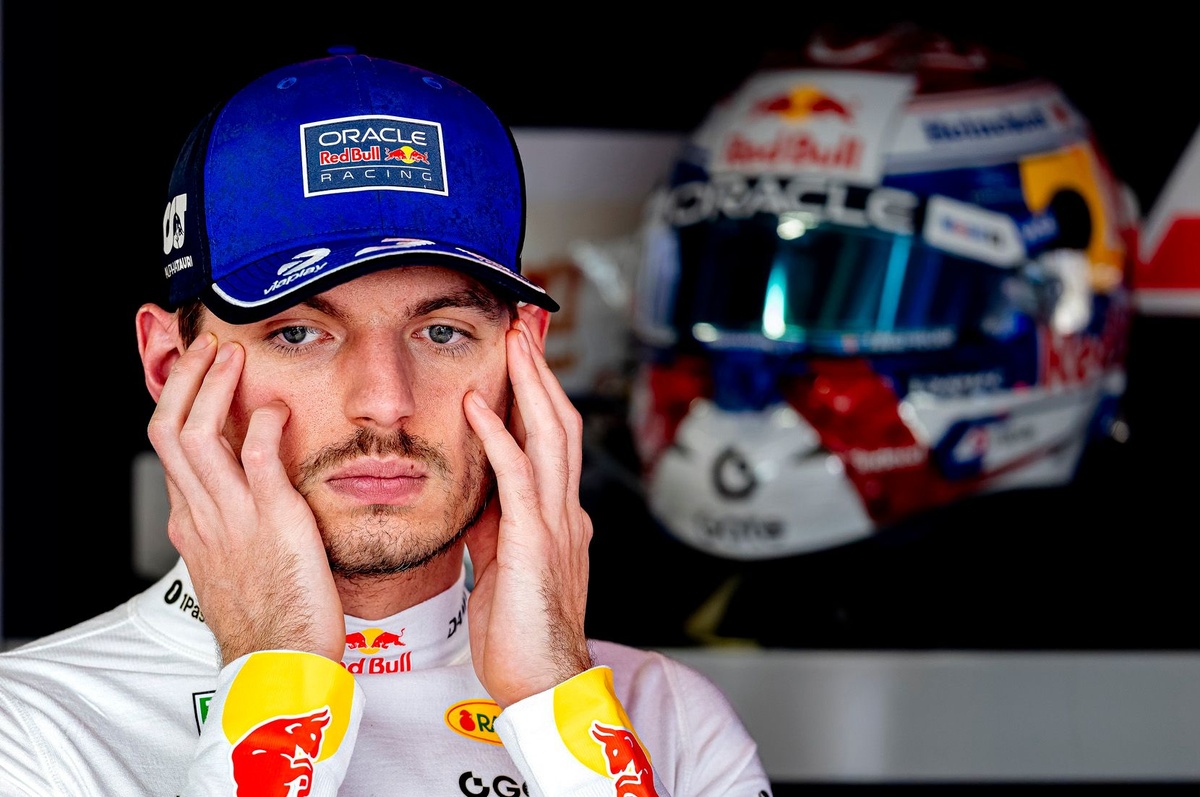
You’ve probably heard this by now, but there was only one story in town during the Japanese Grand Prix’s Thursday media day: Max Verstappen had told a journalist – the Guardian’s Giles Richards, to leave his media session, held in Red Bull’s hospitality unit, and threatened not to answer any questions until the scribe in question had left the premises.
The bone of contention had been in the journalist’s press conference question to Verstappen in the wake of the Abu Dhabi season finale last year. Here is the transcript of that question and response, pasted below.
Q. Max, you lost out to Lando by just two points. What do you think now about the incident with George Russell in Spain? Do you regret that looking back in hindsight?
MV: You forget all the other stuff that happened in my season. The only thing you mention is Barcelona. I knew that would come. You’re giving me a stupid grin now. I don’t know. Yeah, it’s part of racing at the end. You live and learn. The championship is one of 24 rounds. I’ve also had a lot of early Christmas presents given to me in the second half, so you can also question that.
I don’t think that’s an unreasonable question to ask, and nor do I think that Verstappen gave an unreasonable response. Others may – and have – disagree(d) with the content of the question and suggested it was a case of “gotcha” journalism, but it’s the sort of question that would be asked to anybody in that situation and context.
Removing the existential questions about the butterfly effect and assuming Verstappen’s actions and the balls dropped by McLaren along the way play out the same way in the points scenario, then his actions at Barcelona ultimately cost him a fifth title. It’s not a stretch to say that he probably knows that and must live with that. Invariably, he will be asked about it, although he is not obliged to answer.
Verstappen has also taken umbrage with Richards’ apparent smirk during the session (which has been denied), which he since upgraded to them laughing in his face during the Abu Dhabi session. It’ll be interesting to see if the narrative changes again to Richards having performed a dance of joy in the press conference room.
Now, in that same press conference at Abu Dhabi, Oscar Piastri also got asked about the lessons and ramifications of his somewhat pallid performances in Austin and Mexico, which should illustrate the point that drivers get asked similar questions all the time, if to dispel the narrative that Verstappen was unfairly singled out.
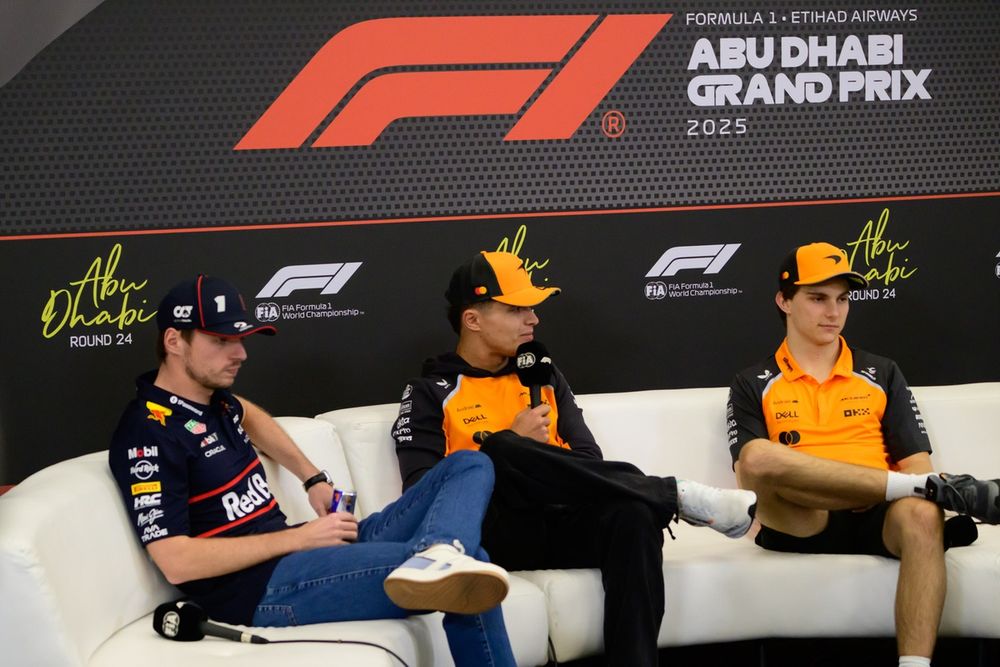
Verstappen held a grudge over Richards’ question at the Abu Dhabi press conference last year
Photo by: Erik Junius
Further case in point: had Lando Norris failed to clinch the championship, he’d have been asked about his crash with Piastri in Canada…
…indeed, he was asked about this at the Dutch Grand Prix by a different journalist in effectively the same manner. Just as Verstappen answered the question about Barcelona in his own inimitable style, Norris was also typical in his response to another journalist’s question. Again, this is copy-pasted below in full.
Q. All points count in a championship battle, but when you look back, do you sometimes have regrets? Are you stressed that points lost somewhere earlier in the calendar might be decisive in the end?
LN: I mean, could I at times have made better decisions? I think so. If I had that thought a little bit more in my head at the time… probably the main one was China Sprint qualifying. I think my lap was good enough for pole until the final hairpin where I locked up. If I had that thought just before braking that “it’s a long season, don’t try and be a hero”, I wouldn’t have finished it like that. I lost eight points there. Canada, if I could rerun that and just be a little bit smarter and not take so much risk, could I have not lost quite a few points there? Yes. I don’t know. I wouldn’t say I regret those moments. Do I wish it changed? Do I wish it was better? Do I wish I could do it again? Yeah. But at the same time, I don’t regret making those decisions at the time, because that’s me, that’s life, and that’s the way it goes. Sometimes it goes your way and you get lucky, sometimes it doesn’t and you don’t make the best decisions. But those are also the times you learn the most and help yourself more for the future. So, no – I live my life not by regretting what I’ve done, more trying to learn and improving from it.
Were the roles reversed, Verstappen’s Barcelona clash with George Russell would have been forgotten and Norris’ internecine battle with Piastri might have been in the spotlight once more. In that scenario, everyone and their dog would have lauded Verstappen for what would have been a near-impossible comeback to win a fifth title.
Perhaps Verstappen was looking to make a point when he ejected Richards from his session. He wanted to remind them who was in charge. But, for those who are au fait with his oeuvre, this was certainly not an attempt to entrap Verstappen. You hope for the best in people, and you hope to be the journalist or writer who can elicit a nice story of self-reflection. In this instance, Verstappen probably got the wrong end of the stick – and in that situation, there’s suddenly an axe to grind when there didn’t need to be one.
While our media centre colleague received an outreach of support, they also received abuse from people who went to bat for Verstappen. Their standpoints included a general good-will response to only Verstappen’s own point of view (or at least an assumption thereof), a general misunderstanding of what our job as media entails, the hackneyed trope of ‘British bias’, and others questioned the value of journalists entirely. Would these fans have remained as steadfast to those beliefs had it been either Norris or Piastri who sent a journalist away?
It’s fair to say that there is a lack of trust in the media at the moment, something played upon by those who decry factually accurate stories as “fake news” and turn the public against the one thing that can keep them in check.
One wishes to clarify further that is in no way an attack on Verstappen, neither on a personal or sporting level. The identity of the driver involved is largely irrelevant in this situation, and one trusts that the widespread disagreement across the media in attendance would be the same in any circumstance. It’s no surprise why many opt for easy questions to ensure their access is left in place.
Put simply, a journalist was removed from a media session that they were free to attend because the subject did not like a question they had asked previously. And that sets a dangerous precedent – not just in F1, but globally.
The importance of journalism in F1 and the world
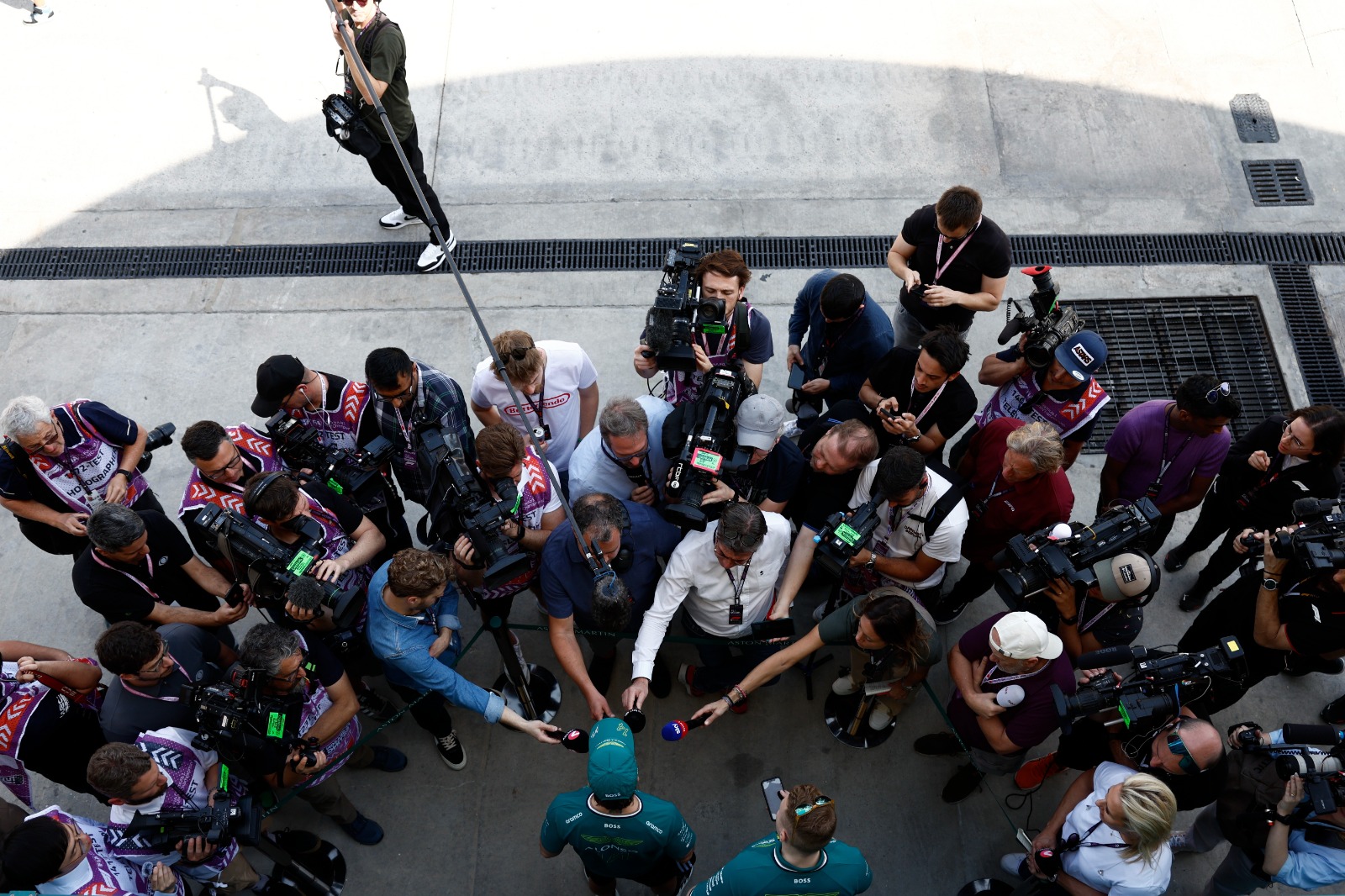
Fernando Alonso fields questions from the media
Photo by: Zak Mauger / Getty Images
One would like to think that there’s sense of duty with regards to journalism; one generally enters it with the noble intention of speaking truth to power, to uncover corruption and duplicity, and bring it to light. That’s the utopian view, but it’s a lot less romantic than that. Truth can be inconvenient. It is also not discriminatory. People have died in their pursuit of truth, and others have failed to do so.
As F1 journalists, we are immensely privileged; we don’t trade in topics that could change the fabric of the world as we know it. We’re writing about fast cars and the people who drive them. We’re not going to have biopics made about us in the style of Frost/Nixon, nor will we win Pulitzer Prizes or expose true cabals of evil and deceit. We’re here because we love F1 and want to share that passion with others, but we still have the desire to drill into the stories that matter. Journalism is journalism, and the stories we get depend upon the field in which we play.
In the wake of the Abu Dhabi question to Verstappen, there were many social media comments who decried the role of journalists in F1. The perception is that we’re little more than a braying pack of muck-rakers, solely aiming to cause trouble to sell papers. This, for the most part, is untrue of independent media.
Misinformation has become a lucrative trade and the rise of AI has only served to expedite the dissemination of falsehoods into the news cycle
This is an accusation that I had heard in a previous role, with a staff member asking the head of communications “why do we even need journalists?” in response to a news article that had publicised well-known internal problems with a championship’s new car. While the journalist stuck to their guns, and admirably so, there was a treasure trove of untapped information that the championship’s organisers were glad that they’d missed.
In any field, journalism is supposed to offer a different slant to a focus-group curated narrative. Be it through news stories, comment pieces, analysis pieces, or any of the other multimedia environments in which we work, good journalism should go beyond surface level. If that’s not of interest to you, then surface-level media still exists; public relations departments seek to define what that is.
PR departments aim to uphold an image, serve shareholders, and put a spin on damage control as and when required. As someone who has worked on both sides, both standpoints are fine. The two aspects should ultimately co-exist together in some form but, when one tries to supersede the other, this is where problems arise.
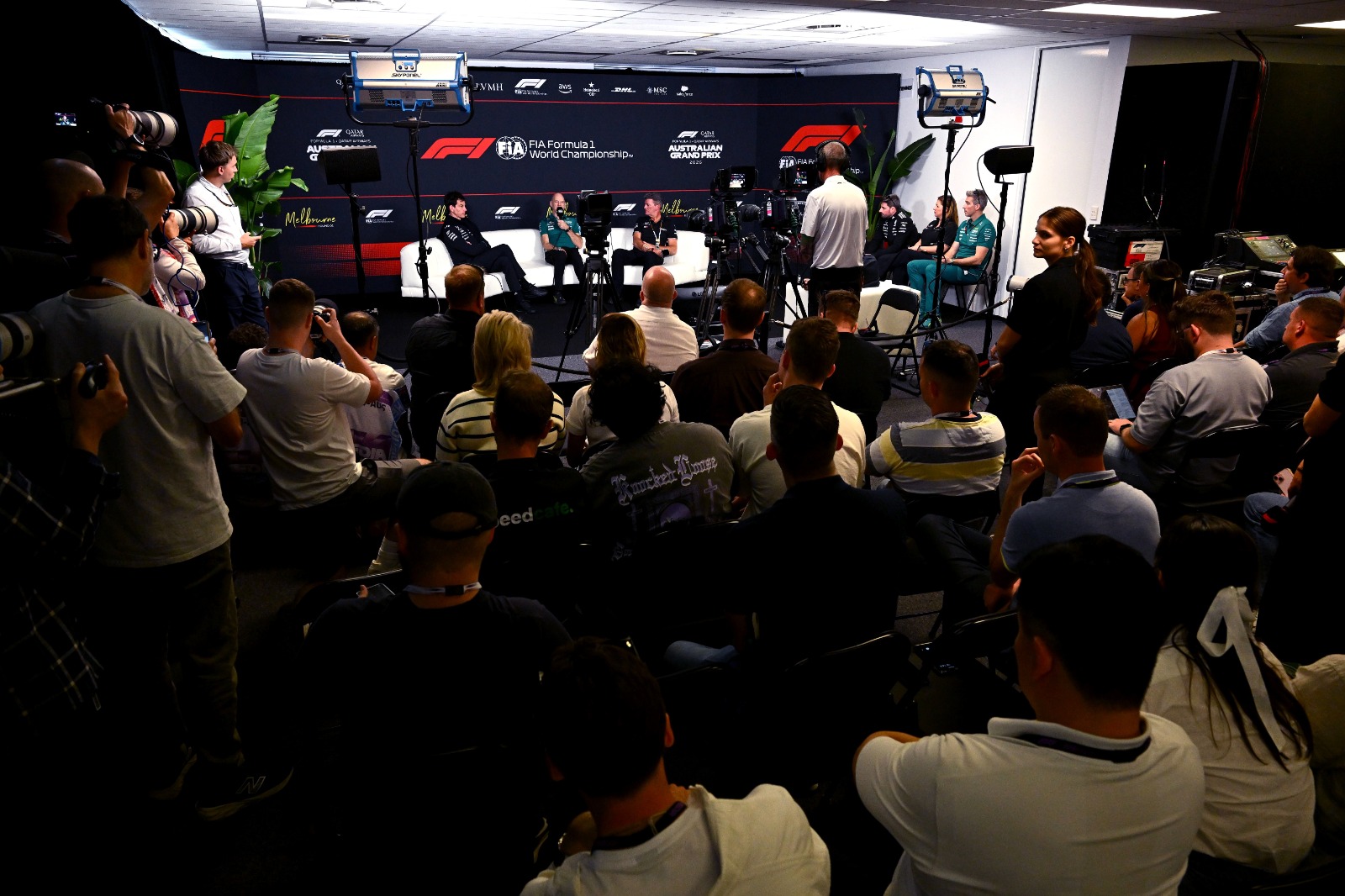
F1 media access is restricted, with drivers’ schedules tightly governed
Photo by: Mark Sutton / Formula 1
Globally, misinformation has become a lucrative trade. The rise of AI has only served to expedite the dissemination of falsehoods into the news cycle. One might have a view of a certain subject and, if the more conventional media companies offer a differing opinion, it’s easy to seek out alternative and fringe outlets who support that viewpoint – even if it is not based in truth.
Let’s take the COVID pandemic, for example, since it remains a visceral experience we all shared through 2020 and beyond. If there were 400 studies supporting the use of vaccines and one against, there were many who gravitated towards the outlier – even if it was utterly bogus.
Long before COVID, the investigative journalist Brian Deer, writing for the Sunday Times, exposed one such paper in 2004. In 1998, a paper was published in The Lancet purporting a causal link between the measles, mumps, and rubella vaccine (MMR) and autism, authored primarily by physician Andrew Wakefield. Wakefield’s study tested 11 children who had been given MMR, fraudulently linked them together with a “non-specific colitis” that was allegedly produced by the vaccine, which he postulated was the gateway to the children’s apparent symptoms of early onset autism.
This produced a colossal media frenzy as Wakefield did the rounds on national news, his conclusions that separate vaccines for each had demonstrated a much lower risk of developing autism for any inoculated children. It was a national scare, certainly in the UK, and set back public trust in vaccines considerably.
Deer’s reporting uncovered that Wakefield had a considerable conflict of interest, in that a) he’d been paid by a trial lawyer handsomely to gather potential candidates for a study ahead of a potential class-action lawsuit against vaccine damage, and b) he was the patent holder of a separate measles vaccine. Without Deer, a renowned journalist, public faith in vaccines may never have been restored had Wakefield been allowed sole control of the news cycle thanks to his PR offensive. But in failing in its obligation to question Wakefield, the wide-ranging media outlets of the time have allowed him to cultivate an anti-vaxxer following in the US, putting children at risk.
Again, F1 journalists scarcely deal with such high-stakes scenarios. But when you have a championship that is incredibly well-marketed and generally holds the cards with regards to the public perception, there needs to be a force that holds it, its stakeholders, and the people within to some degree of account.
Photo by: Mark Thompson / Getty Images
Let’s take the 2026 regulations, for example. F1 and its associated media outlets have to offer the hard sell to what is ostensibly a flawed regulatory set, because they want bums on seats and eyeballs on screens. That’s not a criticism; that’s their job. But are they going to be explaining unwanted phenomena like super clipping, or why the power units have necessitated active aero, or pitching tougher questions to drivers? No; again, that’s not their job.
But it’s our job to tell the warts-and-all stories, not just the neatly manicured version. PR and advertising brands sell the sausage to you – we show you how it’s made, and determine whether it can legally be declared a ‘sausage’.
Besides, F1 drivers, team members, and leaders are thrown plenty of softball questions over a weekend to fill a content schedule, but one might argue that they earn enough money that they cannot expect to be solely asked questions that they like. There’s got to be some degree of compromise.
For example, the current US president banned several media outlets from their White House press credentials because he didn’t like the often-legitimate criticism. This is dangerous, particularly as outlets more inclined to agree with the president’s views were given the briefings and less likely to provide any kind of resistance. And when power is unchecked and unchallenged, it is unbridled. It’s the people who suffer, and the people who already have power can accumulate more. Media literacy is important.
The awkward question of partisan behaviour
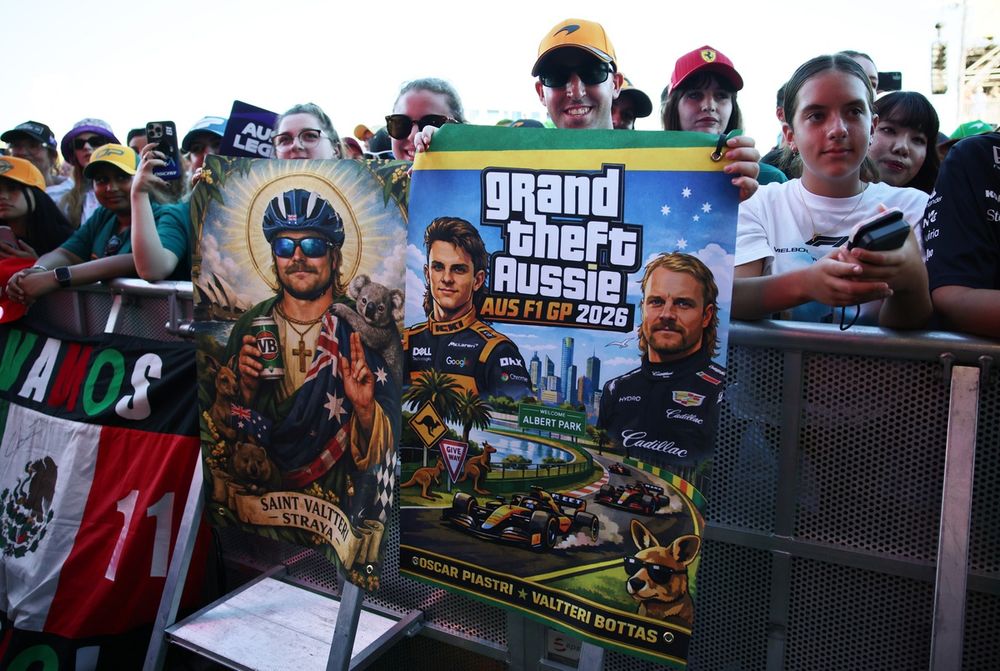
The Australian drivers got a warm reception in the ’26 opener down under
Photo by: Anni Graf – Formula 1 via Getty Images
As mentioned above, journalism and truth are sometimes inconvenient. One inconvenient truth is that every journalist in the world has an agenda, but this is not necessarily a bad thing. Most want to inform, educate, and entertain. Others want to follow the rabbit hole and see what well-hidden secrets are at the end. There is admittedly a select few who will use their platform to canonise one thing and abhor another. But this is, thankfully, a rarity.
With a fanbase as diverse as Formula 1’s, every driver receives some degree of support. This is support that can vary wildly, from mild appreciation to fervent deification of an athlete. In the latter case, any criticism – justified or not – can be viewed as unprofessional and unbecoming. In our recent example, opinions have been divided; as mentioned, Richards received both support and hatred for essentially doing his job. Comments from people who have read full articles about the scenario, and the varying points of view might be more inclined to condemn the ejection of any journalist from a press session. Those who purely read the situation from the driver’s side might be a fan and thus will be more likely to take their side.
And that’s fine, if it doesn’t descend into ad hominem arguments. But, too often, it does.
One of the fall-back arguments is that it was an example of ‘British bias’, the all-too-easy suggestion that UK-based outlets will favour only home drivers and seek to denigrate those who were born elsewhere. Now, as a UK-based journalist working for a UK-based publication, this is a difficult matter to discuss. Personally, I couldn’t give a rat’s rectum about nationality.
Now, it is undeniable that British publications tend to court the majority of airtime. F1’s biggest broadcaster is probably Sky Sports UK. The larger publications are probably from the UK. The language of the paddock is English, as most of the teams are based in a 30-mile radius around Oxfordshire and Northamptonshire. Almost a third of the grid is British. It’s a very UK-dominated industry.
As an independent outlet, there are two strands here: we want to cover F1 with as much breadth and depth as possible. We also know that British drivers ‘sell’ better in the UK. But, ultimately we’re fans of F1, not necessarily of home drivers. It would be gauche to suggest that anyone in the media begrudged Max Verstappen his wealth of success because he was Dutch.
Fernando Alonso was another who, in his success years, liked to suggest he had the wrong passport – particularly when he battled with Lewis Hamilton for the title. This was certainly true of the ITV coverage that the narrative was partisan in the day; the intro sequence pretty much featured exclusively British drivers, something that was thankfully moved away from when BBC reclaimed the broadcasting rights and opted for a neutral CGI sequence at the start. Are there still remnants of this approach? Potentially, yes, but I don’t think it’s anything close to being so overt.
Now, this does take a small turn into whataboutery: broadcasters and journalists from other nations are just as likely to focus home-nation teams/drivers as British publications. Are Dutch outlets more likely to be pro-Verstappen? Absolutely. Is Italian media likely to focus its coverage on Ferrari and Kimi Antonelli? Again, yes. This isn’t supposed to be a conclusion of “everyone does it so it’s fine”, but the spectre of “British bias” accusations probably lingers over UK-based publications more than any complaints of “Dutch bias” for the Netherlands-based outlets.
When we try to cover the gamut of F1 teams and drivers equally, it’s a reductive fallacy that only serves to dismiss an argument that one might not be comfortable with.
What does this all mean for me?
Photo by: Rudy Carezzevoli / Getty Images
If you’ve managed to get this far, fair play; apologies for all the words. At this point, I won’t be telling you anything you don’t already know.
There were multiple reasons for writing this, many of them admittedly in reaction to the social media outcry over Thursday. Formula 1’s fanbase is very different to what it was maybe 10 to 20 years ago, one that has so much more access to drivers, other fans, and people who work in the championship. It’s also more numerous; while this is generally a positive development when it comes to keeping the spectacle we love sustainable, the consequence is that small pockets of the fandom can tend towards a more parochial point of view.
While some media outlets may aim to accommodate for this, the point is that F1 desperately needs its independents. Too much cognitive dissonance exists in the modern world, and too many self-described media platforms seek to profit from this; the snippets cut out of context on Twitter or TikTok rarely provide the full picture of a story, and only serve to create a divisive atmosphere. The media gets accused of twisting words – one might argue that short-form social media content actually warps the full endeavour.
No journalists bear ill will to Max Verstappen. We like that he’s straightforward, and the answers he gives when he’s in a good mood. What most, this writer included, do not like is how a) he handled the situation on Thursday, and b) that he doubled down without having yet cleared the air with Richards. It is understood that Red Bull isn’t entirely happy with Verstappen’s actions either; one hopes that a resolution can be reached.
What I also dislike that someone can exert their power to deny the existence of free press, and the implication that one should only put nice, easy questions to someone in that position. Credibility as a journalist is often mutually exclusive here – like the example of Deer above, the emergence of vital information could only be brought to light because he was willing to ask difficult questions. Maybe this question to Verstappen wasn’t to the same scale, but it’s the same principle.
You can’t be for a free press on a part-time basis, or with caveats that the difficult (so long as they’re appropriate) questions exclude your favourite athlete or public figure. The world is too partisan today; politics, sports, and every other medium has been subjected to this social media-era brand of tribalism, and an unwillingness to engage with differing opinions.
Let’s all try and be a bit better to each other, and share our love for F1 together.
Photo by: Mark Thompson / Getty Images
We want to hear from you!
Let us know what you would like to see from us in the future.
– The Autosport.com Team