
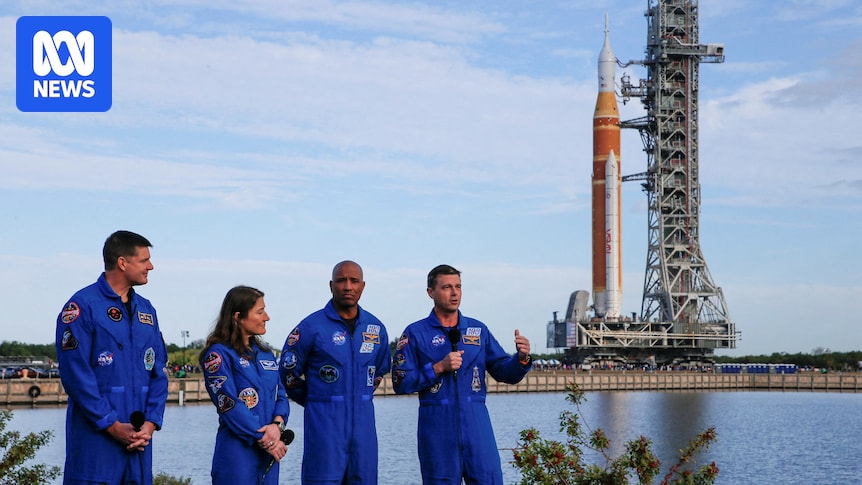
NASA has begun the countdown for humanity’s first launch to the Moon in 53 years.
If Artemis II successfully launches, four astronauts will become the most closely watched crew since Apollo.
That includes three NASA astronauts — Reid Wiseman, Victor Glover and Christina Koch — along with Jeremy Hansen of the Canadian Space Agency.
Here’s what we know about the astronauts whose mission aims to pave the path for future Moon landings.
Reid Wiseman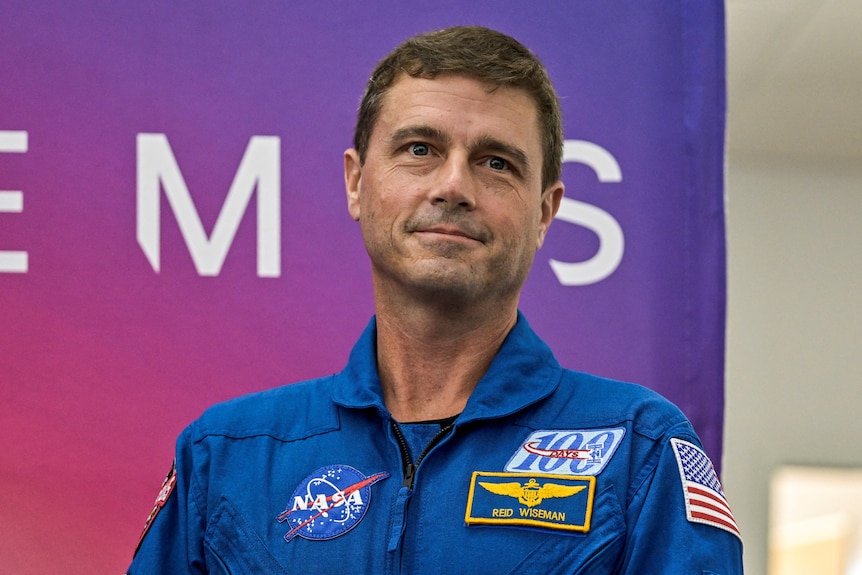 Reid Wiseman is the commander of NASA’s Artemis II mission.(Reuters: Steve Nesius)
Age: 50
Nationality: American
Role: Commander
Background: Navy veteran, pilot and engineer
Astronaut experience: 16 years
Space experience: 6 months
Taking with him: A blank notecard to jot down his thoughts
Leading the nearly 10-day mission is widower Reid Wiseman, who considers solo parenting — not rocketing to the Moon — his biggest and most rewarding challenge.
A retired Navy captain from Baltimore, Wiseman was serving as NASA’s chief astronaut when asked three years ago to lead humanity’s first lunar trip since 1972.
He spent six months at the International Space Station in 2014 as a flight engineer on Expedition 40.
Wiseman says he has a lifelong love of flying, but on the ground he’s afraid of heights.
His two teenage daughters, especially the older one, had “zero interest” in him launching again.
“We talked about it and I said, ‘Look, of all the people on planet Earth right now, there are four people that are in a position to go fly around the Moon,” he said.
“I cannot say no to that opportunity.”
The next day, homemade moon cupcakes awaited him, along with his daughters’ support. The toughest part isn’t leaving them — “it’s the stress that I’m putting on them”, he said.
Open with his daughters about everything, he has not shielded them from the realities of the risk.
While out on a walk with them, he said: “Here’s where the will is, here’s where the trust documents are, and if anything happens to me, here’s what’s going to happen to you … that’s part of this life.”
Victor Glover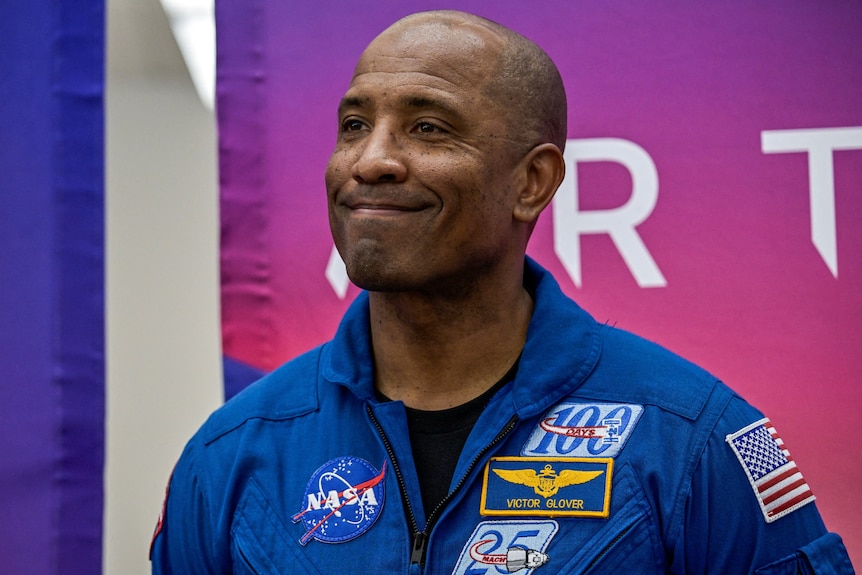 Victor Glover will bring a Bible and an heirloom from his family members on the flight.(Reuters: Steve Nesius)
Age: 49
Nationality: American
Role: Pilot
Background: Former test pilot
Astronaut experience: 12 years
Space experience: 6 months
Taking with him: A Bible and an heirloom from his family members
Victor Glover will become the first Black person to travel to deep space.
He was serving as a legislative fellow in the US Senate when NASA recruited him.
Despite having one spaceflight behind him — an early SpaceX crew run to the International Space Station in 2020 — he finds himself in new personal territory.
His four daughters are in their late teens and early 20s, “and I spend as much time and thought preparing them as NASA does preparing me”.
Glover has described the Artemis II mission as deeply personal.
“This flight represents what’s possible when you build something bigger than yourself,” he has said in the past.
He’s hyper-focused on running “our best race so that we can hand the baton off to the next leg”.
Christina Koch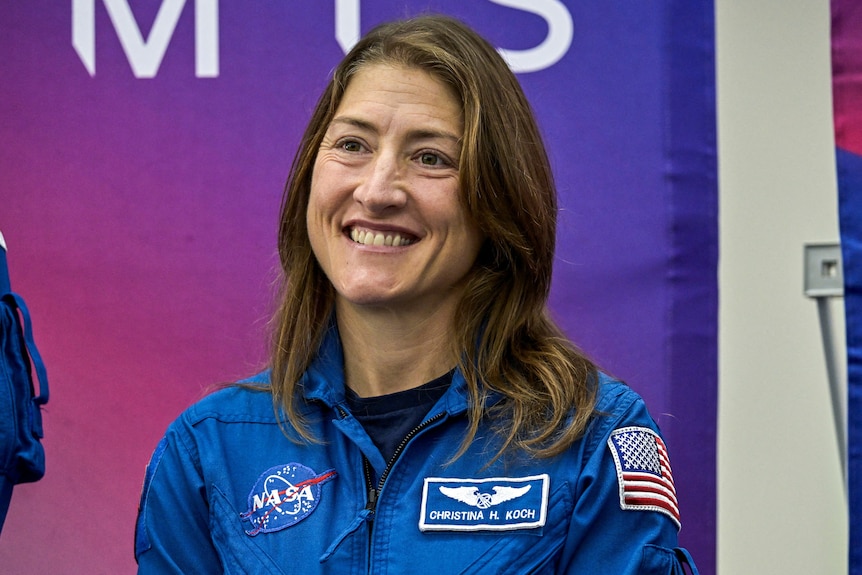 Christina Koch is no stranger to extended stints in space.(Reuters: Steve Nesius)
Age: 47
Nationality: American
Role: Mission specialist
Background: Electrical engineer
Astronaut experience: 12 years
Space experience: 1 year
Taking with her: Handwritten notes from her loved ones
Christina Koch will become the first woman to venture to the Moon.
She is no stranger to extended stints in space, nor to historic firsts. Koch spent almost all of 2019 — 328 days — on the International Space Station, which is the record for the longest single spaceflight by a woman.
Koch, along with fellow astronaut Jessica Meir, also performed NASA’s first all-female spacewalk.
More than any one individual, “it’s about celebrating the fact that we’ve arrived to this place in history” where women can fly to the Moon, she said.
Before she got called up by NASA, Koch spent a year at a south pole research station.
Between that and her space stint, she feels she’s “inoculated” most of her family and friends. However, she has had to remind her husband that Artemis is not like her ISS mission — there will be no casual calls from orbit.
“He’s not going to be able to ring me and ask where something is in the house,” she said.
“He’s going to have to find it.”
Jeremy Hansen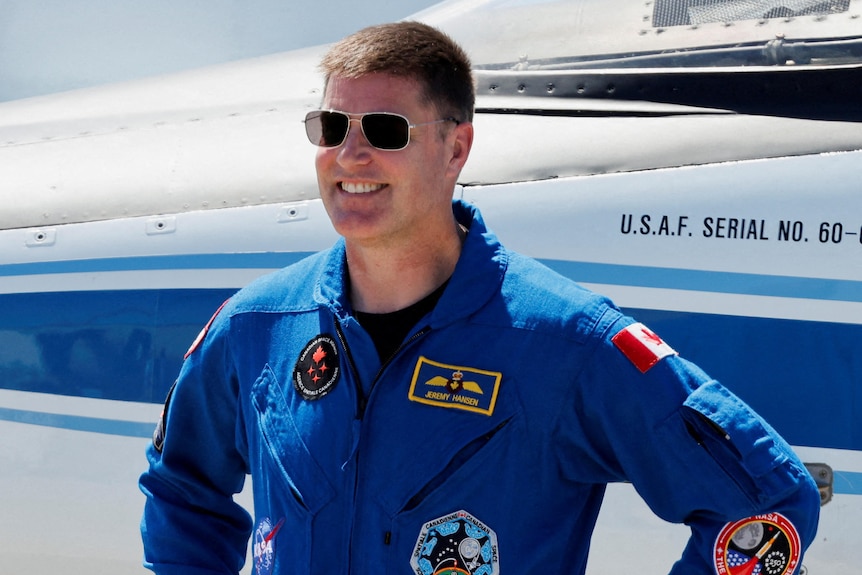 This will be Jeremy Hansen’s first trip to space.(Reuters: Joe Skipper)
Age: 50
Nationality: Canadian
Role: Mission specialist
Background: Fighter pilot
Astronaut experience: 16 years
Space experience: None
Taking with him: Four moon pendants he gave as gifts to his wife and children
Canadian Jeremy Hansen is the first non-NASA astronaut to join a lunar mission and is the only member making his spaceflight debut.
“Maybe I’m naive, but I don’t feel a lot of personal pressure,” he said in the past.
The Canadian Space Agency selected him as an astronaut in 2009, and he was named to the Artemis crew in 2023.
He realises only now how much effort it took to send men to the moon during Apollo.
“When I walk out and I look at the moon now, it looks and feels a little bit farther than it used to be,” he said.
“I just understand in the details how much harder it is than I thought it was watching videos of it.”
But dangers still loom — something he’s shared with his college-aged son and twin daughters.
“The most likely outcome is that we will come back safe. There’s a chance we won’t, and you will be able to move through life even if that happens,” he assured them.
Along with four moon-shaped pendants, Hansen will also be taking maple syrup and maple cookies on his lunar voyage.
The 32-storey Space Launch System rocket is set to blast off early Thursday morning.
NASA’s Artemis II mission should have soared in February, but was grounded by hydrogen fuel leaks.
Here’s an idea on how far the crew are travelling from Earth. The Apollo 13 crew reached 248,655 miles (400,171 kilometres) from Earth in 1970, but Artemis II could break that record, expecting to travel more than 250,000 miles (about 402,000 kilometres).
The ABC will be live blogging the launch from 8am AEDT. The launch window is from 9:30am AEDT.
No.
Artemis II is a test flight that will venture around the Moon and will return at 30 times the speed of sound.
The mission’s purpose is to serve as a pathfinder for Artemis IV, which is expected to touch down near the Moon’s largely unexplored south pole in 2028.
The Artemis program’s main goal is to figure out how humans can permanently live and work on the lunar surface and subsequently how people can survive months-long trips to Mars.
Officially called the Orion Crew Survival System suits, NASA says the spacesuits can help keep astronauts alive if they lose cabin pressure.
“Astronauts could survive inside the suit for up to six days as they make their way back to Earth,” the space agency explains on its website.
The suits are also equipped with survival gear should they have to exit the spacecraft after splashdown.
This includes a personal locator, a rescue knife, a signalling kit with a mirror, strobe light, flashlight, whistle and light sticks.
“To make crew members easily visible in the ocean,” NASA says.