
Welcome to Scott Wheeler’s 2026 rankings of every NHL organization’s prospects. You can find the complete ranking and more information on the project and its criteria here, as we count down daily from No. 32 to No. 1. The series, which includes evaluations on nearly 500 prospects, runs from March 9 to April 8.
The Canadiens’ pool has an A-minus prospect at every position and good overall depth. Graduating Ivan Demidov and not picking in the first round in 2025 did combine to drop their standing a little, but potential home runs in rounds 2 and 3 help soften the fall.
2025 prospect pool rank: No. 3 (change: -6)
Tier 1 1. Jacob Fowler, G, 21, Laval/Montreal (No. 69, 2023)
Fowler has established himself as one of the top goalie prospects in the sport with his play over the last five seasons. That started when he was named to the USHL’s All-Rookie second team five seasons ago and its first All-Star team four seasons ago after leading the league in both save percentage and goals-against average. It was stamped with a stellar freshman year at BC that saw him play virtually every minute behind the top-ranked team in the country; while the team in front of him helped, their strength was most pronounced at forward, and he stole some games and was deservedly named Hockey East Goaltender of the Year. And it was cemented last year with a repeat performance as the MVP (for me) of another top-ranked Boston College team, his save percentage rising from .926 to .940. He also had some strong performances in the AHL in the spring, even if he wasn’t able to hold the Laval net in the playoffs as a rookie.
This season, in his first full year of pro hockey, he has been Laval’s best goalie, outplaying veteran Kaapo Kähkönen when he has been there. And while his early NHL numbers have hovered right around .900, the Habs still have work to do to cut down on how much they give up, despite their growth as a team.
I should note that I’ve seen him look just OK with Team USA both in Gothenburg at the World Juniors and Plymouth at the World Junior Summer Showcase, but he was also excellent at the World Jr. A Challenge, and the body of work is pretty unimpeachable. He had some work to do on some other things (conditioning/fitness, less business on scrambles, losing his posts at times) pre-draft, but he has worked hard at it. He’s now listed at 223 pounds, which is still heavy for his size but is by all accounts in a better place.
He’s the kind of goalie who, if he can see a shot and move to it, is going to stop it. Fowler has so many clear tools: great hands, an ability to take space away through square angles and sound positioning, high-end tracking/reads, excellent rebound control, legitimate power/movement and a knack for making huge pad saves and stopping high-danger chances. He rarely gets beaten through the body or frozen. He doesn’t show holes in the net and has the reflexes to get a piece of (if not outright save) pucks when he does. He has a legitimate shot not just to be an NHL goaltender but to be a top one, and there aren’t many goalies his age (or even a little older) I’m comfortable saying that about. He seems to pitch a shutout once or twice a month these days. I thought he had a compelling case for the Hobey Baker last year and was hurt by some of the conference allotments in the nomination process, evident when he wasn’t a top-10 finalist and still won the Mike Richter Award as college hockey’s top goalie.
I think he’s the Habs’ starter of the future, and that gives him a value edge as the No. 1 prospect in their pool for me.
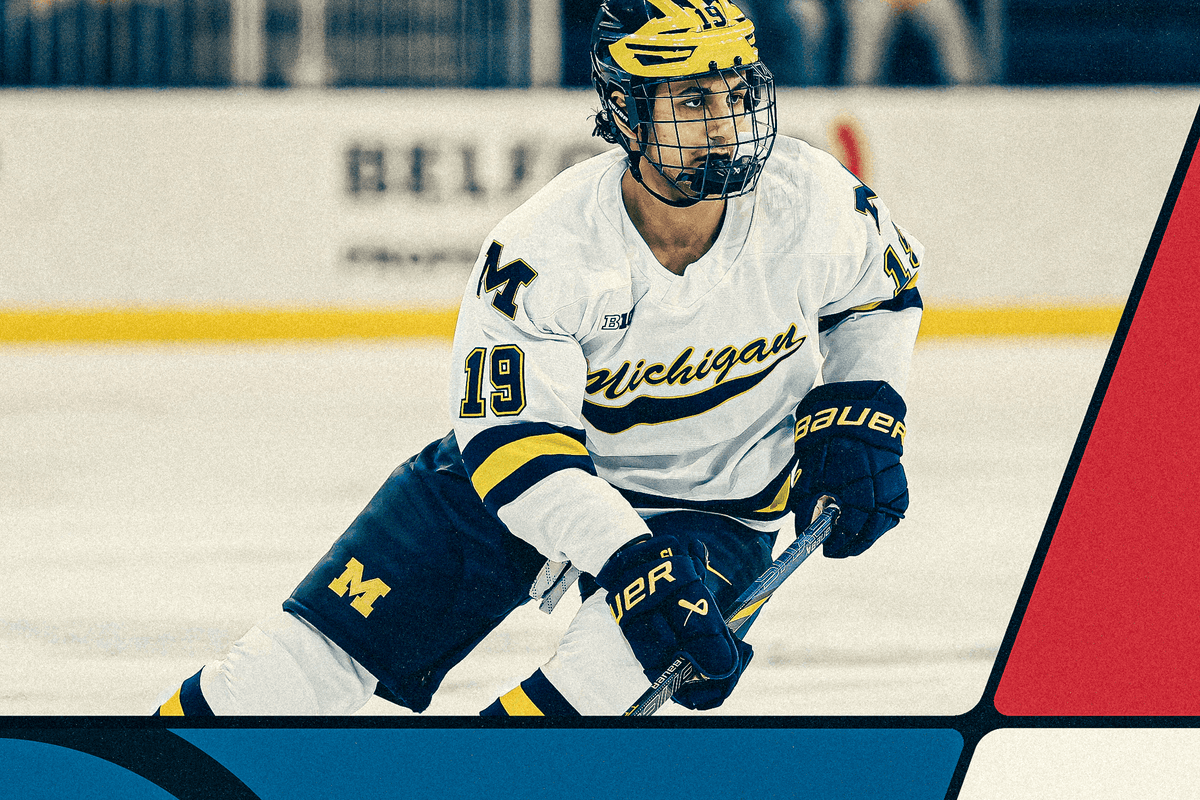
2. Michael Hage, C, 19, Michigan (No. 21, 2024)
Hage has re-emerged as one of the top forward prospects in the sport this year, finishing tied for fourth in NCAA scoring before the national tournament with 51 points in 38 games. He proved he could drive play both on the No. 1 team in the country and for Canada at the World Juniors, where he led the tournament in scoring, even with a couple of posts and a missed penalty shot.
Last year, on a Michigan team that didn’t have the high-end skill of recent years, Hage also played to above a point per game as an 18-year-old freshman and made a lot of plays offensively for himself. Coming up, he was a star minor hockey prospect who would have gone at the very top of the OHL draft had he not chosen to go to the Chicago Steel and commit to the Wolverines. He was then limited to 13 games (in which he had 10 points) in his 16-year-old season in the USHL after undergoing shoulder surgery from an injury suffered in an early practice. Some in USHL and NCAA circles believe that had he not lost that time, he might have been in the top-10 conversation for the 2024 draft. Though he didn’t play back into that mix in his draft year, he came close, taking off in the second half of his draft year and looking, for a multi-month stretch, like debatably the USHL’s best forward before finishing with 35 goals and 79 points in 56 combined regular-season and playoff games. He should have been on Team Canada at U18 worlds two springs ago, too.
I’ve long been high on him and believe he has top-six potential. The big question over the years was whether he could do it as a second-line center or if he would be better served moving to the wing (think Jordan Kyrou). Over time, the consensus has shifted from viewing him as a winger to wondering if he might just stick as a center.
Hage is a natural center with plenty of offensive dimension, though. He has pro size (6-foot-1 and now 199 pounds, with more room to add muscle to his once-lean but always-athletic build) and excellent skating. He has dual-threat skill as a shooter and passer, and he can do both in flight and at pace. He’s talented as a handler and can create for himself or make plays for his linemates. He plays harder than he used to get credit for, stays on pucks and he’s competitive enough. He reads the game well with an intelligent approach to the way he maneuvers around the ice, but also good instincts that he can fall back on and a willingness to try things (and sometimes turn pucks over). I like him in puck control/protection, including in full flight. His detail and work rate are both developing, even if they’re not going to be his calling card. He’ll finish his checks.
His blend of skating, skill, scoring, playmaking and sense is hard to come by and noticeable in every game he has played this year. I’m a big fan.
3. Alexander Zharovsky, RW/LW, 19, Ufa (No. 34, 2025)
Zharovsky is a highly talented winger who scored some beautiful individual goals in the MHL last season and made skill plays in bunches, lighting it up in the second half after starting the year in a more limited role and playing his way to the second pick of the second round. He was streaky early on in those minutes but really began to make a ton of plays both at five-on-five and on the power play once he was elevated and started getting more touches. This season, he showed that his hot streak last year wasn’t a fluke, continuing to flash his individual skill at the KHL level. At season’s end, his 42 points in 59 games were third-best on Ufa and set the league’s all-time U19 scoring record, surpassing names like Evgeny Kuznetsov, Vladimir Tarasenko and Kirill Kaprizov. He was also the only full-time U19 skater in the league this year — no other U19 player scored more than two goals or four points, let alone 16 and 42 — and even its most productive U20 skater, beating Nashville Predators first-rounder Yegor Surin by five points.
He’s lean and needs to add some weight, and has started to do that; he’s now listed at 6-foot-2 and 176 pounds. Even so, he’s a slick puck carrier with a knack for taking pucks to dangerous areas and beating his man one-on-one. He has great hands and poise on the puck. Despite lacking strength, he’s a decent skater and will play through bumps to get to his spots. He can drift in games and can lack focus at times, but when he gets the puck, his eyes light up, and he has the skill to execute and make things happen at any moment. He has top-six gifts, and it’s rare to find a player with his talents outside of the first round.
Of note: He’s signed through the end of the 2026-27 KHL season at the moment.
4. David Reinbacher, RHD, 21, Laval (No. 5, 2023)
Reinbacher is a likable player who can do it all at a decent level. We sometimes see draft-eligible D play their full draft year in a professional league. We seldom see them play big minutes in a good league, though, even when they’re on the older side, as Reinbacher was with his October birthday. But that’s what the Austrian did in Switzerland’s top flight four seasons ago, where he played over 20 minutes more often than he played under it. He drove results at both ends in those minutes, too, with a positive goal differential on an under-.500 team that was outscored pretty significantly.
His post-draft season was a lot tougher on a Kloten team that was difficult to watch and, frankly, a mess, but he was impressive in the AHL right away and showed his very tangible two-way elements with Laval. Last year, he got injured in a hit along the boards early in his first NHL preseason game, requiring knee surgery, sidelining him until late February and limiting him to 23 combined regular-season and playoff games. This year is, in essence, his first full season in North America as a result, and while his numbers don’t — and won’t — pop, he has played to strong two-way results in 21 and a half all-situation minutes per game.
Reinbacher has pro size, desired handedness and a really strong foundation of tools that all guarantee he’ll become a good NHLer. He’s a solid forward and backward skater (though he can look a little stilted at times) who gaps well and defends the rush effectively with a noticeably long stick. He looks to take instead of give in the neutral zone, regularly stepping up to try to bump puck carriers off possession and force dumps, though there are times that style can leave him chasing if his timing is off or he’s flat-footed. He’s strong and plays hard in his own zone and in battles. His head is always up and on a swivel, and he does a good job pre-surveying the ice when he’s going back to get pucks through frequent shoulder checks. He has some poise and processing under pressure, even if his play with the puck on his stick isn’t dynamic per se. He has shown a willingness to attack offensively in the AHL, but also picks his spots and doesn’t search it out. I think his game works better on the smaller ice generally.
I have reservations about whether his game has what it takes to live up to his draft slot — it just lacks a little juice for me — but he should become a really solid second-pairing D. He’s a projectable two-way defenseman who looks like how teams want their D to look these days, and he’s going to have a long career.
Tier 25. Bryce Pickford, RHD, 19, Medicine Hat (No. 81, 2025)
Pickford, drafted as an overager in the third round of last year’s draft, is one of the most prolific goal-scoring D in WHL history and a two-time league champion. He was a depth D on the 2023 title-winning Seattle Thunderbirds and then had a breakout season last year with the 2025 title-winning Medicine Hat Tigers, playing to above a point per game and breaking the 30-goal mark as a defenseman between the regular season, playoffs and Memorial Cup — which included an eight-game goal streak to close out the playoffs. NHL Central Scouting ranked him 100th among North American skaters on their final list, but he continued to play really good hockey after that, not only scoring but playing a hard, competitive, lead-by-example brand on the ice that earned him the ‘C’ with this year’s team. And he made history this year, registering 83 points and finishing tied for second in the league in goals with 45 despite missing 13 games to injury to lead the Tigers back to the top of the standings after they lost last year’s top four scorers and top defenseman Tanner Molendyk.
Pickford is a jacked 6-foot-1, 190-pound right-shot defenseman with a huge shot, an aggressive playstyle on both sides of the puck and a brash personality on and off the ice. He plays with an eagerness to attack and jump offensively, but also closes gaps and is physical defensively. He closes plays early, defends hard and has been a go-to guy on both special teams over the last two years for the Tigers, even after they acquired arguably the best defenseman in junior hockey in Molendyk at last year’s deadline. Pickford is known as a worker on and off the ice who is hockey-obsessed and really made a difference in Medicine Hat’s room with his attitude and boldness. He’s not the most cerebral or high-IQ player, but he plays tough minutes, takes charge of his shifts and has great instincts and skill offensively and defensively.
His production is impossible to ignore, and I’ll be fascinated to see whether his style of play will continue to work in the AHL next season.
6. Adam Engström, LHD, 22, Laval/Montreal (No. 92, 2022)
Engström has become a nice story for the Canadiens over the last few years. He emerged as one of the top ’03 defensemen in Sweden with his play in the SHL, where he went from averaging 14 minutes per game as a regular three years ago to closer to 19 minutes per game two years ago, before making what I would qualify as a very successful jump to the AHL last year in Laval, playing 20 minutes per game in a top-four role as a rookie and contributing on both special teams. His 22 and a half minutes per game in the AHL as a second-year player this year have led a North Division-leading Laval team when he has been there too, and I’ve thought he held his own in depth usage when I’ve watched him play with the Habs.
He’s an athletic 6-foot-2, 193-pound defenseman with soft skill, the ability to shake across the point or side-step pressure, an eagerness to involve himself in transition and a two-way game that has gone from needing work to a borderline strength as he has become reliable at both ends. He’s an impressive forward skater (with some work to do skating backward) with a pro build who shields pucks really well to weave through or around coverage. He plays with confidence, and he’ll usually correct for a mistake with an effort play. With continued development, he could become a No. 5-6 with some modern elements, and he’s already at the very least a top-end AHLer and No. 7-8 who gives you something different from the guys like Arber Xhekaj at that point on the depth chart.
7. Owen Beck, C, 22, Laval/Montreal (No. 33, 2022)
Beck is a strong, athletic player who has endeared himself to scouts and coaches alike over the years for his driven, pro-style game and good skating/pace. He’s a noticeable shift-to-shift player who excels at getting to the inside, pushing tempo and winning battles. There’s some secondary or tertiary skill to his game — he has good hands and enough talent to make things happen when he’s around the puck all the time — even if it fits within more of a hurry-up style than a slow-the-game-down, problem-solving style. He keeps his feet moving, he works north-south to apply pressure and get back and he’s a good transition player on entries and give-and-gos. He sets the tone physically and in work ethic, and supports play really well; he can drive downhill and play to the interior when it’s available.
There are times when his execution concerns me in terms of his ability to make more than simple plays at the NHL level, but the rest helps to compensate. He can be relied upon in defensive situations, can drive and play hard at five-on-five and fits with a variety of linemate types. He’s also strong in the faceoff circle, winning over 50 percent of his draws in the AHL over the last two years, which is promising. His statistical profile has always been a little ordinary, but he took a step with the Saginaw Spirit following a trade two years ago, was really good in his second Memorial Cup for them on junior hockey’s biggest stage and has been decently productive (71 points in 113 games) while playing to strong two-way results for the Rocket.
He hasn’t yet broken through to fully establish himself as a top-12 NHL forward for the Habs, but he’s going to be a solid fourth-liner in the league who can play on the third line in a pinch.
8. L.J. Mooney, C/RW, 19, Minnesota (No. 113, 2025)
Mooney is — and will be — a fascinating case study. He’s one of the most talented and complete players in the ’07 U.S. age group, the cousin of Utah’s Logan Cooley, and has been talked about for years for his skill, skating, minor hockey performance and as the player who played really well as an underager with the 2006s as a tiny 16-year-old because he was also extremely competitive.
The size makes him a real test to project, though. At the start of last season, NHL Central Scouting gave him a “B Rating” which “indicates a 2nd/3rd round candidate,” on the back of his excellent second half and strong showing at his first of two U18 worlds, where he stuck at center despite his size and more than held his own as an underager. Last year, though, his draft year was affected by injury and he struggled at times after returning to have the same impact and score, though he also moved between center and the wing. He came on late in the year, though, and really sold me again with an outstanding showing at his second U18 worlds, where he dominated games with his skating and maneuverability but also played physical, had the puck all the time and once again showed himself to be a true competitor. NHL Central Scouting slotted him 208th on their midterm list and 206th on the final list, but that came out pre-U18 worlds, and his mid-round selection was as earned as anyone’s.
This year, he finished second on a weak Minnesota team in scoring as a freshman, registering 30 points in 34 games after impressing at Canadiens development camp. And though he struggled to break through at his first World Juniors, his skating and creativity flashed at times there as well, though there were also signals of some of the challenges he may face driving play up levels. He has always been a top player in his age group; if you put him in an All-Star game of this draft class right now, he might stand out and make his linemates better. But can he be what he is against pros someday, especially if he doesn’t get an inch or two and struggles to add weight to a skinny frame?
I love the player. He has lightning-quick hands in traffic/one-on-one, quick feet, a quick release, a quick processing of the game and an ability to make plays. That combination of skating ability — he has natural acceleration and tremendous edges, and can put defenders on their heels from a standstill and spin off them with ease — and skill is complemented by a willing work ethic and attention to detail defensively. He supports play well, positions himself well off the puck and doesn’t cheat for offense. He plays with determination and takes a ton of pucks to the guts of the offensive zone and even the front of the net, with a desire to get to the middle consistently. He’s crafty and knows how to play to his strengths and put pucks into space for others. He’ll flash skill off the rush and inside the offensive zone with his maneuverability. There are times when he’s deferential (in part because of his size), but his quickness helps him manage his deficiencies to be a very well-rounded player. He can also flat-out make guys miss and can put them in the spin cycle, he wins his fair share of battles and I’ve seen him bowl over bigger players.
A lot would have to go right for him to play in the NHL someday, but he reminds me a little of the Carolina Hurricanes’ Justin Robidas, a small center with speed and two-way know-how drafted in the fifth round in 2021 who has become a top-end AHLer and started to get NHL games. I wouldn’t bet against him, at least.
9. Joshua Roy, RW/LW, 22, Laval/Montreal (No. 150, 2021)
Loyal readers will know Roy, a No. 1 pick in the Q, is a player I was higher on than most pre-draft; he ranked 34th on my board. He has always been a mercurial player, though. And while he progressed nicely post-draft (and certainly relative to where he was picked), some of the things that made him mercurial have cropped back up as he tries to make the full-time jump from the AHL to the NHL. The multiple 100-point QMJHL seasons were positive. The 19 points in 14 games across two World Juniors were positive. His two strong pro seasons as a top player in Laval and half a dozen NHL goals scored at 20 and 21, all positive. But he hasn’t taken that next step, and some of the flaws in his makeup have been noticeable in his NHL action. And now his entry-level deal is set to expire, and the clock is ticking on him becoming waiver fodder.
Post-draft, he did develop more substance to his game. He has good puck-protection skill. He does a good job leaning on defenders and controlling the puck in the middle of the ice to get to his spots and create chances. When he doesn’t have it, his timing and routes help him get open or pounce on rebounds to remain opportunistic. He can be hard on pucks (though that needs to be more consistent), he has hands and real one-on-one skill in tight and around the net, and he can score weak-side goals. But there have been times where he has elevated his linemates over the course of his career and others where he has looked like a square peg in a round hole.
After working on his fitness, he has taken some steps as a skater and competitor who appears more committed to playing a complete game, even showing some penalty killing proficiency at lower levels, but that hasn’t quite risen to the level it needs to either. I like him with the puck, where he can hold onto it and make plays. His shot is accurate and has some heaviness. He can read and anticipate. He has at times been a big-game player and has worked to become a more defensively responsible, guts-of-the-ice player who will track back.
The little things — things that were once criticisms of his game for some — have come. The reads and positioning on and off the puck. The engagement level. The smarter choices he now makes with the puck. But they haven’t appeared to come far enough for the Habs, who seem like they’ve made up their mind on him a little.
Tier 310. Florian Xhekaj, LW, 21, Laval/Montreal (No. 101, 2023)
Xhekaj is a wiry but strong winger who, like his brother, plays on instinct and aggression. He doesn’t have great hockey sense or playmaking feel, but he plays in straight lines, hunts and wins pucks, finishes checks, plays in the dirty areas, fights and has some finishing around the home plate area. I don’t think there’s much offense, smarts or soft skill to his game, but they’ve all come along enough. He plays the same way shift to shift and game to game, he has some quick-twitch skill, can play both center and wing and his linemates know how to play with him because of how predictable he is. He’s going to be a high-motor, pain-in-the-ass fourth-liner.
11. Yevgeni Volokhin, G, 20, Voskresensk (No. 144, 2023)
Volokhin is a skinny but athletic goalie who was drafted at 6-foot, is now 6-foot-3, and has played in a pretty odd situation over the last couple of years. Two of the best young goalies in Russia, Volokhin and Flyers prospect Yegor Zavragin, both played for the same MHL team in Khanty-Mansiysk in Western Siberia. Zavragin is the better prospect of the two and has been one step ahead of Volokhin (Zavragin got more second-tier VHL play early and then was the first to get a look in the KHL), but Volokhin has played well in good samples in the MHL and second-tier pro VHL, and has earned a few dozen games in the KHL, where his numbers have been a mixed bag so far.
Volokhin plays with the hunch many Russian goalies do (see: Sergei Bobrovsky, Yaroslav Askarov, etc.), getting way out over his toes and relying on his active feet and a wide stance to really push and shuffle off his outside edges to stick with shooters one-on-one. He’s quick laterally and comfortable playing the puck. He gets in and out of his butterfly quickly and can get to second and third chances. He moves really well post-to-post and low-to-high. He’ll occasionally get pulled off his line being too busy in the net, and he can let pucks squeak through his body, but he’s talented and athletic and absolutely worth following.
Tier 412. Owen Protz, RHD, 20, Brantford (No. 102, 2024)
Protz developed into one of the OHL’s top hard-to-play-against D in his two seasons post-draft, impressed at Habs development camp and main camp, and surprised some people when he played his way into the mix for Team Canada’s World Junior team, though he struggled a little at the World Junior Summer Showcase and ultimately didn’t make the team. His offense and statistical profile are atypical of an NHL prospect, but he’s a jacked 6-2, 207-pound left-shot D who is a beast in the weight room, wins battles on the ice and plays a lunch-pail style that fewer and fewer in today’s game do.
He has played 20-plus minutes per game to excellent defensive results on the top team in the OHL this season. Over time, he’s learned to simplify his game and has a clear identity. He’ll occasionally get a little too antsy and make a mistake on and off the puck, but some believe he has the makings of a prototypical No. 7-8 depth D for an NHL coach.
13. Alexis Cournoyer, G, 20, Cornell (No. 145, 2025)
Cournoyer has taken a rare path, playing his way through the MJAHL after he made Shawinigan out of camp but was traded to Baie-Comeau and emerging in the QMJHL in the second half of his 19-year-old season following a second trade to Cape Breton. The Habs and others made the trip to Cape Breton last year to see him put up a .942 save percentage in a sample of 21 games in the Q, and they decided to draft him as an overager on the back of that play.
This season, now as a 20-year-old freshman at Cornell, he has posted a .915 save percentage across 28 games for the Big Red, helping them to the national tournament and a first-round matchup with fellow Habs prospect Quentin Miller’s Denver Pioneers in the Loveland Regional. He’s a 6-4, 202-pound goalie who prides himself on being a gamer who competes, stays calm in big moments and uses his size to fill the net. He has good hands, too. He’s not the quickest goalie, but the foundation of tools and size play to his advantage.
14. Quentin Miller, G, 21, Denver (No. 128, 2023)
Miller is a 6-3, 190-pound who won a QMJHL title and a Memorial Cup as a backup with the Quebec Remparts in his draft year, became a starter in his post-draft season, and then spent last year in the BCHL before landing at Denver this season. He has never been viewed as a top prospect but he quietly and slowly put together a track record that at least earns him a watchful eye: a career .908 in two seasons in the Q, .924 in one season in the BCHL and now a decent freshman year at Denver where, despite again not being the clear-cut starter, he has posted a .916 save percentage.
He’s a good athlete and student of the game who does the little things well: seals posts, controls rebounds, tracks, etc. The Habs will likely want to see him be the guy somewhere before they commit to signing him, I’d think. It’s noteworthy that the diminutive Johnny Hicks has basically been unbeatable for Denver behind the same team, for example.
15. Sam Harris, LW, 22, Denver (No. 133, 2023)
Harris is a net-focused 5-11 winger who scored 30 goals in the USHL to get drafted as an overager, won a national title and hit double-digit goals as a freshman at Denver, and scored 23 goals as a trigger man for Jack Devine as a sophomore last year. This year, he is second among Pioneers forwards in goals and points this year and first in shots; he had 120 in 37 games heading into the national tournament. He can play in hard lines to the net or slow things down. He plays bigger than his size, delivering hard hits, scrapping for his space on the ice and going to the dirty areas. He has some skill, instincts and a natural release. But he has never been a penalty killer for Denver (which limits his potential jobs up levels) and his numbers are more good than great for his size, pace and age. I’ve never been quite sure what his projection looks like up levels, but he should get a pro deal, and you take it from there.
The opportunism in this clip is what his game’s all about:
Honorable mentionsHayden Paupanekis, C, 19, Kelowna (No. 69, 2025)
Paupanekis started his draft year in Spokane and was the central piece in the Andrew Cristall trade going back to Kelowna. He finished last year with 43 points in 71 games split between the Chiefs and the Rockets. With the Rockets, he featured prominently on both the power play and the penalty kill, excelling on the PK with his length and instincts. That play, combined with his athletic traits, made him an early-third-round pick; I viewed him as more of a late-third/fourth, but it didn’t feel like a reach there either. This year, his production hasn’t taken a step with the Memorial Cup hosts post-draft, and he has featured less on the PK on a deeper team.
He’s a big center with legit pro qualities and athletic traits, which makes him relevant. He skates well and can get down the ice in transition. He’s also quite coordinated for his size and is comfortable opening up his hips and going heel-to-heel. He handles the puck well and has beaten some goalies in all alone over the last two seasons. He’s strong. He supports the play well defensively but will also get after guys, track and finish checks and battles on the forecheck. He has a good stick on lifts and wins back a lot of pucks. He’ll work.
I think he has a chance to be an effective fourth-line C in the NHL, but I also thought he was going to take more of a step this year than he has, and that kept him off the list.
Filip Mešár, LW/RW, 22, Laval (No. 26, 2022)
It has been a mixed bag since Mešár’s selection at No. 26 in the 2022 draft. He skipped the summer World Juniors, had a good rookie tournament and camp with the Canadiens, got off to a hot start in Kitchener and impressed at the 2023 World Juniors in Halifax to help Slovakia to a near quarterfinal upset over Canada. (I actually thought he was owed more than his six points in five games and he still led the Slovaks in scoring.) But that feels like forever ago now. He hit a wall in the second half of that year and then kind of repeated that cycle again the following year: hot start in Kitchener, standout performance in some big moments for Slovakia at the World Juniors in Gothenburg and then a bit of a wall production-wise where his numbers didn’t take off like you’d hope. After registering five points in his first four games in his first full season in the AHL to start last year, he missed eight weeks with a lower-body injury and has been fine but unremarkable in 13-14 minutes per game in the year and a half since, looking more and more like he might just be a mid-tier pro level guy.
He’s a B-plus skater who can play fast and thrives with the puck on his stick. He can play on the perimeter or knife to the inside, and can use space to feed pucks or use his versatile and deceptive shot. He has change of pace, he attacks with confidence and when he plays quickly instead of just moving quickly, he’s really noticeable out there. Against his peers, he was always a highly involved player who worked to use his speed to push tempo and chase down loose pucks. I’ve seen him make skill plays on one shift and win a series of 50/50 battles to make something happen on the next. He’ll track back and work for pucks. He has an accurate wrister.
But he has struggled to take that next step at the AHL level, and he doesn’t have a game-breaking offensive dimension, despite being highly skilled in a variety of areas, nor the size (5-10, 180-something pounds) to turn into an everyday NHL player. He’s not what coaches look for in checkers despite playing with energy and doesn’t have the brain to be a top-nine skill guy.
Filip Eriksson, C/LW, 21, Luleå (No. 165, 2023)
Eriksson wasn’t on a path to getting signed heading into this year, and then finished third among U22 SHL skaters in points (29) and second in goals (15) across 52 games with Luleå to make his case. He’s a 5-11 forward who can play both center and the wing and contributed on the second units of both of Luleå’s special teams. He’s a good skater with a comfortable one-timer and a quick catch-and-release motion. He has some skill with the puck and can make things happen in open ice, off the flank on the PP and through traffic. He’s reliable defensively. He’s not an ultra-competitive type or a hyper-skilled type for his size, though, and sometimes those guys just make good second-line AHL/SHL players.
Logan Sawyer, LW, 19, Providence (No. 78, 2024)
Sawyer is a 6-2, 190-pound winger who finished two points shy of leading the Friars in scoring as a teenage sophomore who made the rare BCHL-to-NCAA jump as a true freshman last year instead of spending a season in the USHL in between. In his draft year, he was good at the World Jr. Challenge, played to a point and a half per game to start the year in the AJHL, and then played to a point per game following Brooks’ jump to the BCHL, which included a strong showing in the playoffs.
He has a bit of an unconventional skating stride, with knees that can knock and feet that can kick and splay out; he’ll often pick up his stick and really sway through the shoulders, too. But he has good enough speed, jumps on plenty of pucks and has shown at two levels that he can make enough plays off the rush. He’s also not the most competitive player and isn’t a penalty killer — which hurts his odds — but he’s not soft or distant, either. He has also made some high-end plays in my viewings, and his frame has slowly filled out, which has helped to straighten some things out. He has a natural curl-and-drag release, and he’ll stick with pucks around the slot to finish off plays. He’s going to be a 3-4 year college player who has to earn a pro deal, and then you go from there.
Aatos Koivu, C/RW, 19, TPS (No. 70, 2024)
One of my final cuts at forward for my top 100 in his draft year, Koivu (the son of Saku) grew on scouts throughout that season as his role with the national team increased and his play at the U20 level was consistent, eventually resulting in some Liiga time. He never really grabbed me, though, and he hasn’t taken a noticeable step in the two seasons since to establish himself in Liiga. The best hockey I’ve seen him play was for the Finns at the World Junior Summer Showcase at the end of July, but he didn’t build on that and then couldn’t carve out a role at the actual tournament because the staff wanted a little more size than he offered. And therein lies the problem with him as an average-sized forward without a defined role.
He’s a good skater and athlete who plays with some interior drive, wins races and has some secondary skill. He’ll push through sticks and contact. He’s a summer birthday, which gives him a slightly longer runway. He can shoot it (his best quality is a pro wrister) and gets into his shooting action and out of his release quickly. He can play with some jump. But he’s not a natural playmaker, he doesn’t take over games or shifts, and I could never quite pinpoint an NHL role/type for him. He’s going to have a good pro career, I just view him as more of a future AHLer/SHLer/KHLer.