
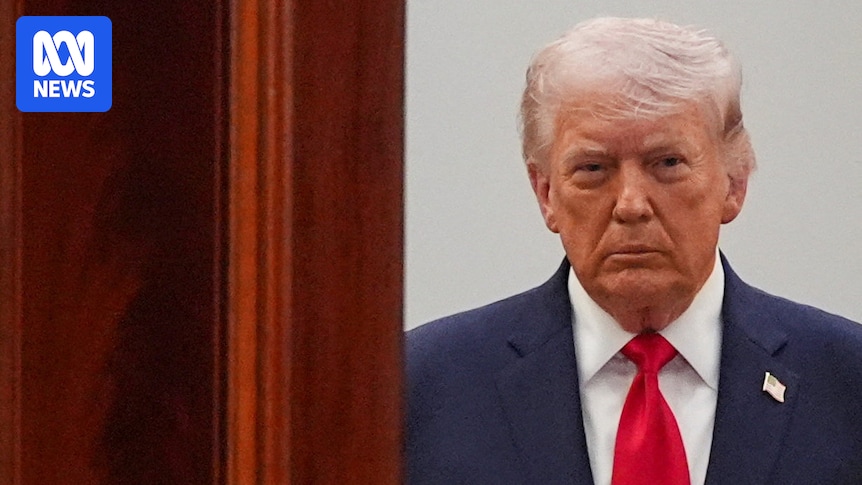
One of Donald Trump’s defining traits is his tendency to call a loss a win.
The 2020 election is one stark example among many refusals to concede after defeat.
So, many of Trump’s critics have been expecting that, at some point, he’ll declare a successful end to the war — regardless of whether it’s won, lost or stuck in a stalemate.
Iran war live updates: For the latest news on the Middle East conflict, read our blog.
Trump’s prime-time address wasn’t quite a war-is-over declaration of victory. But that will apparently come in two to three weeks.
“I can say tonight that we are on track to complete all of America’s military objectives shortly, very shortly,” Trump said.
“We are going to hit them extremely hard over the next two to three weeks.
“We’re going to bring them back to the stone ages where they belong.”
Trump’s speech contained no major announcements or revelations.
It also shed no new light on exactly how this all ends, or what will come next.
Rather, it was largely a cobble-together of past talking points and Truth Social posts, along with a reminder to concerned Americans that past wars have lasted much longer than this one.
Perhaps the most notable takeaways relate to what wasn’t said, rather than what was.
What wasn’t said
Despite speculation, Trump did not announce plans to send ground troops into Iran.
He made only brief mention of the nuclear material known to remain in Iran’s possession and suggested that it could be cause to revive the conflict after it ends.
“The nuclear sites that we obliterated with the B-2 bombers [last year] have been hit so hard that it would take months to get near the nuclear dust,” Trump said.
“And we have it under intense satellite surveillance and control. If we see them make a move, even a move for it, we’ll hit them with missiles very hard.”
Trump also did not talk about dumping NATO, despite his public and private musings on the topic in past days.
And — significantly, if not surprisingly, given recent statements — he did not have a plan to deal with Iran’s Strait of Hormuz blockade or its devastating impacts on the world economy.
Those nations that need the strait must “grab it and cherish it”, he said.
“We will be helpful, but they should take the lead in protecting the oil that they so desperately depend on,” he said.
In any event, Trump said, “when this conflict is over, the strait will open up naturally”.
A different tone to other leaders
Polling suggests a lot of Americans would have been looking for something else that was largely absent from this speech — a plan to deal with the spike in living costs caused by the war.
Though the US is less reliant on oil from the Middle East than a lot of the world, it’s not immune to the economic shocks.
This week, average petrol prices shot past $US4 a gallon — up from less than $US3 a gallon on the eve of the war.
That’s a hefty hip-pocket hit for those many Americans commuting long distances in big cities.
Anthony Albanese and Britain’s Keir Starmer made price spikes central to the national addresses they delivered in the past 24 hours.
And both outlined multi-point plans to provide some relief: in Australia, cuts to fuel and trucking taxes, and in the UK, a strategy to bring down power bills.
Trump knows that the cost of living is a key concern for many Americans too.
In fact, the last time he gave a national address like this — not including the annual State of the Union — was a pre-Christmas speech about all the ways he said he was making life cheaper.
But in this speech, that barely featured.
He said a “short-term increase” in petrol prices was “entirely the result of the Iranian regime launching deranged terror attacks”, before pointing to his “big beautiful bill” tax cuts and repeating a past pledge that the economy will “soon be roaring back”.
Loading…
It was a different tone to that taken by Albanese and Starmer, who both told their countries the coming days would be challenging.
“The economic shocks caused by this war will be with us for months,” Albanese warned.
Starmer said he had to “level with people: this will not be easy”.
Another glaring omission
Thinking back to the start of the year, a lot of the initial talk of war with Iran was sparked by Trump’s declaration he was “locked and loaded” to save the country’s protesting civilians from the ruling regime.
“If Iran shots [sic] and violently kills peaceful protesters, which is their custom, the United States of America will come to their rescue,” he posted on January 2.
Two months later, when the US and Israel launched their attacks, Trump said he wanted Iranians to rise up and overthrow the regime.
“When we are finished, take over your government,” he said in a social media video. “It will be yours to take. This will be probably your only chance for generations.”
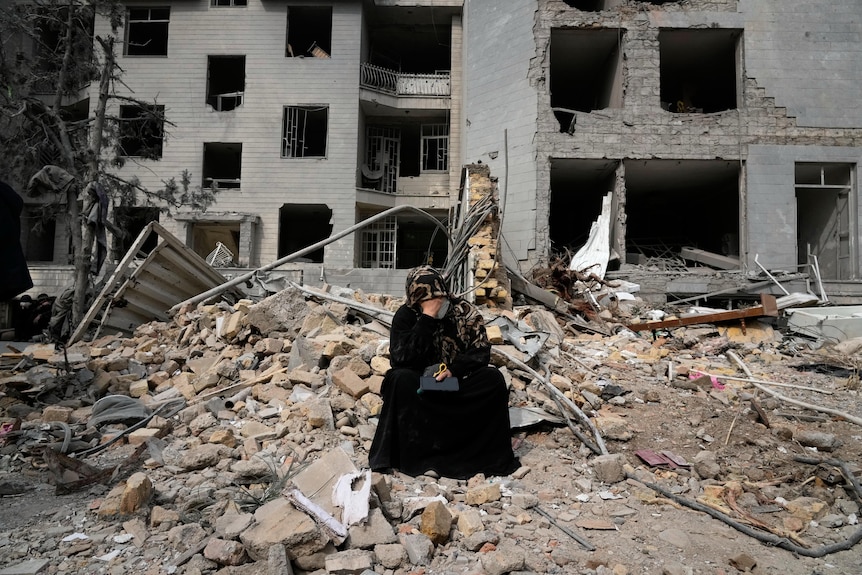
US and Israeli air strikes have caused death and destruction in Tehran. (AP: Vahid Salemi)
In today’s national address, Trump claimed regime change had now happened — even though it was “not our goal” — because so many leaders had been killed.
“The new group is less radical and much more reasonable,” he said.
He’s not given a basis for that belief, which runs counter to the general view of experts that Iran’s new supreme leader is even more extreme than his father, who he replaced.
(Earlier, on Truth Social, Trump referred to the “new regime president”, even though Iranian president Masoud Pezeshkian remains alive and unchanged.)
Trump says he wants these new “less radical” leaders, whoever they may be, to make a deal.
“If there is no deal, we are going to hit each and every one of their electric generating plants very hard and probably simultaneously,” he said.
In other words, the president is threatening the plunge the country’s people into darkness and chaos as a way of punishing the regime he promised to protect them from.
Now — as is often true when the US gets involved in the Middle East — suffering civilians barely rate a mention.
Perhaps that is the most glaring, but least surprising, omission of all.
Loading…