
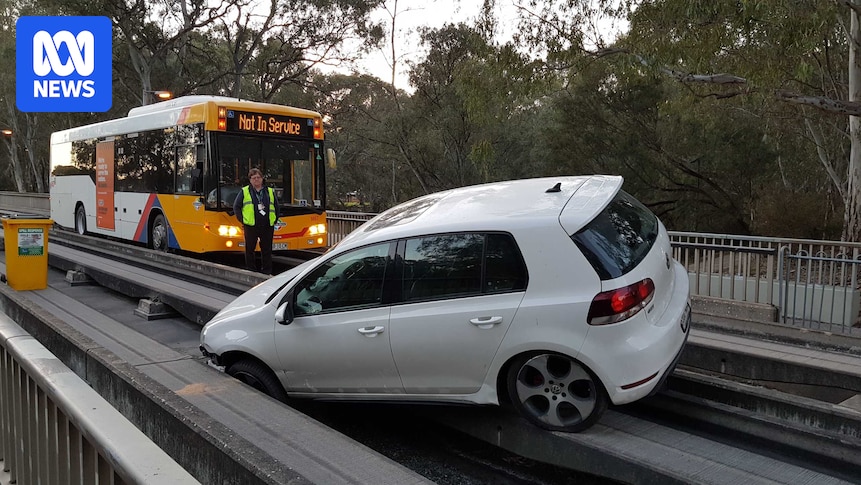
For a whole year, no cars have crashed trying to drive on the Adelaide O-Bahn busway track.
The Adelaide Mail satirical news website has been keeping track of how many days it has been since the last car became stuck on the bus-only concrete track.
Dan Schmidt, who calls himself “one of South Australia’s least respected satirical news reporters” on the Adelaide Mail website, said it appeared to be a record, at least since he started keeping track of the problem more than 15 years ago.
“A month ago, we realised ‘hey, it’s actually getting quite high’, because for a while there it was every 28–60 days a car would drive on the O-Bahn, so we think all our O-Bahn promotion — or O-Bahn-otion — has helped stop it,” Schmidt said.
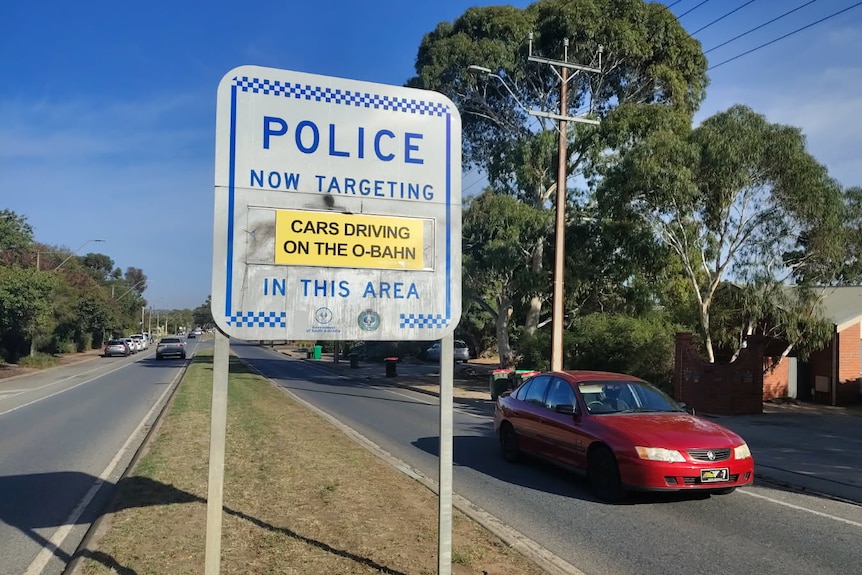
A sign Dan Schmidt installed to mark the occasion on Wednesday — April Fool’s Day. (Supplied: Dan Schmidt)
An Adelaide Metro spokesperson confirmed it has been 365 days since the last crash, but this was not the first time there has been a 12-month period without an incident.
They said the track has “multiple physical and visual controls in place to deter unauthorised access”.
“Cars entering the O-Bahn are uncommon,” the spokesperson said.
“All O-Bahn entrances have prominent signage and other interventions to deter unauthorised vehicles from entering the track, including red ‘BUS ONLY’ paint on the entry and exit roadways, large ‘No Entry — Bus Only’ signs and flashing lights at Park Terrace.”
The O-Bahn track opened in 1986.
Loading…
Only buses with small guidance wheels attached to the front corners can use the wide concrete tracks to go up to 80 kilometres per hour from Gilberton to Modbury, in Adelaide’s north-eastern suburbs.
Despite many warning signs, cars regularly make it onto the track, either accidentally or deliberately, but then crash into the median before getting to the next exit.
The last incident occurred on April 2 last year, when six teenagers were arrested for allegedly driving a stolen car on the track for 2 kilometres.
To mark the anniversary of that incident, Schmidt and his colleague in journalism, Trent Bartlett, are doing a live version of their Adelaide Mail Week in Review podcast from a bus on the O-Bahn.
“I am all aboard the O-Bahn — quite literally and figuratively,” Schmidt said.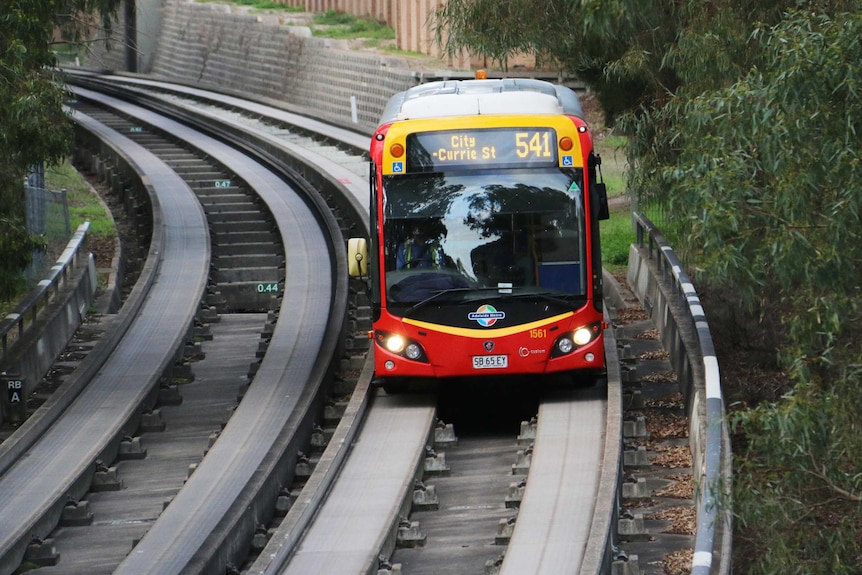
A bus travels along the O-Bahn. (ABC News: Malcolm Sutton)
Car drivers ignore signs
The O-Bahn was inspired by a similar track in Essen, Germany.
The O comes from the German words for bus “omnibus” and path “bahn”.
As well as in Essen, similar systems operate in the Japanese city of Nagoya and Cambridgeshire, in the UK.
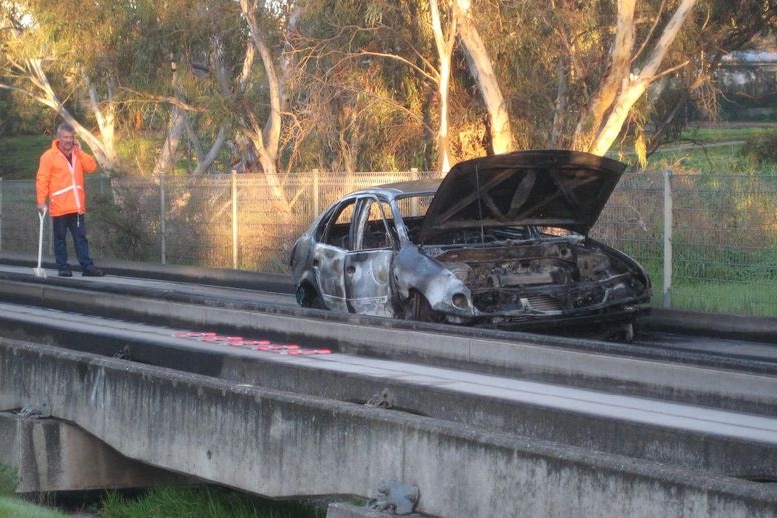
A burnt-out car dumped on the O-Bahn in 2009. (ABC News)
Michael Pretty from the Bus Preservation Association of South Australia organised a gathering of vintage O-Bahn buses to mark the 40th anniversary last month.
He said there was no issue with the track that caused cars to crash, but an issue with the car drivers.
“If car drivers have gone down there, that’s because they’ve ignored the warning signs,” Mr Pretty told Radio National.
“They used to have what’s called sump-busters out the front. They used to rip the oil pan out of a car if it tried to go on.
“But now that modern cars have got different suspension, they drive right over the top of it, so then the only way they come to grief is if they fall down the middle.”