
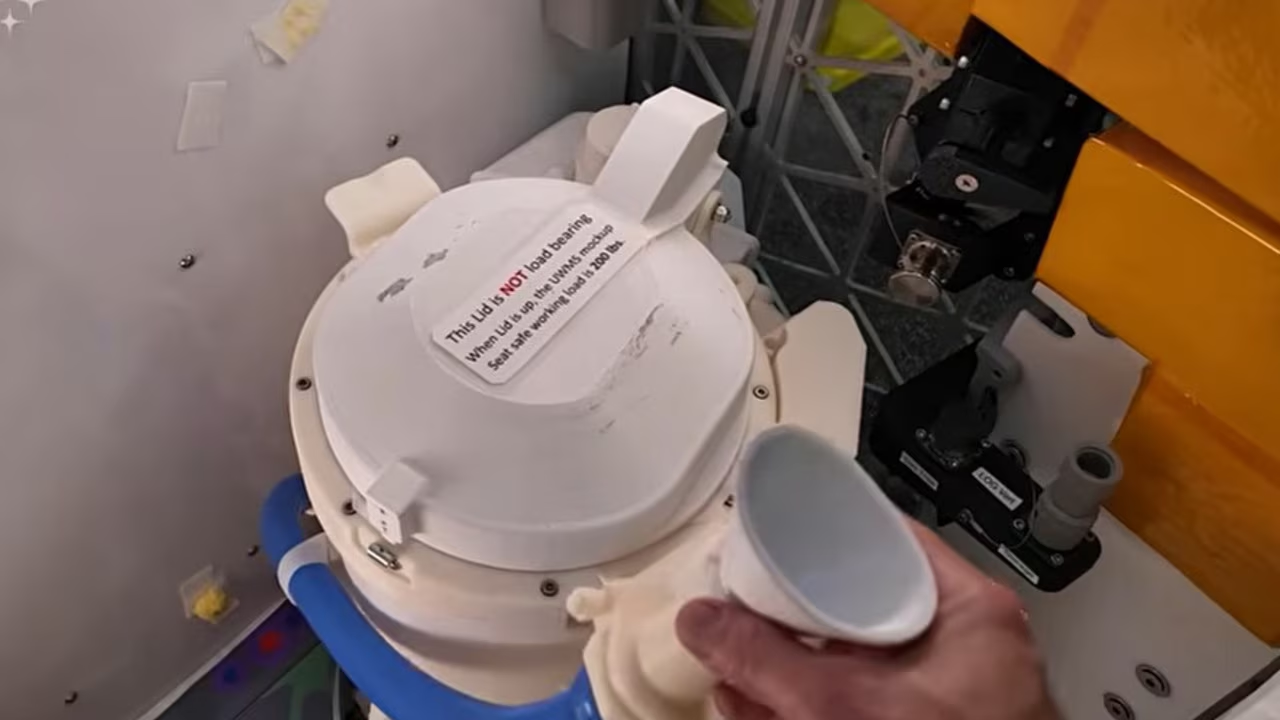
Much to the mental – and, more importantly, bodily – relief of the four astronauts on board NASA’s Orion spacecraft, an unwelcome setback at the start of the historic 10-day mission has been resolved.
Within hours of the Artemis II launch – NASA’s first crewed lunar fly-by in over half-a-century – crew delivered a troubling, eight-word message back to Earth. A fault light was blinking on one of the craft’s most-anticipated features: the toilet.
“The toilet fan is reported to be jammed,” NASA spokesperson Gary Jordan said during live mission commentary.
“Now the ground teams are coming up with instructions on how to get into the fan and clear that area to revive the toilet for the mission.”
Hailed as a leap forward in deep space toilet technology, the $US30 million ($43.4m) Universal Waste Management System (UWMS) on Orion took years to develop, designed in response to longstanding complaints from astronauts about on-board amenities on past missions.
NASA’s director of flight operations Norm Knight told reporters at the Kennedy Space Centre the malfunction was due to a controller issue on the toilet. Without fixing, the astronauts would only be able to use the commode to poo, not urinate.
“In the meantime, they’re getting their contingency – their backup waste management capabilities specifically for urine,” Mr Jordan said.
“The faecal collection of the toilet, that specific capability, can still be used with the waste management system aboard Orion.”
Luckily a few hours later, flight controllers walked Artemis mission specialist Christina Koch through how to fix the toilet.
“Happy to report that toilet is go for use,” Mission Control’s Capcom Amy Dill radioed to Ms Koch.
“We do recommend letting the system get to operating speed before donating fluid, and then letting it run a little bit after donation.”
Ms Koch replied: “We are cheers all around, and we will do that.”
In a video ahead of the launch, Artemis mission specialist from the Canadian Space Agency, Jeremy Hansen, said: “We’re pretty fortunate as a crew to get a toilet with a door on this tiny spacecraft.”
“The one place during the mission where we can go and actually feel like we’re alone for a moment,” he added.
Without a toilet, astronauts on the Apollo missions had to pee into condom-like contraptions under their spacesuits, while faecal waste was collected in a bag taped to their bum.
The Artemis crew will vent their urine out of the spacecraft every day, while faecal waste will be stored in a collection container and disposed of on return to Earth.
Astronauts begin burn to blast out of Earth’s orbit towards Moon
The four Artemis astronauts have now fired up their spacecraft’s engine to break away from Earth’s orbit and zoom towards the Moon.
With enough thrust to accelerate a stationary car to highway driving speed in less than three seconds, the burn lasted just under six minutes, propelling the astronauts on their three-day voyage towards Earth’s natural satellite – the first since 1972.
“Looks like a good burn, we’re confirming,” mission control in Houston said.
“The crew is feeling pretty good up here on our way to the Moon,” Mr Hansen said.
“Humanity has once again shown what we are capable of.”
The burn came one day after the enormous orange-and-white Space Launch System (SLS) rocket carrying the Orion capsule blasted off flawlessly from Kennedy Space Centre in Florida for the long-anticipated journey around the Moon.
Now that they’re moonbound, there’s no turning back: the astronauts are on a “free-return” trajectory, which uses the Moon’s gravity to slingshot around it before heading back towards Earth without propulsion.
In the event that something goes wrong, the astronauts are wearing suits that also serve as “survival systems” – in the unlikely case of a cabin depressurisation or leak, they’ll maintain oxygen, temperature controls and the correct pressure for up to six days.
Ms Koch and Mr Hansen are joined by Americans Reid Wiseman and Victor Glover.
The 10-day mission is aimed at paving the way for a Moon landing in 2028.
It marks a series of historic accomplishments: sending the first person of colour, the first woman and the first non-American on a lunar mission.
If all proceeds smoothly, the astronauts will set a record by venturing farther from Earth than any human before — more than 250,000 miles (402,336 kilometres).
It is also the inaugural crewed flight of SLS, NASA’s new lunar rocket. SLS is designed to allow the United States to repeatedly return to the Moon with the goal of establishing a permanent base that will offer a platform for further exploration.
It was meant to take off as early as February after years of delays and massive cost overruns.
But repeated setbacks stalled it and even necessitated rolling the rocket back to its hangar for repairs.