
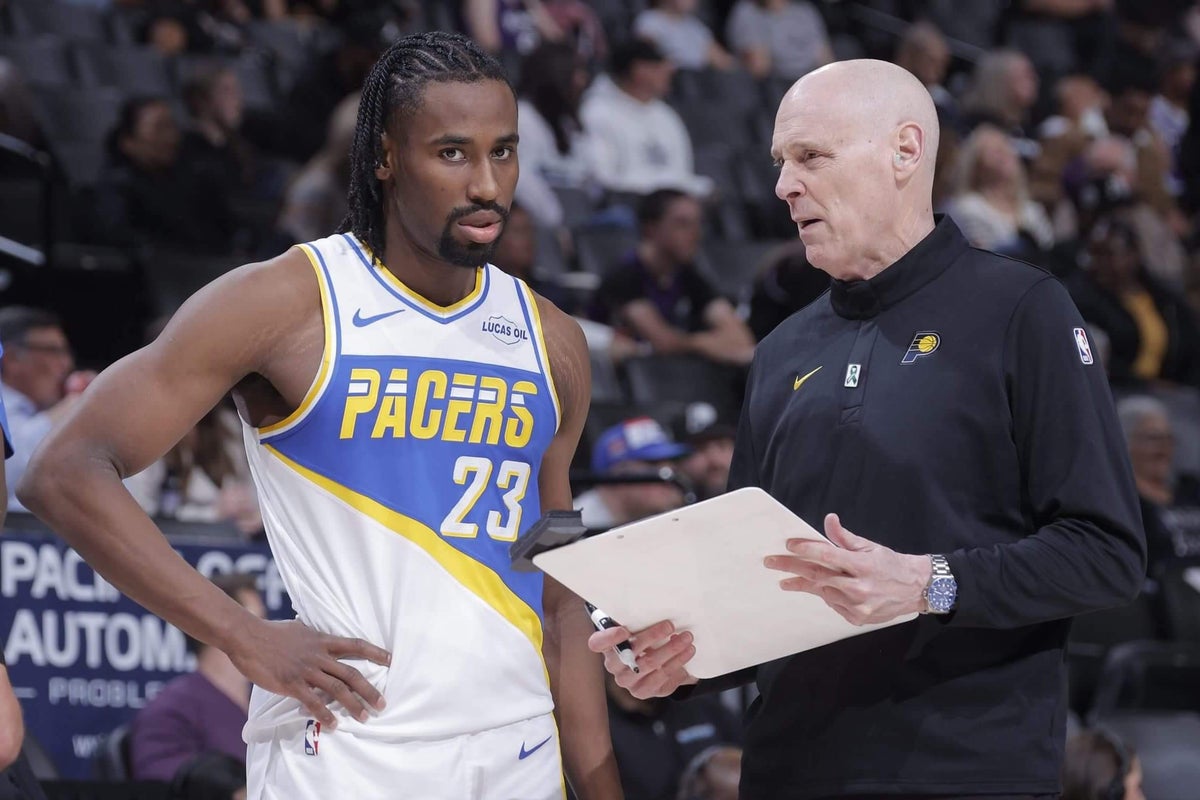
INDIANAPOLIS — Four minutes into the fourth quarter of the 73rd game of the season, down 20 points, Pascal Siakam gets into a defensive stance, swiping at and ultimately stealing the ball from the Los Angeles Lakers’ Austin Reaves. Siakam was approaching 2,000 minutes played this season. His Indiana Pacers, to this point of the season, had won 16 of their 72 games played.
Two minutes later, Siakam hit a 3-pointer. The Pacers were still down 16. Seconds later, Siakam fouled out, having picked up his fourth, fifth and sixth fouls within two minutes — and then got T’d up and tossed from the bench as he argued with the referees.
Final: Lakers 137, Pacers 130. Loss No. 57.
Mere feet from Siakam stood Tyrese Haliburton, having returned to the Pacers’ bench after several weeks of dealing with shingles. The viral infection hit as Haliburton continued his rehab from the Achilles’ tear that cruelly waylaid him in the opening minutes of Game 7 of the NBA finals in Oklahoma City last June, an injury that has cost him this season. His absence from the floor began a cascading set of decisions and circumstances that led this franchise to, as they say in the Association, tank lean into the development of the team’s young players.
Around here, they don’t tank lean into the development of the team’s young players. This franchise — under Herb Simon’s ownership, Rick Carlisle’s coaching and the longtime front-office collaboration of team president Kevin Pritchard and general manager Chad Buchanan — has always done what it did against the Lakers on March 25: compete, and at a high level. The Pacers are the patron saints of the “mid-build” that many fans believe is preferable to a complete teardown: building methodically through the draft and player development, rarely splurging on free agents and counting on continuity throughout the organization to foster a consistent, professional, winning culture.
All but the winning remain in place this season. And the winning, or the lack thereof, still matters.
“It is what it is,” a Pacers veteran said the other day, a smile on his face.
The expectation is that this is a one-off, a brief respite before the Pacers get a top pick in the upcoming draft (and that’s a bit complicated). Haliburton can return to his All-NBA form next season; Siakam remains a two-way terror; newly acquired center Ivica Zubac opens up all manner of pick-and-roll possibilities; guard Andrew Nembhard returns to his role as one of the league’s best on-ball defenders, with a year’s experience under his belt on the ball; and Indiana is, once again, a contender in the Eastern Conference.
There remains, though, the last few games of this slog of a season, during which the Pacers have had 16-, 13- and eight-game losing streaks. This is a proud franchise. Thus, needing to do … this … even for one season, is discomfiting. And needing to do it less than a year after being so close to the Larry O’Brien trophy is jarring.
“We talk a lot about just staying with the process,” Nembhard said. “I think it’s the competitiveness, bringing that energy every night, kind of when the season’s getting to the end, and it’s already out of (playoff) contention. It’s something you’ve got to work on. It’s only going to make us better for next season, having that competitive energy when it doesn’t really matter.”
“There’s a saying: You’re either humble, or you’re about to be humbled,” Carlisle said.
The franchise is also still dealing with the $100,000 fine from the NBA in February for resting Siakam in a Feb. 3 game against Utah, while also holding out Nembhard and forward Aaron Nesmith — Nembhard for lower back management, Nesmith with a left hand strain. Even though the game was the second of a back-to-back set and the Pacers’ third game in four nights, the league said a review by an independent physician determined that all three players could have played at least a few minutes in the game. Siakam, an All-Star each of the last two seasons, fell under the “star player” designation of the Player Participation Policy implemented in 2023.
It’s hard, from those depths, to recall how recently the Pacers were four quarters away.
“Two quarters,” Carlisle said, evenly, in his office at the team’s practice facility.
And, of course, he’s right. Even after Haliburton’s devastating first-quarter injury, the Pacers somehow summoned up enough will to take a 48-47 halftime lead. Eventually, the Thunder walked them down in the third quarter and pulled away, leaving Indiana to face the following season without its superstar guard.
You coach long enough, you’ll have seasons like these. Carlisle had a couple with the Dallas Mavericks in the years after their 2011 championship, as Dirk Nowitzki aged and the team was unable to keep important people who contributed to the title run. And he had one just a few years ago here — the 2021-22 season, the first season of Carlisle’s second stint in Indy. That year, Indiana blew up the core of the team that made the playoffs five seasons in a row, but didn’t win any of those five first-round series. Multiple trades netted Haliburton and future picks that ultimately became Nembhard and third-year guard Ben Sheppard.
“When things get like this,” Carlisle said, “you’ve just got to find a way to operate that’s consistent and positive. That’s the tack that we’ve taken.
“The players have been terrific. … We acquire guys that are great people along with being good players. If you don’t have that kind of character, something like this can be a lot more arduous.”
Every NBA player has pride in his skills and determination to win and play well — if, for no other reason, to have good tape for his next team to see. It’s especially hard to think about tanking here with a franchise that has, for decades, resisted the temptation.
Indiana has made the postseason 20 times in the last 30 seasons through multiple iterations, from the Reggie Miller-led squad that made the finals in 2000 under Larry Bird (when Carlisle was the team’s offensive coordinator) to the Jermaine O’Neal-led group in the early 2000s — a team derailed by the Malice at the Palace in 2004 — to the Paul George-centric Pacers who challenged LeBron James’ Heatles for Eastern Conference superiority in the early 2010s. Carlisle won his NBA championship in Dallas, but he’s coached more than 700 games here in two stints.
But Haliburton’s injury was only a harbinger of what was to come.
Forward Obi Toppin missed four months with a stress fracture in his right foot suffered early in the season. Forward Johnny Furphy tore his ACL in February. Sparkplug sixth man T.J. McConnell has been slowed by a hamstring pull. Nembhard had a strained shoulder early and a lower back injury now.
“It’s been a tough season,” McConnell said. “But it’s hard to look past the minutes and the growth that some of the guys that, even last year, didn’t get. Especially Drew taking on a bigger role, Ben Sheppard, the young guys continuing to come in and give us a spark and get valuable minutes in the NBA. That’s a really valuable thing. It’s something we can’t look past. We’ve got to continue to honor it, and continue to build guys up when they get those opportunities.”
The Pacers knew, once their stalwart center Myles Turner left for the rival Bucks in free agency last summer, that they’d have to hit the reset button. They had two major concerns entering the season: losing their culture inside their locker room or losing their fans. They hoped they’d built up enough credibility over the years with both constituencies to survive the year.
“We know that we’re a better team than our record shows,” reserve center Jay Huff said. “We’ve had some inconvenient injuries. And we’re trying through this whole time to keep winning habits, try to win some more games and keep playing how we know we need to play to win games. Keep the culture around here a winning culture.”
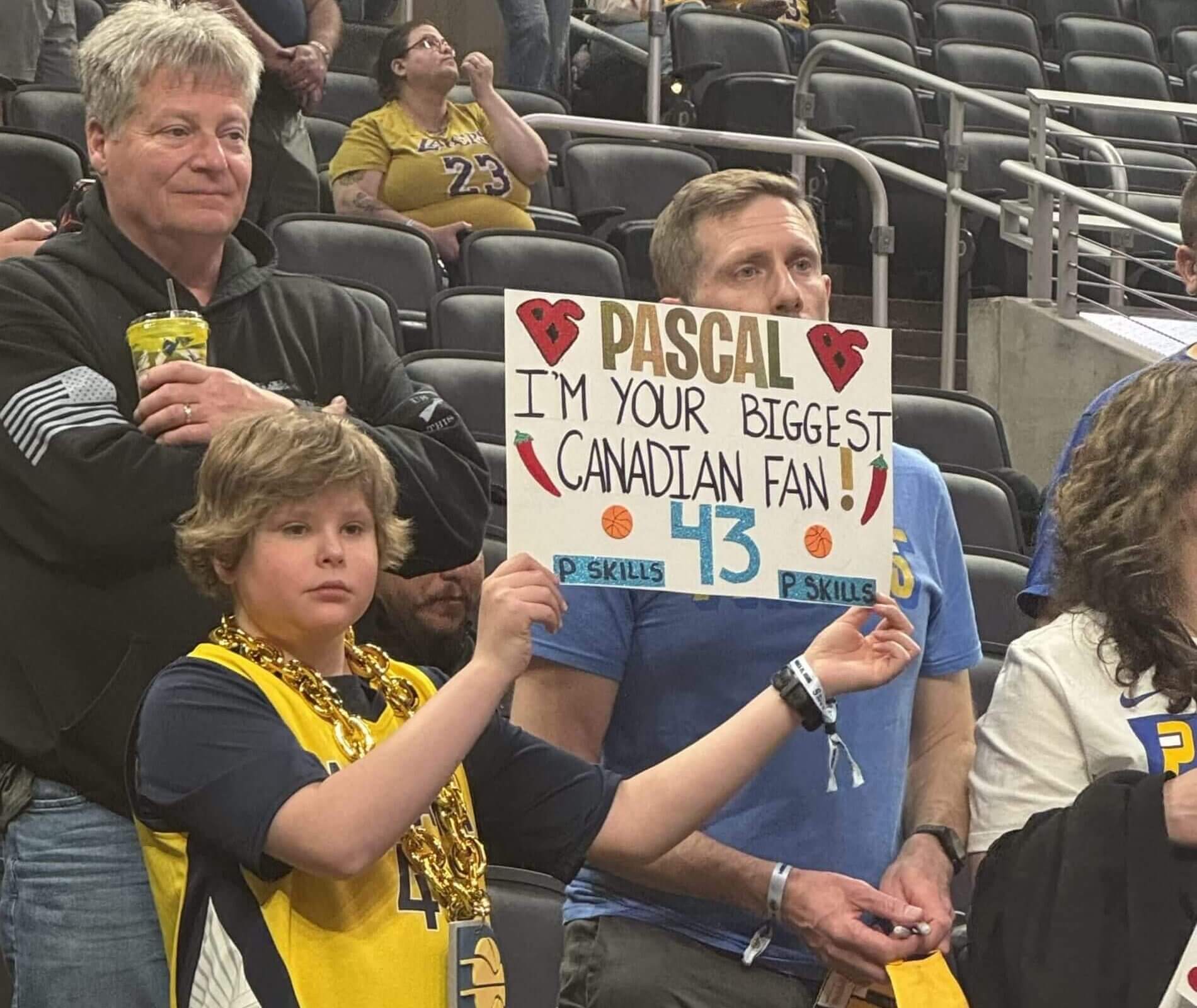
A young Pacers fan shows appreciation for Indiana forward Pascal Siakam. (David Aldridge / The Athletic)
While there were a lot of Lakers jerseys in the crowd at Gainbridge Fieldhouse last week, there were also a lot of people supporting the home team, as there were during recent rare home wins over Orlando and Miami. Siakam and the veterans noticed. Per Elias, the Pacers are averaging a little more than 16,600 per game at home this season, which would be a drop-off of roughly 100 people per game from last year’s average.
Last week, that included Shane Harris, who co-owns a Big O Tires franchise in Mooresville, Ind., about 20 minutes from Indy, with his wife, Jessica. They, along with their son Jaden and his friend Matt Thomas, were using the company’s four season tickets last week for the Lakers game. Harris said that someone makes use of the company tickets for about half of the Pacers’ home games every year.
“For us, it’s something more for our employees,” he said. “Even if they had several years of not being competitive, we would continue to do it. It’s just something good for our employees, to give them something back.”
So, you’re good with … leaning in to developing the young players this season?
“I don’t know,” Harris said. “I’m torn on that. But you’ve got to look to the future. I’m not that upset about it. Do what you’ve gotta do.”
The Pacers’ hopes about adding a player from the top of what may be a loaded 2026 draft hinge on some more maneuvering, however. The trade netted them Zubac and forward Kobe Brown from the LA Clippers for Bennedict Mathurin, Isaiah Jackson, a 2029 first-round pick, a 2028 second-round pick — and a conditional 2026 first. The condition is simple, but ominous: If Indiana winds up with one of the top four picks in the draft after next month’s lottery, or with the 10th through 30th pick in the first round, it will hold onto the 2026 first and convey a 2031 first to the Clippers.
But if the ’26 pick winds up at picks Nos. 5 through 9, it will convey to the Clippers for this year’s draft.
It’s a reasonable gamble. Zubac is out for the rest of this season after suffering a broken rib during the Pacers’ March 18 game with the Portland Trail Blazers. But the 29-year-old looks like a potential strong fit at both ends. The Pacers’ frenetic pace and movement will take some getting used to, but when things slow down in the half court, Zubac should mesh nicely. With him always among the league leaders in screen assists, and at just a $20.5 million per-season average through 2028, Indiana couldn’t do better in finding an impact big man at a non-elite price.
Carlisle says often that his is a “get-to” job, not a “have-to.” He’s worked harder than ever on building relationships, not overloading his young players with too many minutes and too many new responsibilities. The team’s veteran player committee lets him know when a day off is needed. There will be challenges next season getting Haliburton back up to speed, but prior to the shingles diagnosis, he had been hitting all of his physical markers as he continued his rehab.
A little more darkness before the return to the light.
“Coming into this, it was daunting,” Carlisle said. “We were 1-13 to start the season. Very difficult. How do you maintain consistency with that? The answer is, you just do. We had seven hardship deals that we had signed with players, many of whom were in and out in very short periods of time. … My thing was we’re going to be unbending, and we’re going to continue to work toward the ultimate goal, which is to win a championship.
“We were right on the doorstep last year. And then, this year happened.”