
People used to paint their own signs. I don’t mean just shop names but everything from gig posters to banners they planned to hold up at sporting events. These amateur sign painters would have to work out how to fit a bunch of letters into a defined space. They would have to make all sorts of aesthetic decisions – colour, scale, font and so on – and then display the results in public.
There is a shift in the way you write once words get to a certain scale. Handwriting does not work on a sign. You can’t support your hand’s weight with the side of your palm. You need to move your whole arm like a teacher at a blackboard. People don’t really use their hands like that anymore. Kids draw on iPads while parents use AI to touch up family photos. These days, it seems as though everyone has a computer and a cousin who knows how to use it. You get to choose between Arial and Times New Roman, but that’s it: the rest of the decisions are made for you. Then you print it, the lines are straight and the letters are centred. It looks “professional”, whatever that means. It’s now possible to walk down a shopping strip and see no trace of a hand at all.
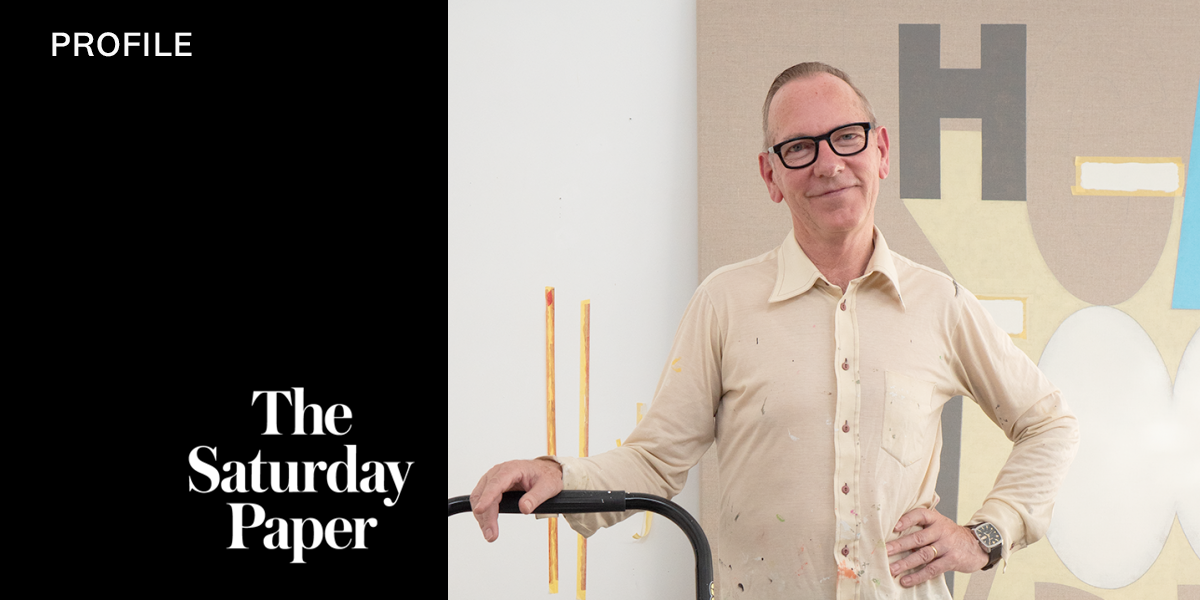
Before AI, before mobile phones, before the internet, Jon Campbell was painting. I don’t mean signs, I mean “Painting” painting. When I met him, 20-something years ago, a mutual friend introduced him like this: “This is Jon, he’s a great Painter.” For the record, Jon Campbell is one of my best friends. I will not pretend to be impartial.
Although Campbell is primarily a painter, he works across a range of media – drawing, sculpture, collage, music, neon, textiles, printmaking, the list goes on. His subject matter varies but a few recurring themes have emerged throughout his career. His upbringing in Melbourne’s western suburbs is a continuing source of inspiration. Campbell’s artworks often use text. Words are abstracted to the verge of illegibility in both the shape of the individual letters and also through the manipulation of the words themselves, through contraction and exaggerated phonetic spelling. They’re full of local parlance and slang, the poetry of the suburbs. The word “kebabs” is treated with the same reverence as “Sam Kerr’s Left Calf”.
Campbell currently has a survey exhibition titled yEAH / dUNNO at Geelong Gallery. It features a selection of works from the past 40 years or so, from a high-school sketch of Bob Dylan to a site-specific installation on the gallery’s wall. It’s not a comprehensive retrospective so much as a snapshot of a lifetime spent looking and making things. There is no overarching theme to the show, just a bunch of objects that make sense together. The exhibition takes up the spine of Geelong Gallery, inside and out. The entrance of the building has been transformed into a massive “YEAH”, and the rear façade of the building is covered by an equally large “DUNNO”. Campbell has used “Yeah” a lot over the years, in paintings, drawings, neons, you name it. Best known is his petition to make it the new Australian flag. It’s a positive affirmation – a mantra of possibility. It sums up his infectious enthusiasm.
At a time when everybody seems to have an opinion about everything, “Dunno” is refreshing in its uncertainty. It’s disarmingly honest. Maybe it’s okay not to know everything. It pre-emptively answers every artist’s most frequently asked question: “What’s that meant to mean?” If the artist is not present, people instead claim, “I could paint that.” Or, if they really want to sink the boot in, they say, “My kid could paint that!” It’s meant to be a ridicule, but I prefer to pretend it is an excited statement about a child’s possible foray into the arts. Yeah!
I believe everyone should paint. It’s a birthright, like singing and dancing. People did it in caves in the past, and if the world continues on its current path, I suspect they will do it in caves in the future. The proverbial caveman didn’t just paint the walls of caves. They painted everything they could get their hands on. The artwork produced on cave walls, protected from the elements, is the only thing that survived. History is like that. Museums function a bit like a protective cave: they are a trailer-load full of the best things saved from hard rubbish.
The inside artworks of yEAH / dUNNO are spread across three large spaces. The first shows a selection of Campbell’s more “traditional” artworks: paintings, a neon, the flag and a sculpture.
In that space, there is a painting on plywood that reads “Save Our Pool”. The varnish has yellowed somewhat and taken on the patina of an old cricket bat. Campbell had made several versions using this slogan about 2006 when the Maribyrnong City Council was planning to demolish the local pool. The Footscray Municipal Baths had been open since 1929. Residents originally used the baths more for bathing than for swimming, but, over time, they became a community hub. I’d never been there myself, but I had always found the painting’s sentiment evocative. “Save” is a plea to others for help. We are usually asked to consider the whales, the rainforests or even the planet itself, so it was nice to see it attached to something specific and seemingly manageable. We could save a pool.
At a time when everybody seems to have an opinion about everything, “Dunno” is refreshing in its uncertainty. It’s disarmingly honest.
The second room is an installation of paintings on unstretched fabric. They are hung from the ceiling en masse, like flags at the Olympics. As you view them from the back, you realise they have been painted on novelty tea towels. Franco Cozzo and Footscray Halal Meats and the Great Barrier Reef, all swimming together. It’s like that mullet haircut description: business in the front, party in the back.
At first glance, the kitsch imagery printed on the back of tea towels is humorous, but there is something melancholic about it all. You can mentally trace back to someone 50 years ago, while on holiday in Echuca, who was so impressed by paddle steamers they decided to buy a memento. Then it sat in a drawer for 40 years until somebody donated it to an op shop. Who knows how long it sat there before Campbell swooped in, took it back to his studio and wrote “Snot Block” on it. The original designs are the remnants of an Australia that no longer exists. Campbell’s additions, the handpainted signs and colloquialisms, will also slip away.
The final space contains a group of tables displaying Jon’s works on paper. They sit in the centre of the space with the gallery’s permanent collection of other artists on the wall. There is a play between Campbell’s unpretentious sketches and the high art. In the centre of these tables is an ornate cabinet that is part of the gallery collection and cannot be moved. It contains what appear to be Fabergé eggs. I think about the jeans of the same name that cool kids wore in the ’80s.
While I was driving to Geelong to see the exhibition, I saw a sign for Torquay, and one of Campbell’s songs popped into my head: “13th Beach / Point Impossible / Torquay / Jan Juc / Winkipop / Southside / Wye River / Drivin’ down in 78 / Looking for that perfect break / Hitchy, Beaky, Marty, Morry, Wayneboy and me / And feelin’ free”.
It’s a simple enough subject for a song – a group of friends driving down the coast to go surfing – but it succinctly articulates a lot of Campbell’s recurring themes. He lists the beach names in the order they punctuate the coastline and doing so heightens their poetic and odd names. The group of friends crammed into a car, like the figures crammed into the edge of a canvas, or the letters to the edge of a window. Each friend is integral to the whole experience. One senses it wouldn’t be the same if Wayneboy were not there, but he is. There is beauty in the seemingly mundane nature of it all. It’s a reminder that “feelin’ free” is not only possible but something worth striving towards.
While reading the roll call of surf beaches, I think of the “set list” paintings Campbell has made. There is one by the local band Magic Dirt in the Geelong exhibition. The performer scrawls a set list before the performance. It’s a mud map of how the gig will go. In a way, it predicts the future by manifesting the songs into existence. After the gig, it loses that function for the performer and becomes a memento, a record of what happened. Campbell takes these scrawls from the foot of the stage and puts them in the literal spotlight.
I wanted to ask Campbell some questions about the Geelong show, so I arranged lunch. We met at a bakery in Coburg and I attempted to talk about art stuff, but it all seemed a little contrived and that soon fizzled out. It was like giving your friend a job interview. In the end, we chatted about what the Carlton Football Club should be doing to improve team cohesion. If someone connected to the club is reading this: please get the team to sing the song properly after a victory – no schoolboy sound effects. No lolligagging. Get a professional choir coach in, split them into tenors, baritones and basses, and have each sing their part.
I asked Campbell if they ended up saving the Footscray pool. “Nah… They tore it down!” I guess you would dig up a pool or fill it in, but a public pool is not just the hole full of water you swim in, and they did tear everything else down. He told me an aged-care facility had been built on the old site. Later that evening, when I found old photos from the 1950s of kids playing in the pool, it dawned on me that those same kids may now be living in the building that stands where the pool once was. I asked Jon if people had those signs up everywhere around Footscray. “Nah, not really,” he said. “I just took one to a few of the protests.” The painting that hangs in the gallery is not a trophy of some community triumph. It’s what remains from an unsaved pool.
After lunch, I drove Campbell up the road to pick up a pair of pants he’d had altered. As I was parking, I noticed a handmade sign in a kebab shop. Whoever made it had added the extra flourish of putting a bunch of lines through the letters so they resembled the stacked meat on a gyro. The individual letters appeared to be rotisserating. I pointed it out. Jon took note, then left to pick up his trousers.
As Melbourne came out of the Covid lockdowns, Campbell and I started kicking around the idea of heading out into the landscape to do some “plein air” watercolours. The idea came about because of our shared interest in Albert Namatjira and the other artists of the Hermannsburg School. It was all a fantasy, really – the attempt to get back to nature, no phones, no computers, just a couple of artists in the wilderness. We made plans, but it never happened. We never seemed to find the time, or perhaps the reality wasn’t as interesting as the idea. We also struggled to find a location close to the city where the “air” was “plein” enough.
A couple of months ago, Campbell decided to get the ball rolling. He suggested I come by his Coburg studio and do it there. Why not? When I arrived, he had already propped up a large Namatjira book on a small easel. The plan was to each paint a copy of it. The traditional method of learning is through copying the masters and perfecting a skill through repetition. Campbell had a bunch of old watercolour sets he had picked up here and there and piles of various offcuts of paper he had collected over the years. So we sat for a couple of hours, chatted, listened to music and got our brushes wet.
I wanted to avoid peak-hour traffic, so we decided to call it a day. We looked at what we had done. Mine was clumsy and uncertain. Campbell’s was beautiful: a near-perfect reworking of the Namatjira but with his own flourishes. The colours popped. The lines flowed gracefully, like a surfer on a wave. I expressed how much I liked his painting. Ever the enthusiast, he graciously pointed out a couple of things he liked about mine. I reiterated that I really liked his painting and noted how much better his was than mine. The composition, the colour, the fluidity. He said, “Well, yeah, but I’ve been doing this for a long time.”
This article was first published in the print edition of The Saturday Paper on
April 4, 2026 as “Signs of the times”.
For almost a decade, The Saturday Paper has published Australia’s leading writers and thinkers.
We have pursued stories that are ignored elsewhere, covering them with sensitivity and depth.
We have done this on refugee policy, on government integrity, on robo-debt, on aged care,
on climate change, on the pandemic.
All our journalism is fiercely independent. It relies on the support of readers.
By subscribing to The Saturday Paper, you are ensuring that we can continue to produce essential,
issue-defining coverage, to dig out stories that take time, to doggedly hold to account
politicians and the political class.
There are very few titles that have the freedom and the space to produce journalism like this.
In a country with a concentration of media ownership unlike anything else in the world,
it is vitally important. Your subscription helps make it possible.
Send this article to a friend for free.
Share this subscriber exclusive article with a friend or family member using share credits.

Used 1 of … credits
use share credits to share this article with friend or family.
You’ve shared all of your credits for this month. They will refresh on May 1. If you would like to share more, you can buy a gift subscription for a friend.
SHARE WITH A FRIEND
? CREDITS REMAIN
SHARE WITH A SUBSCRIBER
UNLIMITED
Loading…