
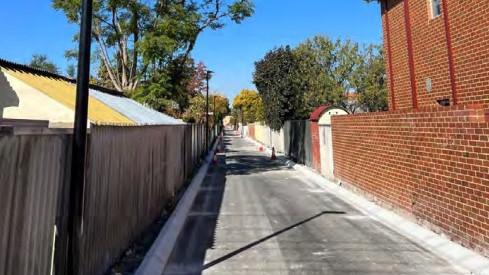
Claremont’s private laneway could come under local government ownership under a new proposal to repair the deteriorating access points over the next 10 years.
The town council will put the new Rights of Way strategy out for public consultation, seeking support from private laneway owners for its proposal.
The town would then be responsible for upgrading and maintaining acquired laneways, which would cost it an estimated $4.89m.
Claremont mayor Peter Telford said the program was 15-years in the making and aimed to address a long-term issue affecting local residents.
“There’s been a strong indication from the community that this is an issue they want addressed,” he said.
Some 57 of the 79 ROWs within the Town of Claremont are privately owned. Under the existing rules, the town cannot approve or fund upgrades for any of these laneways unless they have significant drainage issues.
According to a 2021 asset condition report, many of Claremont’s laneways are in “very poor” condition, and have inadequate drainage and surfacing.
The issue was discussed again after council received a petition from 32 owners of property adjacent to Cactus Lane late last year. The petition sought council’s help to upgrade the construction of the private ROW.
Mr Telford said in order for the town to transition the ROW network into a public asset, it needed support from about 70 to 75 per cent of the adjoining owners of each laneway.
 Camera IconClaremont mayor Peter Telford said the program was 15-years in the making and aimed to address a long-term issue affecting local residents. Credit: Iain Gillespie/The West Australian
“Under the current law, the town is prevented from maintaining these private-owned laneways ratepayer funds,” he said.
“We’re hoping the consultation process will get as much feedback as possible.”
If the town reaches that level of support, Mr Telford said the town would set up a pilot reconstruction program for one laneway, most likely Cactus Lane.
Mr Telford said the initial process would take about a year to complete.
The town would then review the ROW network and propose upgrades based on a four-tier priority system for management that would be rolled-out over 10 years.
The cost breakdown will see laneways categorised as “priority 1” to receive a total $3.89m in funding, while “priority 2” laneways would be pull from a $1m funding allocation. Additional staffing, administration and survey costs were yet to be determined.
The draft Rights of Way strategy is set to go out for a 28-day public consultation period.