
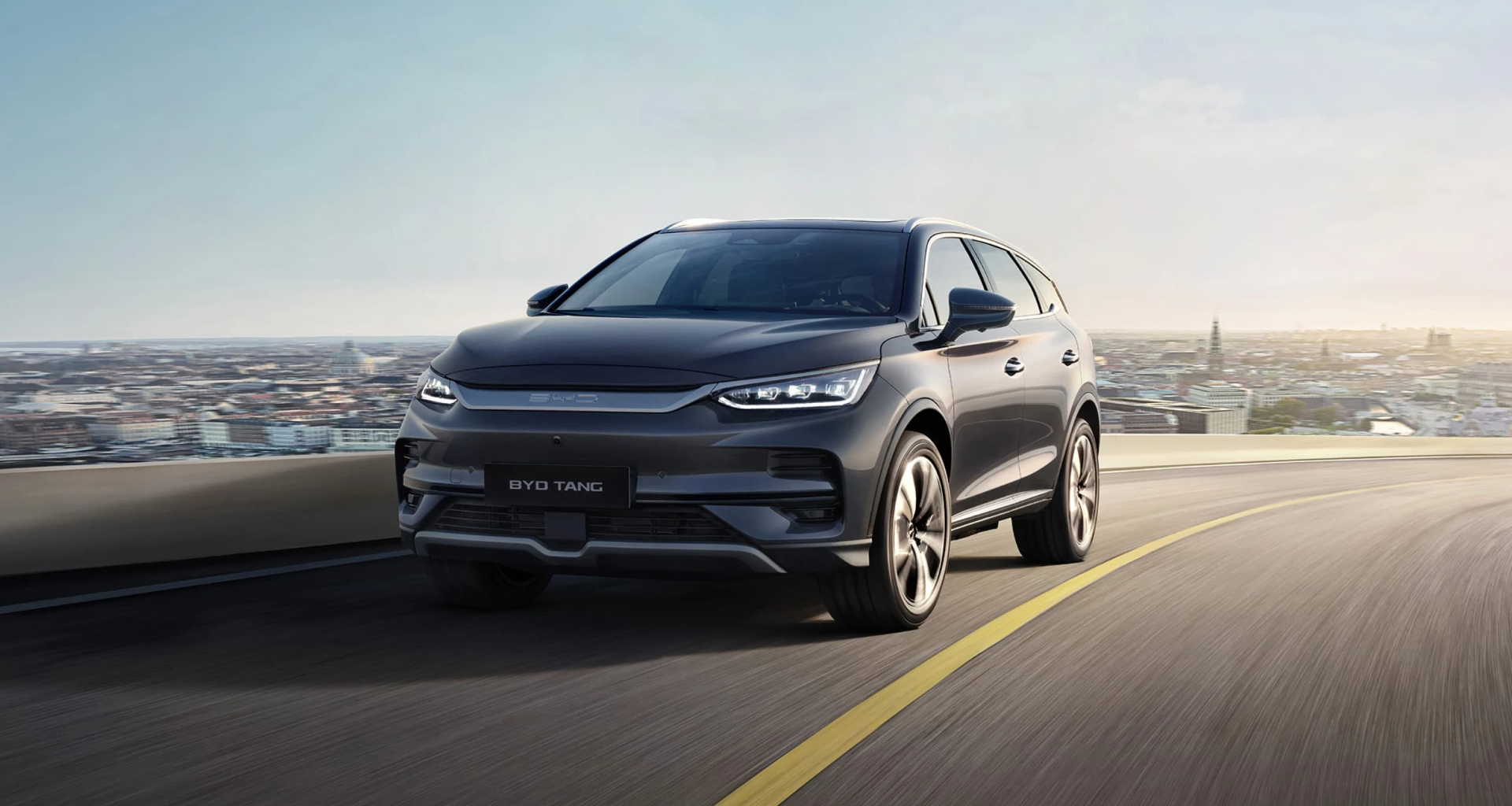
Positioned as the brand’s flagship SUV, the BYD Great Tang is scheduled to launch in China this May with both BEV and PHEV variants. The all-electric version is expected to deliver up to 590 miles of range on a single charge, along with BYD’s flash-charging technology designed to significantly cut charging times.
Built as a production-ready evolution of the Dynasty-D concept first shown at the 2025 Shanghai Auto Show, the Great Tang also brings premium features such as rear-wheel steering and an adaptive air suspension system for improved handling and ride comfort.
Both BEV and PHEV versions have already applied for sales approval in China, signaling an imminent market debut.
Combining long range with high-performance AWD
Built around BYD’s second-generation Blade Battery, the all-electric Great Tang supports megawatt-level charging and targets class-leading range. The rear-wheel-drive version uses a 300 kW motor paired with a 130.15 kWh battery, delivering up to 590 miles of range, placing it among the longest-range electric crossovers, CarNewsChina reported.
For buyers seeking performance, the all-wheel-drive variant produces a combined 585 kW and accelerates from 0 to 62 mph in just 3.9 seconds. Even with the added power, this version is rated at up to 528 miles of range, balancing high output with long-distance capability.
The BYD Great Tang will also be offered with hybrid powertrains built around a 1.5-liter turbocharged engine producing 115 kW. In the DM-i configuration, this engine is paired with a 200 kW electric motor, delivering an all-electric driving range of up to 212 miles from a 66.48 kWh battery.
For higher performance, the DM-p variant combines the same internal combustion engine with dual electric motors, generating a total output of 400 kW. This setup is designed to balance efficiency with significantly stronger acceleration and all-wheel-drive capability.
Rear-wheel steering and advanced air suspension
Engineered with a focus on ride comfort and maneuverability, the new crossover features BYD’s DiSus-A suspension system with dual-chamber air springs. The chassis is further enhanced by rear-wheel steering, enabling a notably tight turning radius of just 17.1 feet – slightly better than the 17.7 feet of the Mini Hatch – making this large SUV surprisingly agile in urban environments.
From a pricing perspective, BYD is expected to strategically position the Great Tang below key models within its broader portfolio to prevent overlap with premium offerings such as the Denza N8L and Denza N9, CarNewsChina notes.
However, the BYD Great Tang is expected to go head-to-head with the Geely Galaxy M9 in China’s full-size crossover segment. The Galaxy M9 has already demonstrated strong market traction, with 11,635 units delivered between January and February, according to China EV DataTracker.
With the Great Tang, BYD is aiming to capture a meaningful share of this fast-growing segment by combining long-range electrification, advanced chassis technologies, and a diverse mix of powertrain options.