
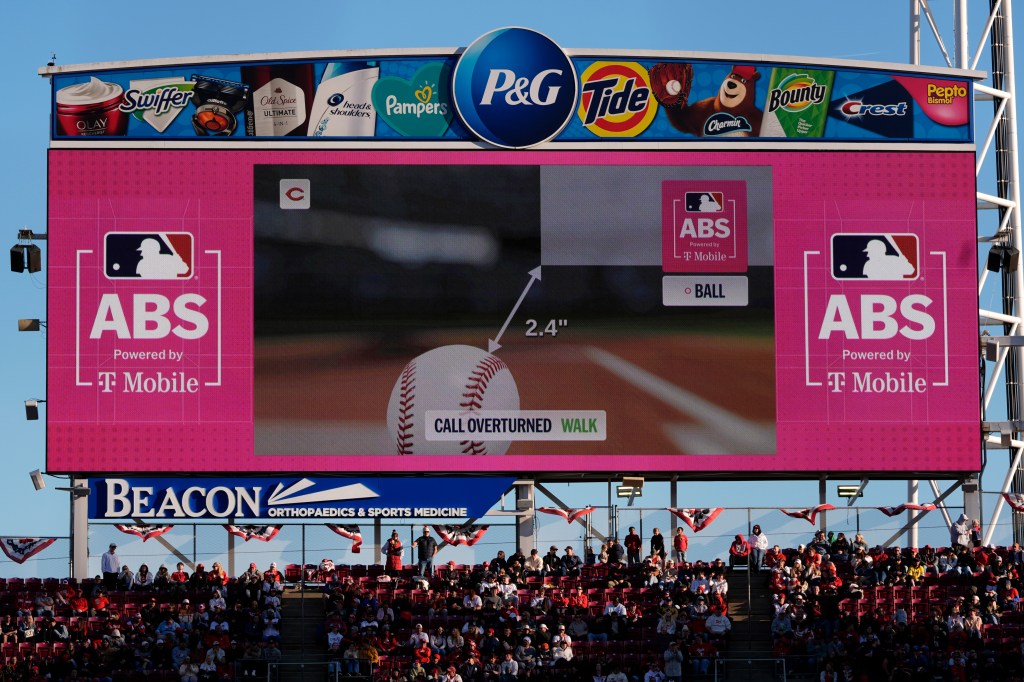
After years of testing in the minor leagues and spring training, baseball’s new Automated Ball-Strike challenge system has finally arrived in the majors. For the first time, big league players have the ability to challenge a call they disagree with, appealing to an electronic strike zone that determines whether the call on the field should stand or be overturned.
The system has introduced a new layer of strategy and drama to baseball, but its introduction has also forced the sport to grapple with a question that never really had a concrete answer until today.
What is a strike?
That seems like a silly question at face value. A strike is any pitch thrown over the plate between the letters and the knees. But anyone who has ever watched baseball knows every umpire has their own unique strike zone, and sometimes that zone grows and shrinks depending on the situation.
Now, for the first time, baseball is attempting to standardize its strike zone.
Under the ABS system, the electronic strike zone is defined as a two-dimensional rectangle set in the middle of the plate that is 17 inches wide and between 53.5% and 27% of a player’s standing height as measured by the league. If any part of the ball touches any part of that rectangle, the pitch will be ruled a strike.
By using the percentage of a player’s height MLB hopes to ensure everyone’s strike zone remains the appropriate size, that way you don’t have a situation where someone like Jose Altuve (5-foot-6) has the same sized zone as someone like Aaron Judge (6-foot-7). But in other respects the zone has fundamentally changed, with the biggest difference being the use of a 2D zone set in the middle of the plate instead of a 3D one measured from the front.
That change has prompted a wide range of reactions. Speaking from personal experience, my cousin has been blowing up my phone all week about the new zone — he’s not a fan — and ESPN’s “Pardon The Interruption” even dedicated their annual April Fools prank segment to the subject, satirically suggesting that MLB was apologizing to the umpires union because the 2D zone was missing breaking balls clipping the front of the plate.
So why do it that way instead of how umpires have historically constructed their zones? An MLB spokesperson provided a presentation to the Herald given by Joe Martinez, MLB’s Vice President of On-Field Strategy and a former MLB pitcher, during a press conference in Arizona on Feb. 13.
According to Martinez, MLB did originally test a 3D zone but found it was prone to strange calls.
“The reason that we landed there, we tested all different kinds of things, a 3D zone or setting it at the front led to some odd strike calls in a way,” Martinez said. “You can envision a slow 12-6 curveball just clipping the bottom corner and the catcher would catch it toward the dirt, and that would be called a strike. So moving that zone back more in line with where the hitter is led to results that were more in line with expectations.”
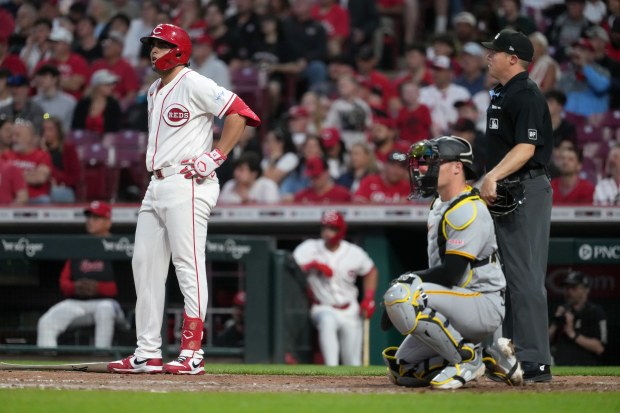 Cincinnati Reds third baseman Sal Stewart, left, waits for an Automated Ball-Strike System during the sixth inning of a baseball game Monday, March 30, 2026, in Cincinnati. (AP Photo/Kareem Elgazzar)
Martinez said defining the strike zone was the hardest question MLB had to answer when testing the ABS system and acknowledged that the league’s solution was “definitely a change.”
“Even though we think of the strike zone as kind of a set thing, umpires traditionally have called something that is kind of flexible,” Martinez said. “It depends on count, game situation, score, all those things, the strike zone tends to expand and contract based on those types of things. So we’re putting a definition on the strike zone now that is different from what we’ve done before.”
Generally speaking the ABS challenge system has been well received. The league said it conducted a fan survey throughout spring training in 2025 which found that 52% of respondents said ABS had a “very positive” impact on their experience at the game and another 20% said “slightly positive.” Less formal polls by MLB Trade Rumors and ESPN found high levels of support for the challenge system, too, but as with any rule change in baseball there has been some level of apprehension as well.
That sentiment is probably best summed up by a quote longtime umpire Gary Darling recently gave to Sam Blum of The Athletic in a piece about how former umpires have reacted to ABS’ arrival.
“The strike zone has never been an exact science,” Darling said. “They’re flipping pitches that are missing by a tenth of an inch, in a system that’s not exact anyway. … As much as baseball wants to define the strike zone, it’s still not defined.”
Whatever pushback may exist, recent history suggests players and umpires will soon adjust to the new strike zone just like they did with the pitch clock. The ABS system will presumably be refined as time goes on and technology improves, but for now the league appears to have achieved its stated goal of providing players with a means to correct missed calls without stripping the game of its human element.
“Although I don’t think you can ever create a strike zone that everybody agrees with and is happy with — it’s actually probably one of the most challenging things of this — we think we did create something that’s generally acceptable and seems to play in a way that allows the game to be played the way that we’re used to,” Martinez said.
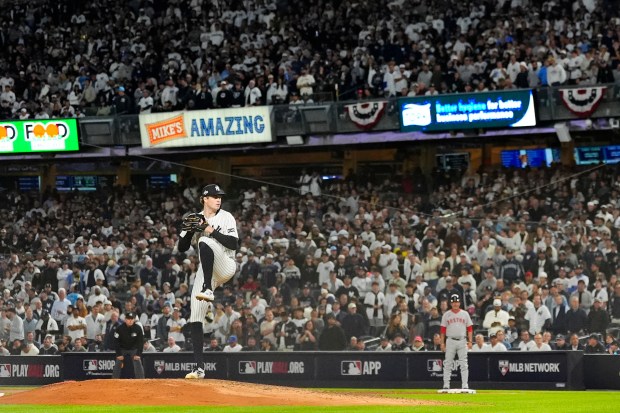 Over the past year Walpole’s Cam Schlittler has emerged as one of the top young pitchers in baseball. (AP Photo/Yuki Iwamura)
Schlittler on the rise
This time last year Walpole’s Cam Schlittler wasn’t really on anybody’s radar. The former Northeastern University standout was ranked outside all of the major top 100 prospect lists and was described by Baseball America’s scouting report as someone who projects as a back-end starter.
Now he might be on the verge of breaking out as a true ace.
Schlittler enjoyed a remarkable rise over the past year. After making his big league debut with the Yankees last July, he posted a 2.96 ERA with 84 strikeouts in 73 innings over his first 14 career starts. He then dominated his hometown ball club in the playoffs, ending the Red Sox’s season with eight shutout innings in the decisive Game 3 of the American League Wild Card Series, and followed that with another strong performance in Game 4 of the ALDS against the Blue Jays.
So far to start 2026 he’s shown no signs of slowing down.
Schlittler made the Yankees’ Opening Day rotation and has yet to allow a run through his first two starts. The 25-year-old struck out eight and allowed one hit with no walks over 5 1/3 scoreless innings in his season debut against the Giants, and last time out against the Mariners on Wednesday he struck out seven with two hits and no walks over 6 1/3 innings.
Schlittler has already become an incredible success story, and if he continues on his current trajectory he should have a long and bright future ahead of him. And with Max Fried already leading the charge and potentially soon a healthy Gerrit Cole as well, his ascension could give the Yankees a terrifying trio atop their rotation come playoff time.
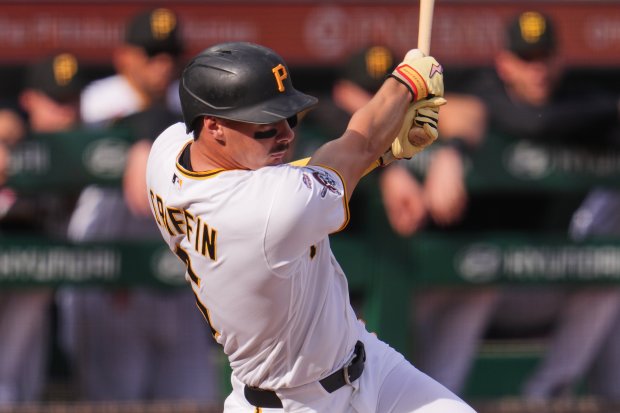 Pittsburgh Pirates rookie Konnor Griffin hits an RBI double in his first big league at-bat during the second inning of Friday’s game in Pittsburgh. (AP Photo/Gene J. Puskar)
Griffin arrives
It barely took a week for the Pittsburgh Pirates to make the call.
Konnor Griffin, a 19-year-old shortstop and MLB’s No. 1 prospect, officially made his big league debut during the Pirates’ home opener Friday afternoon. Griffin became the first teenage position player to appear in the big leagues since Juan Soto in 2019.
The promotion capped off a remarkable rise for Griffin, who was drafted No. 9 overall less than two years ago in the 2024 MLB Draft and has surged through the minors ever since.
He made an immediate impression as well, hitting an RBI double to the left-field gap in his first big league at-bat.
“It’s been an amazing journey, and I feel like I’ve grown so much as a player and as a person — just really been able to take it all in,” Griffin said during a press conference prior to his Friday debut. “And I’m glad I’m here today. I feel super ready for this moment.”
A five-tool phenom, Griffin was named Baseball America’s Minor League Player of the Year for 2025 after batting .333 with 21 home runs, 94 RBI, 65 stolen bases and a .941 OPS in 122 games split across three levels between Low-A and Double-A. He also won a minor league Gold Glove, and while he was optioned to Triple-A at the end of spring training, he quickly earned a shot after going 7 for 16 (.438) with three doubles, five walks and four strikeouts in his first five games.
Griffin gives the Pirates another young superstar to build around after more than a decade in the wilderness, and if he realizes his immense potential, Pittsburgh could wind up having not just the best pitcher in baseball with Paul Skenes, but the best position player as well.