
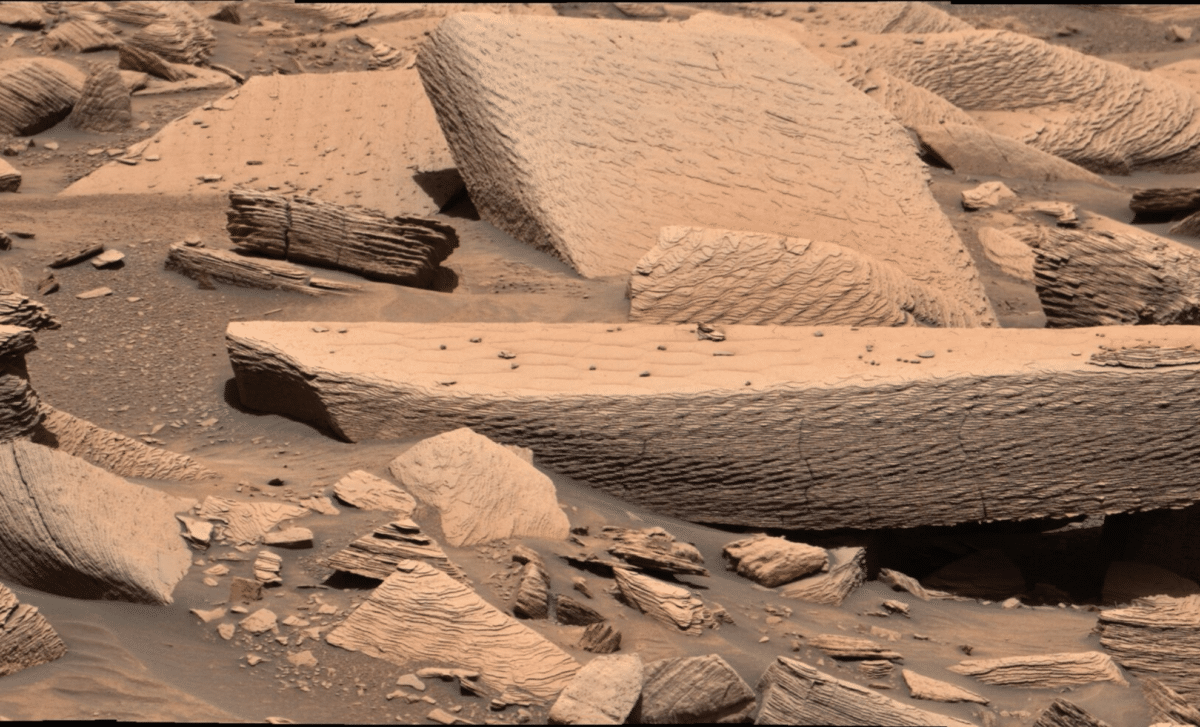
A chance observation by NASA’s Curiosity rover has uncovered the first direct physical evidence of an ancient Martian sandstorm, offering a rare glimpse into the planet’s climate more than 3.5 billion years ago. The findings, published in the journal Geology, reveal that Mars once had an atmosphere dense enough to drive powerful winds capable of reshaping its surface in dramatic ways.
A Rare Geological Signature Captured By Curiosity
The discovery centers on unusual ripple structures embedded in sedimentary rock inside Gale Crater, a region long studied for signs of past habitability. These formations, known as supercritical climbing wind ripples, are exceptionally rare and form under intense, fast-moving winds that transport large volumes of sand over short periods. On Earth, such structures are scarcely preserved, and until now, they had never been identified on Mars. Their presence provides a snapshot of a brief but powerful weather event that unfolded billions of years ago, capturing the dynamics of an ancient storm in remarkable detail.
“Everybody knows that the wind blew on Mars. There was an atmosphere, so it must have moved, forming breezes and gusts, and so there must have been storms, too. But this is the first definitive evidence that we’ve found of such a sandstorm,” says Steven Banham, a planetary geologist at Imperial College London and lead author of the new study. “While it does not contribute to proving the existence of life on Mars, it helps paint a rich picture of the ancient surface environment.”
These ripples appear as fine, crinkled laminations only millimeters thick, yet they encode a powerful environmental story. They suggest a sudden, high-energy event lasting minutes to hours rather than long-term climatic patterns. The implication is striking: Mars was not just a static, dusty world but one shaped by active and sometimes violent atmospheric processes.
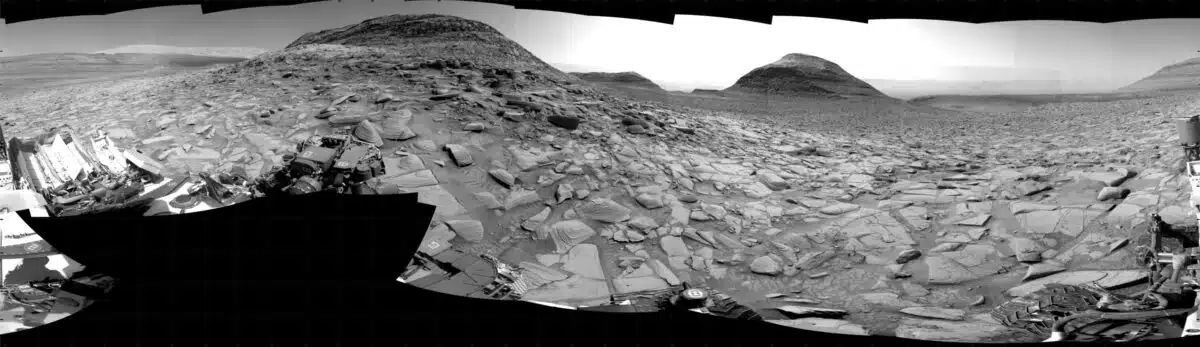 A wide view of the area where the Mars Science Laboratory science team discovered evidence of an ancient sandstorm.
Credit: NASA / JPL-Caltech
A Serendipitous Discovery On The Martian Surface
The finding was not the result of a targeted search but rather a moment of scientific intuition during routine rover operations. As Curiosity traverses the Martian terrain, teams of scientists analyze panoramic imagery taken after each drive. In one such dataset, researchers noticed subtle anomalies, textures that stood out from the surrounding geology. This prompted a closer look using the rover’s MASTCAM imaging system, which revealed the distinctive ripple patterns in high resolution.
“This was very serendipitous. We weren’t really looking for these deposits, and then, lo and behold, we drove around the corner and found them,” says Banham. “We were lucky that we had just the right people on shift that recognized them.”
Such moments highlight the human element behind robotic exploration. The identification required not just advanced instruments but also trained eyes capable of recognizing rare geological signatures. The discovery underscores how exploration often advances through a combination of planning and chance, where unexpected observations can redefine scientific understanding. It also demonstrates the continued value of Curiosity, more than a decade after landing, as it continues to reveal new aspects of Mars’ ancient history.
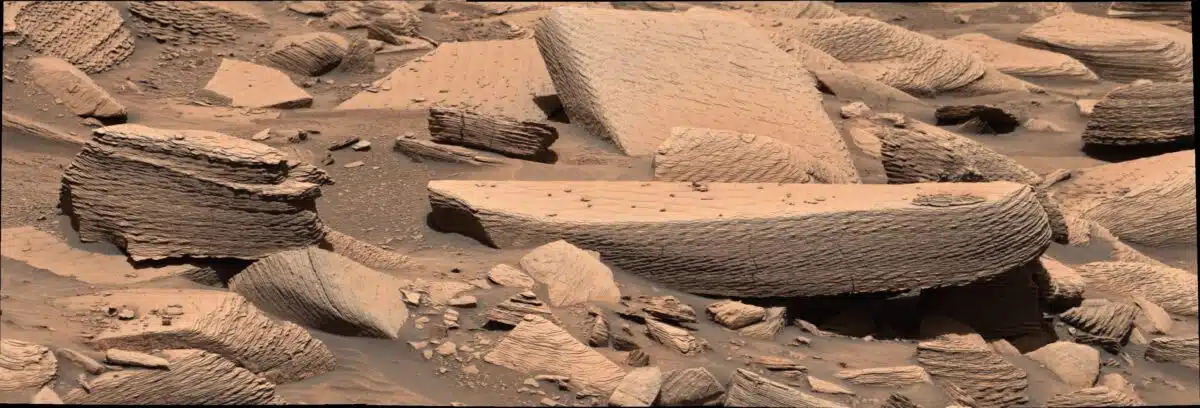 A closer view of the supercritical climbing wind ripples that provide direct evidence of a sandstorm, roughly three and a half billion years ago.
Credit: NASA / JPL-Caltech/MSSS
Evidence Of A Thicker Ancient Atmosphere
One of the most significant implications of these structures lies in what they reveal about the ancient Martian atmosphere. Today, Mars has a thin atmosphere, composed mostly of carbon dioxide, with surface pressure too low to move sand grains in the way observed in these formations. The newly discovered ripples suggest that conditions in the distant past were dramatically different.
“These deposits in themselves indicate that the atmosphere was denser at the time than it is now, to form these structures,” says Banham.
A thicker atmosphere would have supported stronger wind dynamics and potentially more stable surface water, reinforcing the idea that early Mars was more Earth-like than it is today. This aligns with other evidence from Gale Crater, including ancient river channels and lakebed sediments. Together, these findings point to a period when Mars had a more active climate system, capable of sustaining both liquid water and dynamic weather patterns. The study, published in Geology, adds a crucial piece to this puzzle by providing direct, event-scale evidence rather than long-term geological trends.
The Hunt For Rain And The Next Big Discovery
While wind-driven features are now confirmed, scientists continue to search for another elusive piece of Mars’ climatic history: direct evidence of rainfall. Orbital and rover data have already revealed valley networks and sedimentary deposits consistent with flowing water, yet physical traces of raindrop impacts remain undiscovered. Finding such evidence would provide definitive proof of precipitation, offering deeper insight into the planet’s hydrological cycle.
“People have been looking for those since Pathfinder and the MER rovers, and nobody’s seen them,” says Banham, referring to early Mars missions. “It must have rained, as we’ve seen evidence of rivers and lake deposits. But we’ve not got that definitive evidence of rain until we see rain impacts. That would be magic if we found those.”
The discovery of the sandstorm ripples raises expectations that similarly rare features may still be waiting to be found. Each new observation by Curiosity or future missions has the potential to uncover fleeting moments frozen in stone, moments that reveal how Mars once functioned as a dynamic planetary system. The Red Planet continues to surprise, not with grand landscapes alone, but with subtle geological clues that preserve entire events from a world long vanished.