
Here’s where batting has gone in IPL 2026. One opener hit a 15-ball fifty. Another hit seven of the 11 he faced to the boundary. As a team, 221 was chased down with almost an entire over to spare. 210 with nearly twice as much. It’s thrilling stuff.
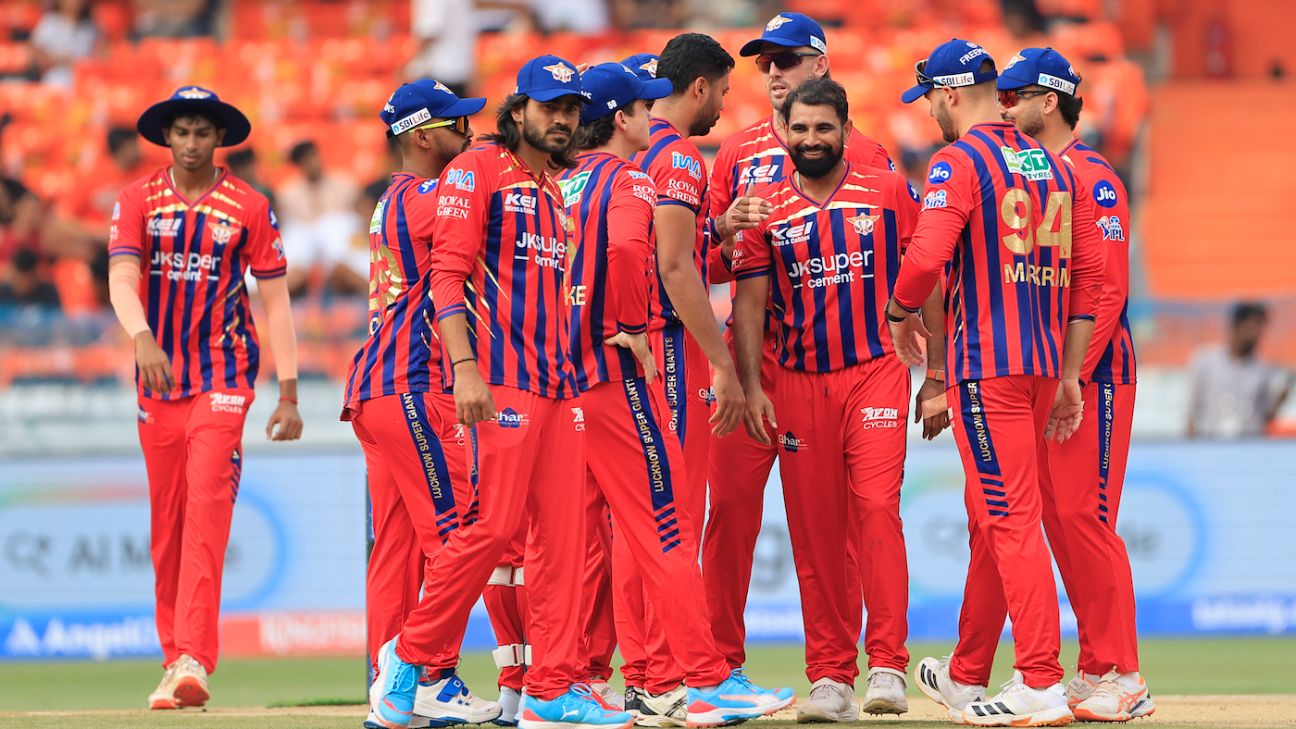
On Sunday evening, in Hyderabad, Mohammed Shami gave a glimpse of where bowling is going in response to this hyperattacking era of T20 cricket. He started the innings with a death over, going for three yorkers and a slower ball. This is significant. A bowler known for his swing and seam didn’t even try to play to his strengths. What he did instead was try and take away his opponent’s strengths.
Travis Head and Abhishek Sharma score their runs at a rate of 12.29. This is partly because they see good length balls and think that’s the bowler offering them leverage when he’s actually trying to hit the top of off. You know, like the textbook says except against guys like these the textbook is wrong.
Editor’s Picks
Shami turned 18 of his 24 balls into dots – the IPL record is 20 – and only nine runs were possible through the entire spell. It was the most economical one from a Lucknow Super Giants (LSG) bowler and in the top 20 across the history of this tournament. He’s keeping company with Lasith Malinga (4-0-9-3) and Zaheer Khan (4-1-9-2) and has one-upped Jasprit Bumrah (4-1-10-5).
There must have been a lot of planning involved to pull off something like that. During a dugout interview, the LSG coach Justin Langer said the captain Rishabh Pant took one look at the pitch and knew it would be slow and they needed an extra spinner. Shami basically bowled like one for the first two overs. Thought like one too. Just before the wicket ball, he made sure M Siddharth fielding at short third moved closer and finer. Shami had stifled the run flow until then. He knew Abhishek would be itching to go. He presented an offcutter away from his body. Nick. Catch. By the same fielder that he had only just precisely positioned.
That slower ball was pretty full. There was very little distance for it to travel before reaching Abhishek’s bat. On a flat surface, he probably would have mis-hit that for four. He was going so hard at it. This one had plenty of grip. It was really apparent in the Head dismissal. This time the batter actually clocked the change of pace. He slowed his downswing but not his intent. It was after all a length ball. Head was preparing to hit through the line – and cover – when the ball did two things he just couldn’t account for. It bounced waaay more and it deviated waaaay waaaay more than it had any right to. Head walked back miming the extra bounce with his hand.
Mohammed Shami dismissed Abhishek Sharma and Travis Head with cutters BCCI
At this point, Sunrisers Hyderabad were 9 for 2 after 2.1 overs and Shami reasoned that they would likely shift focus from attack to defence. Now he backed himself to bowl like the new-ball specialist he is, presenting that seam up, nice and proud, and getting decent away movement from the right-hander.
It may seem like batting skills have outstripped bowling skills – particularly fast bowling skills – in modern-day T20 cricket. And broadly, that is true only because there is more scope for invention with one than the other. There is more margin of error with one than the other. But as Shami showed on Sunday and Tushar Deshpande showed on Saturday and Lungi Ngidi showed during the T20 World Cup, these guys aren’t taking it lying down.
They’re setting aside their egos and lobbing up 115kph wiffle because they seem to work better than 150kph heat. They’re parking the lessons they learnt growing up – pitch it up, keep the stumps in play – for something more practical – go short and wide if you have a big square boundary in your favour. Dig into those yorkers early if you can keep the batter to a single.
In his heyday, Shami was called swinging Shami. That nickname reflects his attacking skills. Here he was yorker Shami. And slower-ball Shami. And not-letting-the-batters-hit-boundaries Shami. His performance highlighted his defensive skills and also how they are becoming far more valuable in T20 cricket than simply running in only looking for wickets.