
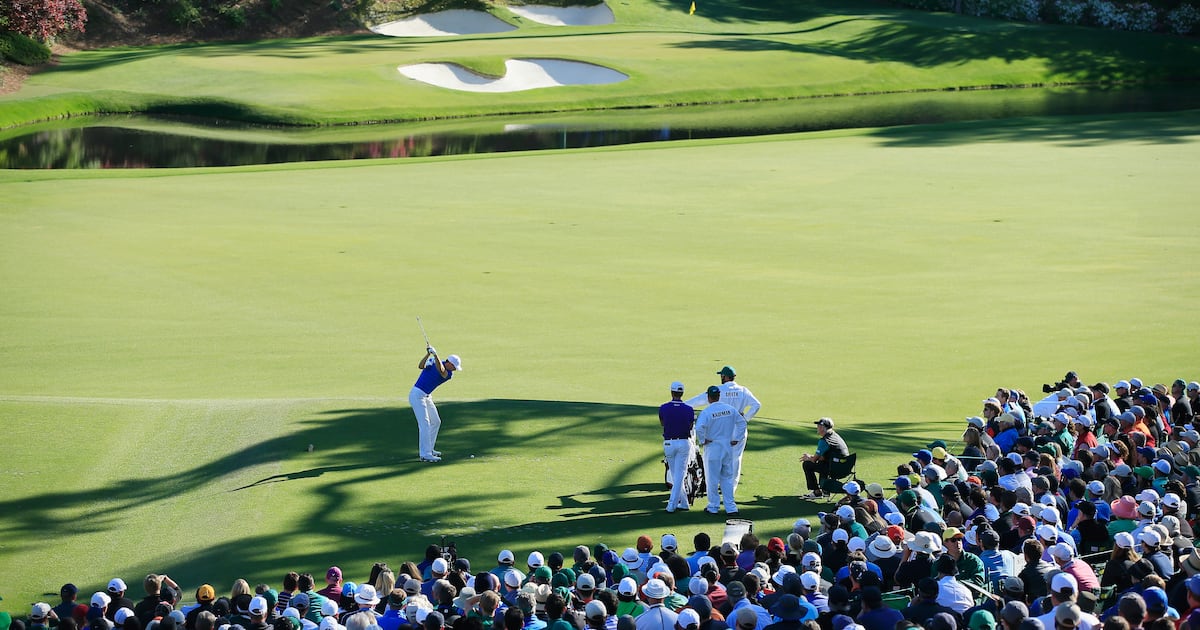
It is 10 years since Jordan Spieth collapsed on the back nine at the Masters. He reached the tenth tee on Sunday with a five-shot lead, and even though he bogeyed that hole, and the next, he could have absorbed those setbacks and still won. His chance, though, met a grisly end on the 12th, the shortest and sneakiest hole on the course.
Part of what makes Major golf such a compelling spectacle is the stalking prospect of calamity. Small ‘c’. The 12th at Augusta is not much longer than 150 yards, and in any other setting or in any other context, it would not be a menace to the best players in the world. Rory McIlroy has a 46-degree pitching wedge that will cover that distance with a smooth pass at the ball. With a club like that in their hands, the pros don’t expect trouble.
But the 12th at Augusta represents the essence of Major golf. Above all else, it is a mind game. It bends the players’ thinking. “Sometimes, I get there,” said Jack Nicklaus, six-time winner of the Masters, “and my hands just shake.”
Back in 2016, some of the back-and-forth on the tee between Spieth and his caddie Michael Greller was picked up on TV. Greller gave him the line (to the right of the CBS TV camera) and the club (a nine iron) but Spieth was not convinced. “Won’t this go over [the green]?” he said.
They agreed to hit a fade, but when Spieth stood over the ball he played a cut. It was the same shot that had landed him in Rae’s Creek two years earlier, when he was in contention in his very first Masters. He knew that was the wrong shot, but it was like the shot had possessed him and there was no time for an exorcism.
“I remember getting over the ball thinking ‘I’m going to go ahead and hit a little cut to the hole,’” said Spieth. “And that’s what I did in 2014, and it cost me the tournament then, too.”
For the penalty drop, they paced out 80 yards so that they could play a shot with spin. Instead Spieth hit the ball so fat that it barely reached the water. It was the kind of shot that any of us could have played without blinking.
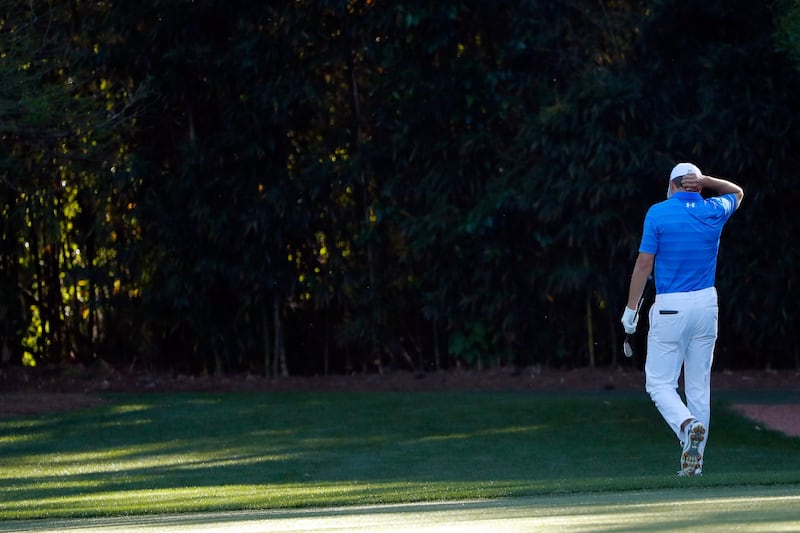 Jordan Spieth of the United States reacts on the 12th hole during the final round of the 2016 Masters Tournament at Augusta National Golf Club on April 10, 2016. Photograph: Kevin C Cox/Getty Images
But Spieth was the defending champion and one of the best wedge players in the world. The pressure of trying to win a Major had turned a pretty par 3 into Dante’s nine circles of Hell. He signed for a quadruple bogey seven.
“That hole, for whatever reason, just has people’s number,” Spieth said later.
You wonder how much of that subliminal terror is passed down, ever before it is experienced. Before McIlroy’s first Masters appearance in 2009 he was asked about which hole “scared” him the most in his practice rounds. He recoiled from the suggestion of fear, but in answer to the question he nominated the 12th. Like generations of others, he was spooked by the swirling winds.
“You get on the 12th tee and you look at the 11th pin and it’s blowing down,” he said. “You look at the 12th pin and it’s blowing into you and you’re like, ‘What am I going to do here?’”
In his first 34 attempts McIlroy birdied the hole just twice, and when he suffered his back nine meltdown while in the lead at the 2011 Masters, the 12th finished him off. Having trashed the 10th and bogeyed the 11th he took four putts from less than 12 feet on the hole cutely named after a flower, Golden Bell.
The green on the 12th is the flattest on the course but in the Sunday pin position in the front right quadrant the light is disturbed by towering trees. “A lot of times you go from sunshine to shadow to sunshine,” said Patrick Reed, “and trying to read putts through different light makes it a lot more difficult.”
All of it feeds into the psychological warfare. The 12th preys on doubt.
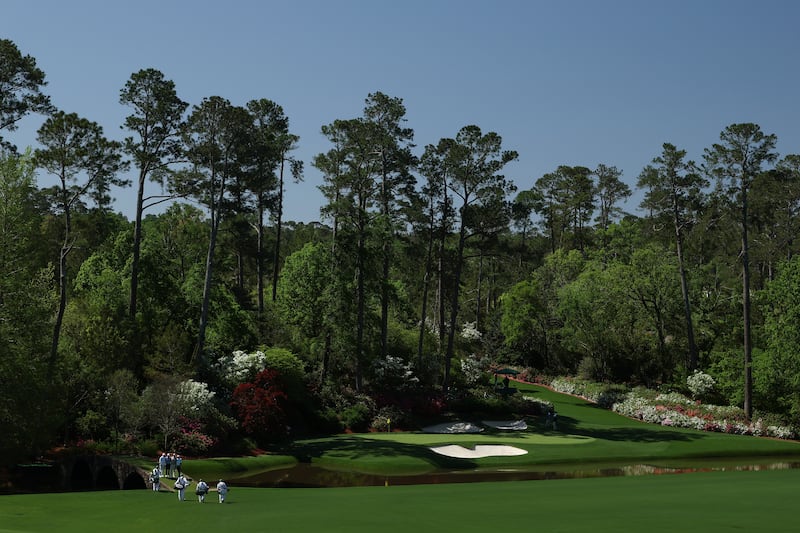 Fred Couples, Brooks Koepka, Justin Thomas and Adam Scott stand on the Hogan Bridge at the 12th hole during a practice round prior to the 2025 Masters Tournament at Augusta. Photograph: Richard Heathcote/Getty Images
Part of its terrible beauty is that it hasn’t been changed in any significant fashion since 1965. The game has turned many revolutions since then, with more compliant golf balls and more forgiving equipment and over the last couple of decades, an array of holes at Augusta have been lengthened to stiffen the course’s defence against bombers off the tee.
But the 12th has not been subjected to any architectural adjustment in more than 60 years. Back in 1965, they raised the surface of the green by 18 inches, and put in split level tee boxes, side by side.
So, over the years the picture hasn’t changed: a shallow green, protected by three bunkers and a shaved bank to the front that slides down to Rae’s Creek. It is a repeat exam.
And yet, year after year, players stand on that tee-box tormented by second-guessing. They know the numbers and they can visualise the shot, but that frequency in their mind is jammed with static.
Through the decades, it has claimed a gallery of stellar victims. In the first two rounds of the 1980 Masters, Tom Weiskopf took 20 shots to play the hole, adding a 13 to a 7. In 1952, Gene Sarazen hit three balls into the creek, finished with an eight and withdrew from the tournament.
In 1959, Arnold Palmer was seeking back-to-back Masters, just as Spieth was in 2016, and he had a two-shot lead in the final round standing on the 12th tee; he took a triple bogey and couldn’t recover.
Sixty years later, Francesco Molinari also stood on that tee box with a two-shot lead in the final round and, like so many others, he didn’t commit to the shot. He tried to play a “chippy” eight iron instead of a hard nine-iron and it came to rest in the creek.
When Tiger Woods took a 10 there in 2020, he wasn’t in contention, but he was the defending champion. It is the biggest number he has ever racked up in a Tour event. Woods put the ball in the water twice without crossing the Ben Hogan bridge and put it in the creek for a third time from a horrendous lie in the back bunker. He skulled it across the green, just like any of us would.
That is what Majors do.