

Just nowMon 6 Apr 2026 at 6:59pmMessages from Apollo legends

Overnight, the crew woke on their sixth flight day to a recorded message from the late Apollo 8 and 13 astronaut Jim Lovell.
“Welcome to my old neighborhood,” said Lovell, who passed away last year aged 97.
“It’s a historic day, and I know how busy you’ll be, but don’t forget to enjoy the view… good luck and godspeed.”
Yesterday, they had woken to a message from Apollo 16 astronaut Charlie Duke, who is still alive.
“On the Moon is a photo of my family,” he said in the recording.
“I pray it reminds you that we — and America, and all of the world — are cheering you on.”
It’s fitting that the crew hears these words as they close in on their lunar destination, linking the past and present of human spaceflight.
12m agoMon 6 Apr 2026 at 6:46pm
Why Artemis II offers rare glimpse of Moon’s far side
If other missions have circled the moon why is this mission seeing parts of the moon never seen before?
– Peter Roebers
Good question, Peter.
The journey promises glimpses of the Moon’s far side that were too dark or difficult to make out during the previous Apollo missions.
Because of the current mission’s April 1 launch, not all of the far side will be illuminated for the Artemis II crew either but the lighting conditions are expected to be more favourable.
NASA geologist Kelsey Young says the crew should still be able to see “definite chunks of the far side that have never been seen” by humans — including large sections of the Orientale Basin.
The basin known as the Moon’s “Grand Canyon” sits on the very edge of the near side, so it has been hard to observe.
23m agoMon 6 Apr 2026 at 6:35pmWhy do the astronauts keep calling the Orion spacecraft ‘Integrity’?
If you’ve been listening to NASA’s YouTube livestream, you might have heard the crew referring to the Orion spacecraft as “Integrity”.
Just moments ago, they also named a crater on the Moon “Integrity” to mark the milestone of breaking the distance record.
According to NASA, the crew chose this name for their home away from home because it “embodies the foundation of trust, respect, candor, and humility” of the teams behind the mission.
Meanwhile, the name of the mission — Artemis — relates to Greek mythology.
 In Greek mythology, Artemis is the goddess of the Moon and the twin sister of Apollo. (Source: ABC News)
Artemis is one of the principal Olympian deities and is the goddess of the hunt, wilderness, wild animals, chastity, and — most importantly for this purpose — the Moon.
Artemis is also the daughter of Zeus and the twin sister of Apollo, who was the namesake of the last NASA missions that went to the Moon.
28m agoMon 6 Apr 2026 at 6:30pm
A birthday to remember
Watching these events unfold on YouTube in the early hours of my birthday. Feeling a bit emotional. This is one birthday I won’t forget.
– Dani
That’s a pretty special way to ring in a birthday. Watching history unfold in real time — and feeling it — is something else.
Happy birthday, Dani!
49m agoMon 6 Apr 2026 at 6:09pmCrew emotional as ‘bright spot’ on the Moon named after commander’s late wife Reid Wiseman was emotional as he named a crater on the Moon after his late wife. (Source: NASA TV)
To mark the new distance record set by Artemis II, the crew have decided to name two craters on the Moon.
The first one they suggest naming “Integrity” — the same name they gave their Orion spacecraft.
The crew have also decided to name “a bright spot” on the Moon after Commander Reid Wiseman’s late wife.
“We lost a loved one, her name was Carroll,” Wiseman says, in tears.
“The spouse of Reid, the mother of Katie and Ellie.”
The three other crew members pat him on the back and Christina Koch wipes away her own tears.
“There’s a feature in a really neat place on the Moon,” Wiseman says.
“And it is on the near side, far side boundary … so at certain times we will be able to see this from Earth.
“It’s a bright spot on the Moon and we would like to call it Carroll.”
59m agoMon 6 Apr 2026 at 5:59pmHistory made: Artemis II breaks distance record
It’s official — Artemis II has just taken humans farther from Earth than ever before.
The crew has now passed the 400,171-kilometre mark set by Apollo 13 in 1970, setting a new record for the most distant humans in history.
It’s a milestone more than half a century in the making — and a defining moment for NASA’s return to deep space.
From here, the spacecraft will continue to push outward and around the Moon.
Artemis II is expected to reach a maximum distance of 406,773 kilometres at around 09:07am AEST.
1h agoMon 6 Apr 2026 at 5:57pm
Humanity is less than 2 minutes away from breaking the record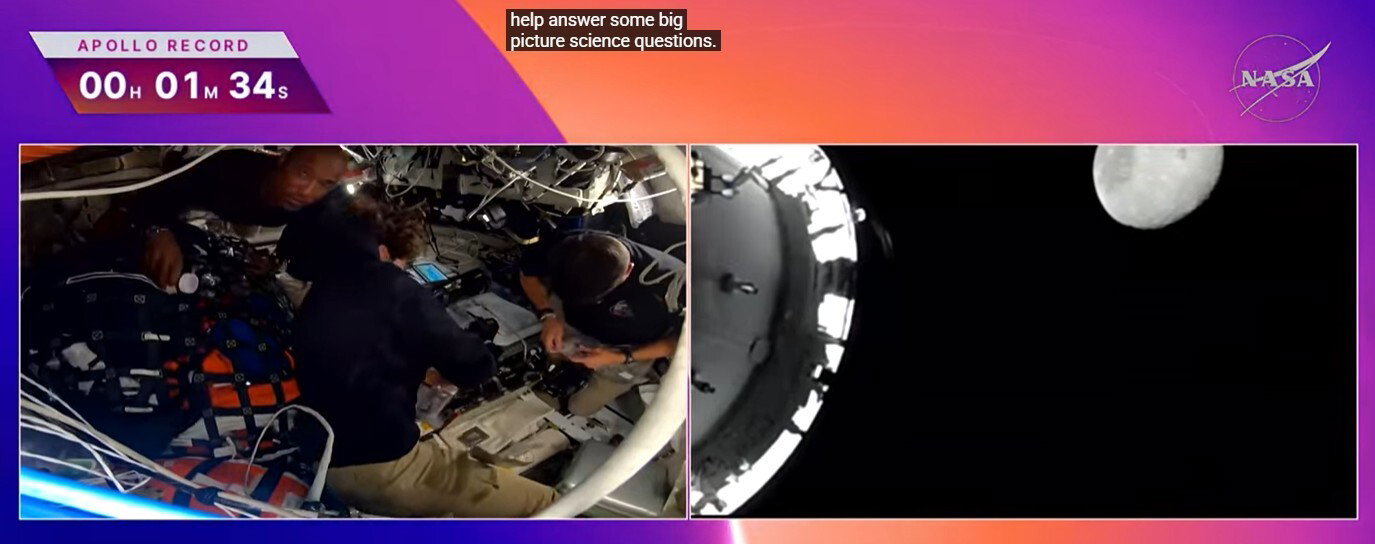 (Source: ABC TV)1h agoMon 6 Apr 2026 at 5:50pmHow to follow along in real-time
 The Artemis II crew answers questions from reporters during the first downlink event of their mission. (Source: NASA)
Live coverage of the mission is continuing on NASA’s YouTube channel as the Artemis II crew prepare for their historic lunar flyby.
The agency also provides a separate stream showing views from the Orion spacecraft — including inside the capsule — as bandwidth allows.
The latest imagery is also being published online throughout the mission.
NASA is holding daily mission briefings from its Johnson Space Center in Houston through to splashdown, with the exception of today, when the flyby is underway.
The crew is also taking part in a series of live conversations as the mission progresses.
In fact, we’re expecting to hear from the crew shortly at 4:10am AEST (Australia time), just before the flyby begins.
1h agoMon 6 Apr 2026 at 5:45pmApollo 13’s distance record was an accident

The crew on Apollo 13 had never planned to be so far from the Moon — especially not so far that they would set a distance record that would stand for 56 years.
Dubbed NASA’ greatest “successful failure”, the record only happened because of an emergency on board the spacecraft on its way to the lunar surface in 1970.
After an oxygen tank exploded, the Apollo crew cancelled their Moon landing and instead looped around the celestial body so they could return quickly back to Earth.
 The Apollo 13 crew after safely touching down in the Pacific Ocean. From left: Fred Haise, John Swigert, and James Lovell. (Source: NASA)
While the mission was particularly hard on the astronauts — who suffered from a cold cabin and not having enough water — all three made it home safely.
We’re glad that Artemis II’s new record is happening under much better circumstances!
1h agoMon 6 Apr 2026 at 5:33pmWhere is the Artemis II crew right now?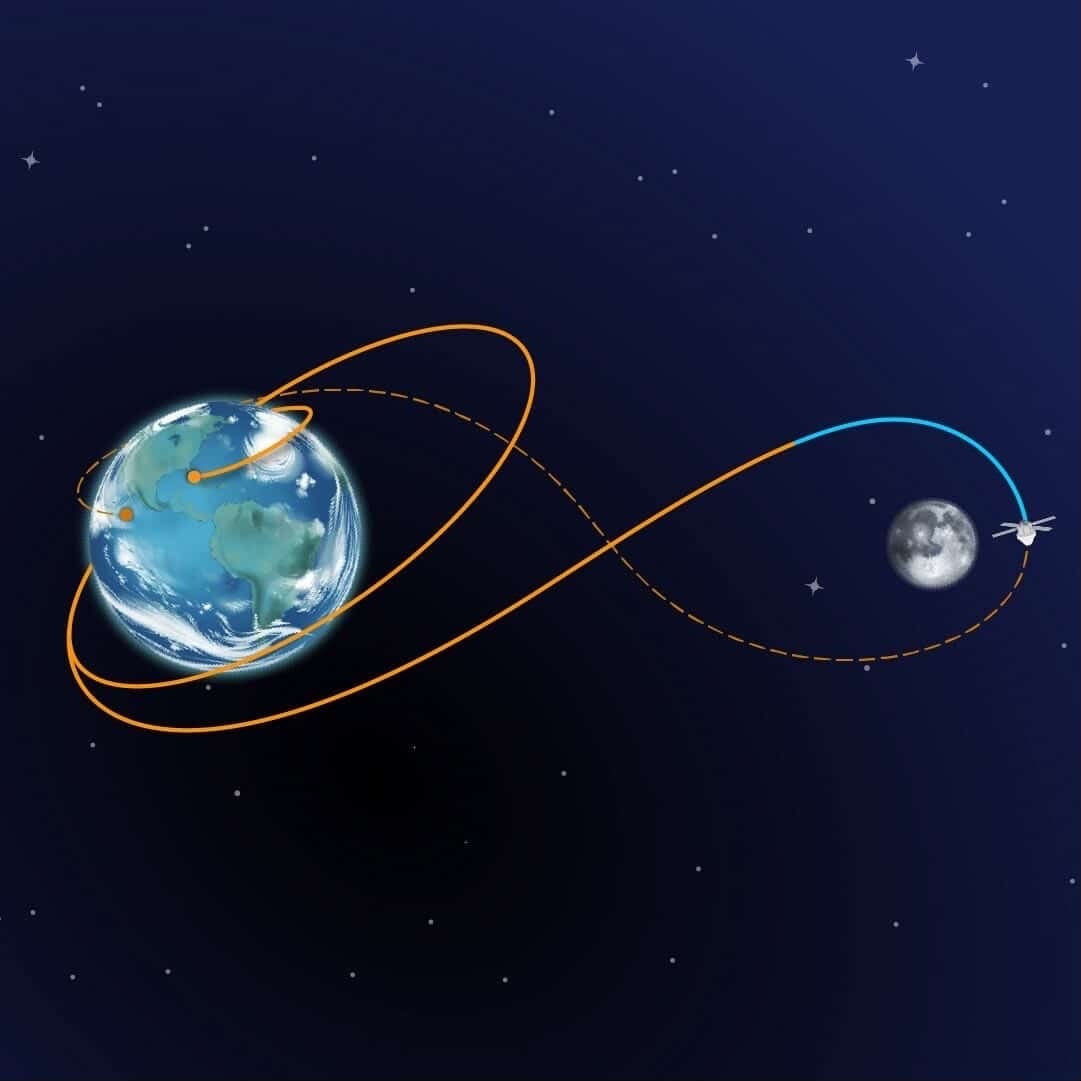 The blue line shows the journey the Artemis II crew has been on since 1:30am AEDT (Australia time). (Source: Canadian Space Agency)
Right now, the Artemis II crew is closing in on the Moon as it prepares for its lunar flyby, beginning at 4:45am AEST today (Australia time).
After six days in space, the Orion capsule has already crossed into the “lunar sphere of influence”, where the Moon’s gravity pulls more strongly on the spacecraft than Earth’s.
1h agoMon 6 Apr 2026 at 5:28pmWelcome to our live coverage
Good morning. I’m Audrey Courty, and we’re about to witness a record-breaking moment in spaceflight.
As Artemis II swings around the Moon, its crew is set to travel farther from Earth than any humans in history — pushing beyond the 400,171 kilometres reached by Apollo 13 in 1970.
This mission is expected to top that shortly, at around 3:56am AEST (Australia time).
The crew will then mark the milestone with a live conversation at 4:10am AEST — just moments before they begin their six-hour flyby around the Moon.
Stay with us as it happens.