

Steven LynchApr 7, 2026, 12:23 PM
CloseSteven Lynch won the Wisden Cricket Monthly Christmas Quiz three years
running before the then-editor said “I can’t let you win it again, but would
you like a job?” That lasted for 15 years, before he moved across to the
Wisden website when that was set up in 2000. Following the merger of the two
sites early in 2003 he was appointed as the global editor of Wisden
Cricinfo. In June 2005 he became the deputy editor of Wisden Cricketers’
Almanack. He continues to contribute the popular weekly “Ask Steven”
question-and-answer column on ESPNcricinfo, and edits the Wisden Guide to
International Cricket.
Multiple Authors
The most recent Test match anywhere was in Sydney in January, and the next one isn’t until June. Is this the longest such gap between games? asked Eddie Powell from England
The exciting fifth Ashes Test ended in Sydney on January 8, and the next one isn’t due to begin until June 4, when England take on New Zealand at Lord’s. That’s a gap of 148 days – almost five months.
Since the Second World War ended in 1945, there have been only two longer periods without an official Test match. The longest such gap was 262 days – nearly seven months – in 1970, between the end of the South Africa-Australia series on March 10, and the start of the Ashes in Australia on November 27. There were no official Test matches in England in the summer of 1970, after a South African tour was cancelled and replaced by a series against the Rest of the World. These matches were billed as full Test matches – and treated as such in Wisden for several years – but were eventually ruled to be unofficial.
The other longer post-war gap was one of 176 days – almost six months – between India’s historic victory over England at The Oval (August 24, 1971) and the start of West Indies’ home series against New Zealand (February 16, 1972). Much of this break can be accounted for by the cancellation of the proposed South African tour of Australia, which was also replaced by an unofficial series against a World XI.
The two World Wars meant there were no Tests at all between March 1914 and December 1920, and August 1939 and March 1946. Apart from that, the longest period without a Test since the first one in March 1877 was a gap of 28 months between August 1899 and December 1901.
I noticed that Shardul Thakur is now playing for his seventh different IPL team. What’s the record? asked Santosh Nadeem from India
You’re right that Shardul Thakur has just made his debut for the Mumbai Indians – his hometown team – after 57 previous appearances for Chennai Super Kings (2018-24), 14 for Delhi Capitals (2022), 12 for Rising Pune Supergiant (2017), 11 for Kolkata Knight Riders (2023), ten for Lucknow Super Giants (2025), and a solitary game for Kings XI Punjab in 2015.
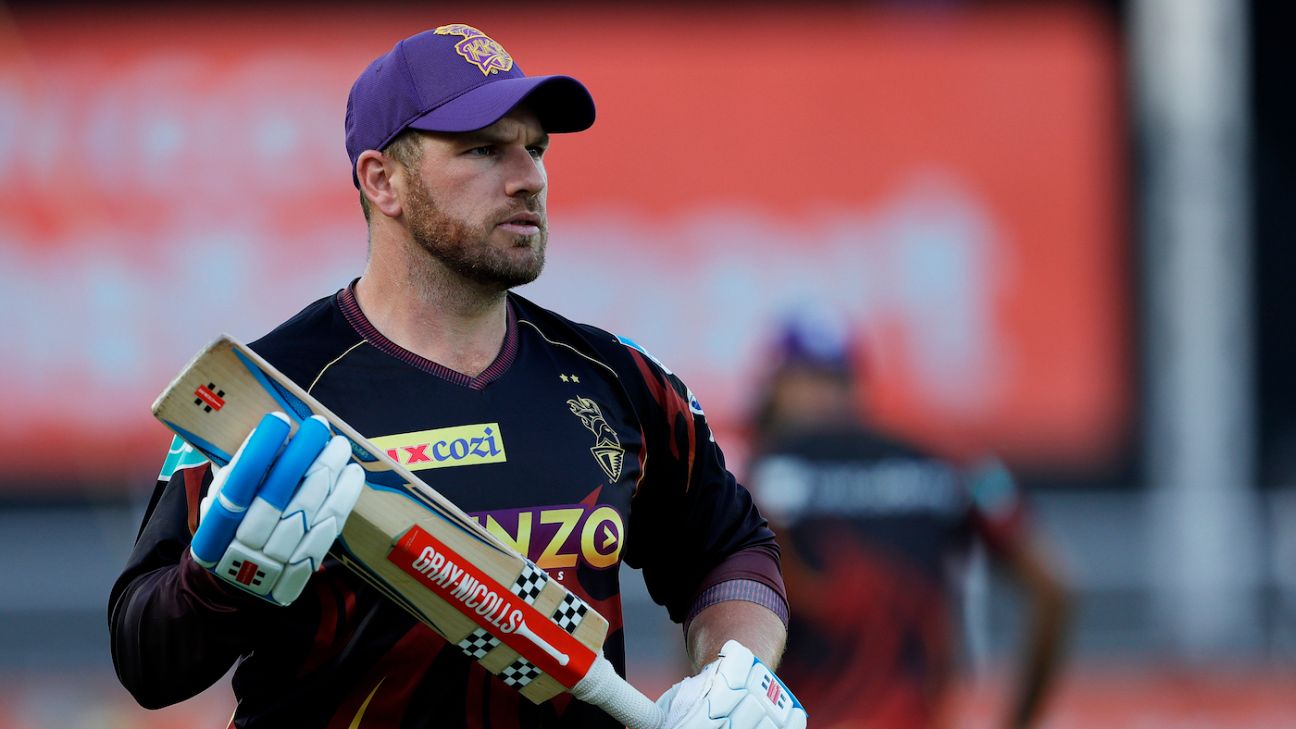
Thakur is one of three men to have played for seven different IPL teams, the others being Ishant Sharma and Manish Pandey. Left-arm seamer Jaydev Unadkat, meanwhile, has played for eight. But the overall record is nine, by the Australian opener Aaron Finch, whose 92 IPL appearances came for Gujarat Lions (26), Pune Warriors (14), Sunrisers Hyderabad (13), Royal Challengers Bengaluru (12), Kings XI Punjab (ten), Delhi Daredevils (eight), Kolkata Knight Riders (five), Mumbai Indians (three), and Rajasthan Royals (one match – his debut in 2010).
Kayla Reyneke hit a six off the last ball of the game to complete victory in both her first T20 and one-day international. This must surely be a unique double? asked Mike Browne of South Africa
Not surprisingly, you’re right in thinking that the feat of 20-year-old Kayla Reyneke is an unmatched double. She made her debut for South Africa in a T20I against Pakistan in Potchefstroom in February 2026; two runs were required from the last ball of the match, from medium-pacer Humna Bilal – another debutant – and Reyneke smashed it over extra cover for six. She’d earlier taken 2 for 13, and picked up the match award.
Around six weeks later, at the end of March, Reyneke made her one-day international debut against New Zealand in Christchurch. New Zealand reached 268, and Reyneke was again in at the end of the chase. This time she needed six off the last ball – and smoked Suzie Bates over the long-on rope to seal a two-wicket victory. “To finish it off that way was pretty cool,” she said. “I was just thinking six runs. I wanted a stable base and to hit through the line.”
The only other instance of a debutant hitting the last ball of their first one-day or T20 international for six to win appears to have been by the Pakistan spinner Zulfiqar Babar, in a T20I against West Indies in Kingstown (St Vincent) in July 2013. He only needed a single off the last ball, from Marlon Samuels, but smacked it over long-off for six.
Sanath Jayasuriya congratulates Muttiah Muralitharan AFP
Which pair has played the most Tests together without ever batting together? I was wondering about Matthew Hayden and Glenn McGrath of Australia? asked Noor Alameen from Bangladesh
That’s a pretty good guess, as Matthew Hayden and Glenn McGrath played 69 Test matches together for Australia. But actually they batted together once – against India in Chennai in 2001, when Hayden was the last man out – for 203 – in the first innings.
The runaway leaders in this regard are the distinguished Sri Lankans Sanath Jayasuriya and Muthiah Muralidaran, who were in the same team for 90 Test matches but never batted together. They also head the ODI list – 318 matches as team-mates, but never shared a batting partnership.
A long way behind in Tests in the South African pair of Herschelle Gibbs and Makhaya Ntini, who never batted together in 64 matches; Alastair Cook and Graeme Swann of England are next with 60. In ODIs, Adam Gilchrist played 170 with Glenn McGrath and 153 with Brett Lee, and never batted with either of them. The T20I record is currently 81 matches, by Paul Stirling and Josh Little of Ireland. The Malaysian brothers Virandeep and Pavandeep Singh have played 80 T20Is without batting together, as have Pavandeep and Sharvin Muniandy.
Brian Lara made the highest two individual scores in Tests at the Antigua Recreation Ground. Is there anywhere else where one batter made the highest two highest scores? asked Stuart McKenzie from England
Brian Lara made 375 at the Antigua Recreation Ground in St John’s in April 1994, and bettered that ground record ten years later with 400 not out, also against England. Lara is indeed the only man to have recorded the highest two individual Test scores on a single ground.
There are a few near-misses. The following have made the highest and third-highest Test scores on the same ground: Sri Lanka’s Marvan Atapattu at the Asgiriya Stadium in Kandy; Don Bradman of Australia at Headingley (Leeds); Afghanistan’s Rahmat Shah in the only Test so far at the Rajiv Gandhi Stadium in Dehradun; Kane Williamson for New Zealand at Seddon Park in Hamilton; Sri Lanka’s Upul Tharanga in the only Test to date at the Shaheed Chandu Stadium in Bogra (Bangladesh); and Mahela Jayawardene of Sri Lanka at the Sinhalese Sports Club in Colombo (where Kumar Sangakkara lies second, fourth and sixth). Sachin Tendulkar made the second-, third- and fourth-highest scores at the Vidarbha CA Stadium in Nagpur, where Andy Flower’s 232 not out for Zimbabwe in 2000 leads the way.
Shiva Jayaraman and Sampath Bandarupalli of ESPNcricinfo’s stats team helped with some of the above answers.
Use our feedback form, or the Ask Steven Facebook page to ask your stats and trivia questions