
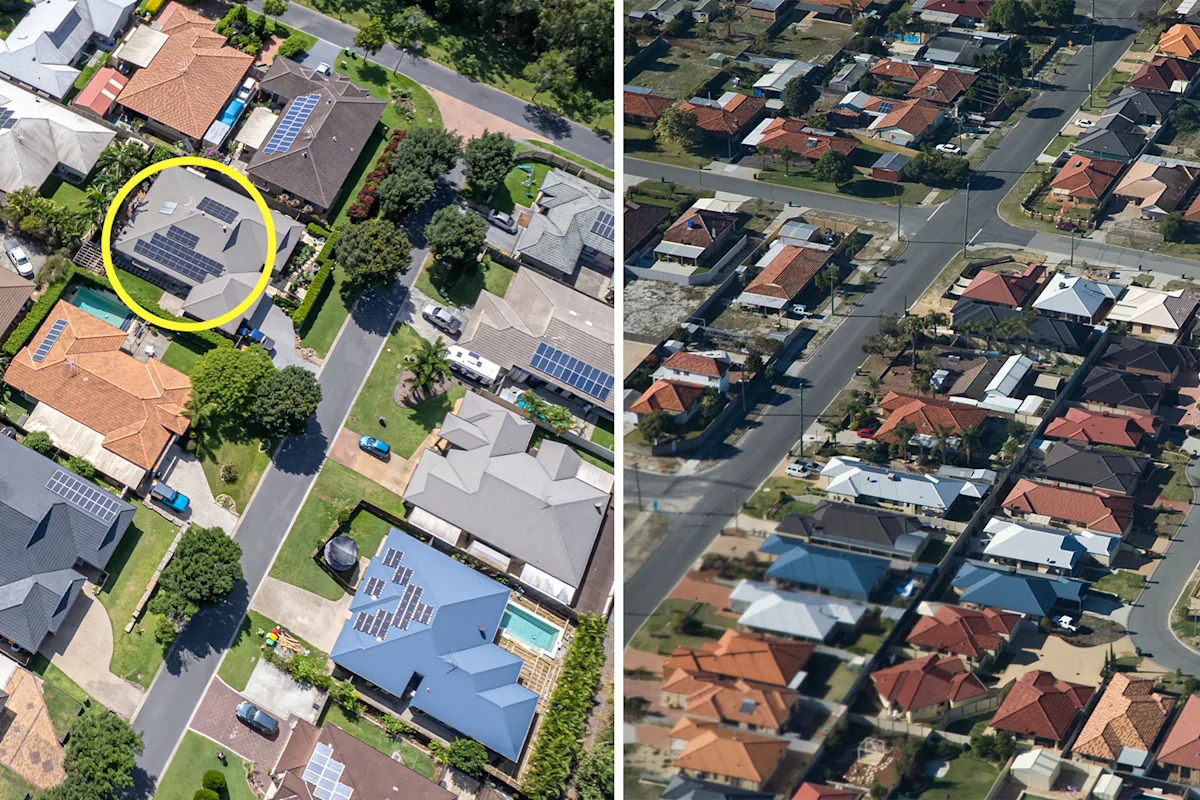
As energy prices continue to soar, more than 4.3 million Aussies have added solar panels to their homes to bring down their power bills.
But at $5,000 to $10,000 for a basic system, the investment isn’t small, and so households rightfully expect quality solar panels to last at least 20 years.
But for millions of Australians, that period will be much shorter, particularly if they’ve purchased newer models.
Some could see their panels expire in just 10 years, particularly in regions further north.
The problem is being caused by ultraviolet (UV) radiation, something Aussies are familiar with, as it causes 95 per cent of skin cancers.
New research by the University of NSW has found this light isn’t just harming our bodies, it’s degrading the solar panels on our homes as well.
The author of the new study, Dr Shukla Poddar, told Yahoo News that some are burning out seven to 10 years faster than expected.
“Maybe we are getting five per cent more energy, but it’s also reducing the longevity of the module, because UV is harmful,” she said.
Dr Poddar’s research is increasingly finding that Australia’s harsh environment is having a bigger impact on panels than manufacturers predict during lab testing.
Her 2024 research revealed that solar panels decayed faster around Sydney, Brisbane and Perth than in more temperate Melbourne, Hobart, and Adelaide.
In those cases, the problems included moisture, heat, and sunlight.
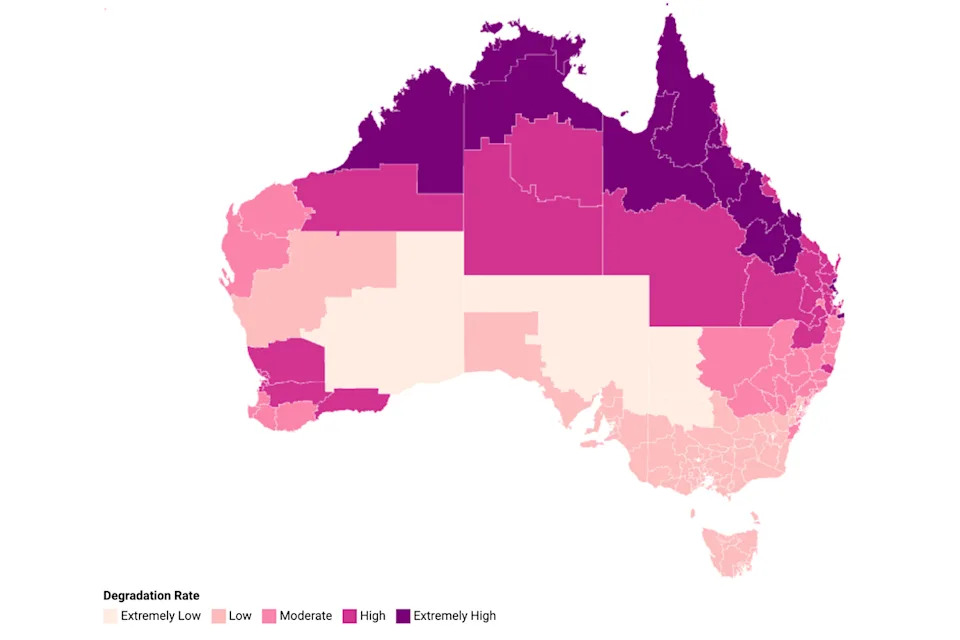
A 2024 study found degradation rates of solar panels was higher in the country’s north. Source: UNSW
Why is UV suddenly so damaging to solar panels?
The problem with UV has emerged over the last seven years, with the rollout of fancy new Heterojunction (HJT) and TOPCon modules, also known as N-Type panels.
Dr Poddar predicts that newer models, which are predicted to be 35 per cent more efficient, will also have the same problem.
The issue is particularly bad in arid outback areas like Alice Springs, but the issue extends beyond Australia, with Sub-Saharan Africa, parts of China, India, the southern United States, and the Atacama Desert in northern Chile also badly affected.
As climate change worsens in these regions, the problem will continue to escalate.
To extend the life of solar systems, the modules will need to be redesigned. And this means testing them in arid and semi-arid environments, not just the standard 25 degrees over 60 days.
In the short term, some solar farms in harsh environments have been trialling UV blockers to reduce exposure, but more research is needed to determine whether they are blocking other types of light.
Can the problem be fixed?
Dr Poddar believes another way to prolong the life of panels that are susceptible to UV is better tracking systems, which steer them away from the sun, rather than towards it, during the hottest days.
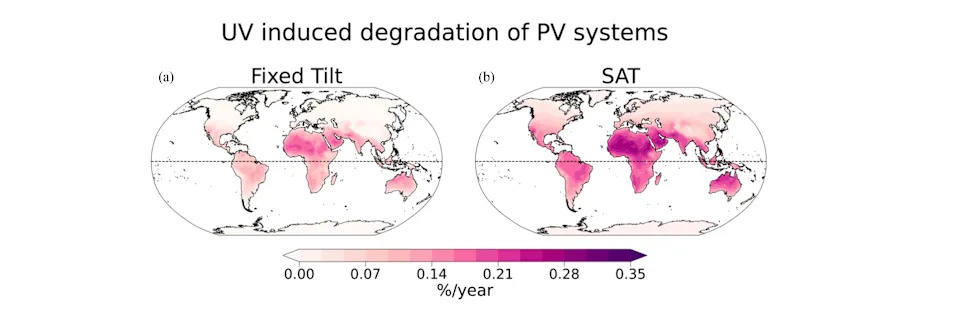
This chart shows the difference in degradation caused by UV on fixed-tilt versus single-axis tracking (SAT). Source: UNSW
The research found single-axis tracking systems, which are designed to follow the sun, had higher exposure than those that are fixed in one position.
“There’s a lot of scope for improvement, and we just want to make sure in the next five to 10 years, we’re in a better place,” she said.
The new research was published in the IEEE Journal of Photovoltaics.
Do you have a story tip? Email: newsroomau@yahoonews.com.
You can also follow us on Facebook, Instagram, TikTok, Twitter and YouTube.