
The cancellation of the Bahrain and Saudi Arabian grands prix due to the ongoing US-Israel war on Iran leaves Formula 1 facing a surprise break.
F1 should have this week been heading to Bahrain for the start of a double-header in the Middle East, and the fourth and fifth rounds of the 2026 season. But the forced cancellation of both races has resulted in a five-week break without any competitive on-track action through the month of April.
The double-whammy cancellation has several consequences on both the logistical and sporting side that will impact every team, and that could potentially shape the rest of the season…
Two fewer races before F1 engine rule change
The first, and most obvious consequence, is the immediate loss of two races. This has left a hole in the F1 2026 calendar between the Japanese Grand Prix on 29 March and Miami Grand Prix on 3 May.
Across a seven-week period, there will be just one race with a three-week break already planned following Miami and Canada. F1 will not replace either Bahrain or Saudi, meaning the calendar will be reduced from 24 races to 22. There is a financial impact to consider as well, with F1 facing a reported combined loss of $100m in hosting fees.
Article continues below ADVERTISEMENT
Article continues below ADVERTISEMENT
In a sporting context, this is bad news for Mercedes. The Silver Arrows have made a perfect start to 2026, winning all three grands prix so far, as well as the Shanghai sprint.
Given its early supremacy over the field, Bahrain and Saudi would have likely provided Mercedes with two more wins and a chance to further extend its advantage at the top of both world championships.
“I think we would have maybe wished that it continued over into the two Middle Eastern races and we could score a few more points,” Mercedes boss Toto Wolff said half-jokingly after the Japanese GP.
Additionally, there are two fewer races for Mercedes to enjoy a suspected performance benefit before a tweak to the compression ratio limit comes into force from 1 June.
The topic of compression ratios proved a controversial political battleground that dominated pre-season headlines. Mercedes’ rivals have succeeded in securing a rule change they believe will wipe out any advantage the German manufacturer is accused of having.
Article continues below ADVERTISEMENT
Article continues below ADVERTISEMENT
The tweak will affect everyone as all 11 teams will have to comply with the new compression ratio test from the aforementioned date, but the rule change could have a direct impact on the competitive picture. Rival teams are certainly hoping it will peg Mercedes back.
Extra time for upgrades and learning 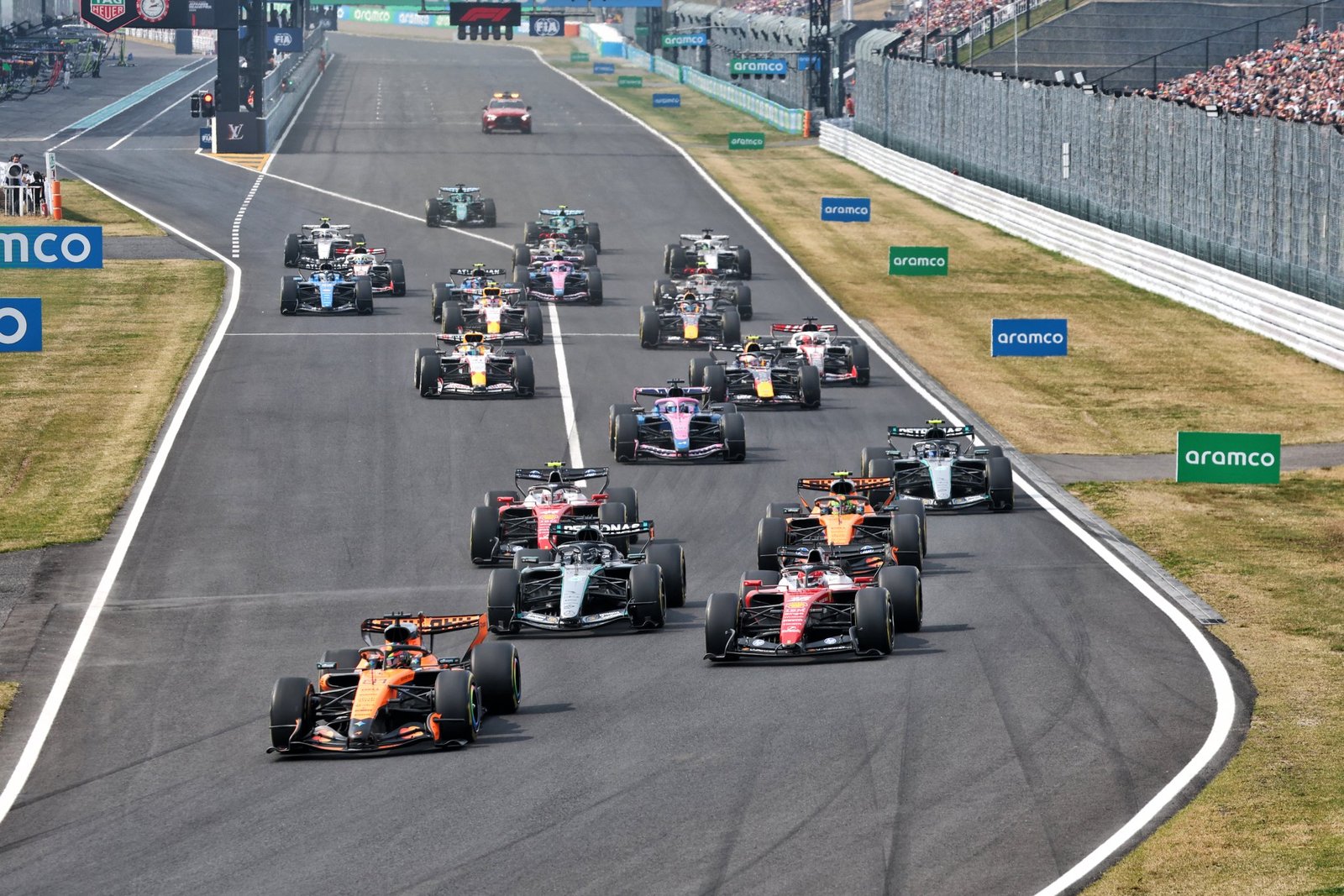
Piastri takes the lead at the start of the Japanese Grand Prix
One major positives for perhaps every team other than Mercedes is the additional time the unplanned break will provide to focus on improving their respective 2026 challengers.
While Mercedes is arguably the biggest loser of the five-week gap, it will give the likes of Ferrari and McLaren a chance to try and close the gap by working on upgrades. Ferrari is already understood to be working on a sizeable package for introduction in Miami.
As well as the chance to work on aerodynamics, it will also give teams precious time to understand and optimise their energy management and complex engine systems better.
Article continues below ADVERTISEMENT
Article continues below ADVERTISEMENT
McLaren already appears to have made encouraging progress in this area during the two-week break between the Chinese and Japanese grands prix, leading to a stronger performance at Suzuka as the British squad proved to be Mercedes’ nearest challenger. With an additional five weeks of learning to take advantage of, this could be more bad news for Mercedes.
Ferrari team principal Fred Vasseur suggested the Miami Grand Prix will see the start of a “new championship” as teams “push like crazy” to roll out significant upgrades.
A chance to fix the 2026 rules
F1’s enforced break has one unintended yet positive ramification. It will provide time to stop and reflect on the first three races following the biggest rule change in the series’ history.
The much-maligned new rules have been overshadowed by controversy and caused division among drivers and fans alike. While debate rages about what is ‘real’ racing among the harshest critics, important safety concerns have also been highlighted.
Oliver Bearman’s terrifying 191mph crash in Japan brought attention to fears drivers have long expressed about the vast speed differences between cars as a direct consequence of the new engine rules.
Article continues below ADVERTISEMENT
Article continues below ADVERTISEMENT
Given the nature of the high-speed Jeddah Corniche Circuit and its close-proximity walls, F1 might have dodged a bullet by not racing there before the rules could be looked at. Drivers have voiced concerns about similar profile circuits in Baku and Singapore.
F1 stakeholders are set to gather for a series of crunch meetings over the coming weeks to try and come up with solutions for the biggest problems with the new regulations.
The first meeting is due to be held on 9 April and will involve team technical representatives, the engine manufacturers, and the heads of F1 and its governing body the FIA to discuss potential changes. A second meeting will then be convened on 20 April featuring team bosses.
It is hoped that an agreement can be reached in time for any tweaks to be implemented ahead of the Miami Grand Prix.
Subscribe to our F1 Newsletter