
No matter how evenly a team shares the net in the regular season, the playoffs are a different animal.
Some teams have no question about who will be starting Game 1 in the playoffs. The Tampa Bay Lightning know Andrei Vasilevskiy is their guy. Jeremy Swayman is a sure thing for the Boston Bruins, and so is Karel Vejmelka for the Utah Mammoth.
Others with a shared approach in goal, whether that’s an even rotation or a 1A-1B situation, face two key questions down the stretch: Will the balance in net change in the playoffs, and if so, who will take over as the No. 1?
Most years, teams skip right to the second question, because regular-season rotations usually don’t extend to the playoffs.
Take last season. Eight teams reached the postseason with a relatively even split in net, but a plan for one goaltender to take over as the No. 1. Even the Washington Capitals, who rotated Logan Thompson and Charlie Lindgren every other game for most of the regular season, started to test Thompson with late-season consecutive starts to prepare him.
Six of those teams stuck with that No. 1 throughout the postseason. The exceptions? The Edmonton Oilers, because of Stuart Skinner’s struggles and then Calvin Pickard’s injury, and the Toronto Maple Leafs, due to injury. And those tend to be the only reasons why teams swap things around in a playoff environment.
There can still be outliers. After a strong Game 1 from Swayman against the Maple Leafs in the first round of the 2024 postseason, Linus Ullmark was tapped for Game 2 for the Bruins. But even after going against the grain in the early goings of the postseason, Swayman started all 11 of Boston’s remaining playoff games.
The 2023 Minnesota Wild made a similar swap, going from Filip Gustavsson to Marc-André Fleury in a short-lived playoff run.
But generally, a regular-season rotation stops before the playoffs and only changes out of necessity.

Click to expand
Lately, some tandems are already trending toward their playoff starter. The Oilers have named Connor Ingram their starter over Tristan Jarry. Gustavsson seems like the primary pick to start in Minnesota. Jakub Dobeš has taken over 1A responsibilities for the Montreal Canadiens and is running with the opportunity, with 20.5 goals saved above expected over his last 10 games.
The Buffalo Sabres, similar to last year’s Capitals, have rotated Ukko-Pekka Luukkonen and Alex Lyon pretty evenly. UPL has been tested with three straight starts, which could be a sign that he could be The Guy when Buffalo returns to the playoffs.
But it’s a bit more complicated for other teams.
The Vegas Golden Knights have been outright tumultuous in net this year, with complicated options to choose from. Brandon Bussi seemed like the answer for the Carolina Hurricanes, but has only earned one quality start in nine games since the Olympics, leading to a more even split with Frederik Andersen. Scott Wedgewood has played more for the Colorado Avalanche, due to Mackenzie Blackwood’s ups and downs, so this could be a hot-hand situation, at least to start.
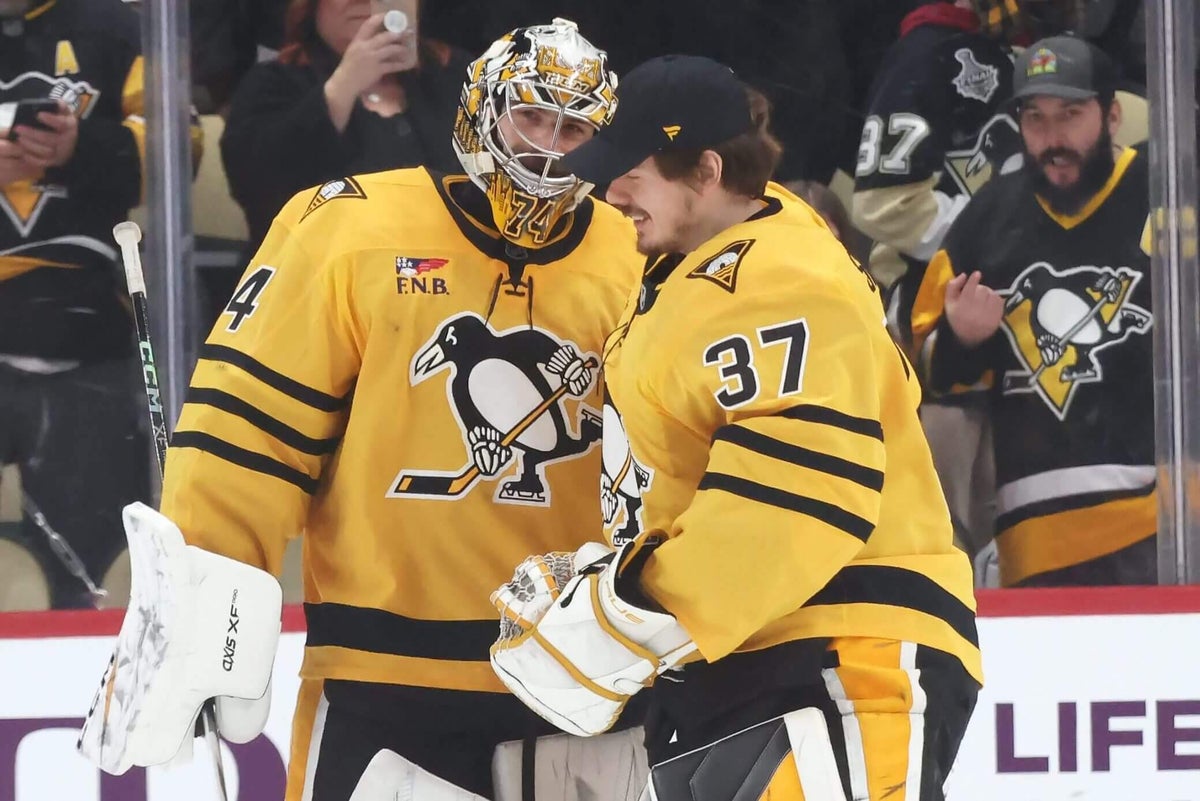
In Pittsburgh, assuming he’s healthy and ready for the playoffs, Stuart Skinner has better numbers since joining the Penguins but obviously has some baggage. But that baggage is a lot of Stanley Cup playoff experience. Arturs Silovs only has a little playoff experience at this level, but he was named MVP for his Calder Cup-winning play in the AHL last spring.
Maybe one of these teams will buck the trend and mix things up — even if just to keep both goalies fresh in the early goings of the playoffs, like the 2024 Bruins. But most will likely ride one starter until a situation grows dire and calls for a shake-up.
Desperate times call for coaching change measures
The coaching carousel never stops spinning in the regular season — not even with the playoffs just weeks away. Two teams have made bold changes with less than 10 games to go: Vegas fired Bruce Cassidy and hired John Tortorella, and the New York Islanders dismissed Patrick Roy for Peter DeBoer.
These moves spark a lot of intrigue because it’s so out of the ordinary for a playoff team to make a change this late in the game and realistically, there is no time for a systematic overhaul in either situation.
Vegas doesn’t need that drastic a change. Instead, a change in voice (and some strategic tweaks) could be enough to get this group playing closer to its collective ceiling, which is somewhat of a specialty for Tortorella, who really hasn’t coached a team with this much star power.
The Golden Knights, at this rate, were trending toward a Round 1 exit, which would be an outright failure for a team that has invested so much in this window of contention at any cost.
The Islanders’ play over the last month-plus could land them outside the playoffs altogether. Defense was always a potential weak point this year but it’s been outright abysmal lately, leaving both goalies completely exposed. The Isles’ 3.26 expected goals against per 60 at five-on-five since March 1 is the fifth-worst in the league, and far from playoff-caliber.
Call it a lack of structure, a lack of energy, or a combination of the two. Whatever the cause, it proved costly as the team’s playoff odds spiraled from ~70 percent on March 2 to less than 22 percent on April 6. So instead of waiting to make a change in the summer, DeBoer gets an early jump on working with the Islanders.
Only Roy is out and not Bob Boughner, who was brought in to run the defense and penalty kill (and had a rough tenure in a similar role in Detroit). But Boughner does have a history with DeBoer; he was his assistant behind the San Jose Sharks’ defense and penalty kill ten years ago.
Best-case scenario, this change accomplishes two things: 1) some structural tweaks buy this team time to improve on the fly in front of a goalie capable of stealing a playoff series, and 2) it helps the coaching staff and front office identify what else is needed to execute DeBoer’s system next season and beyond.
If the new-coach boost is enough to help the Islanders or Golden Knights get back on track, this could become a trend to watch this time next year.
Negative goal differentials heading into the playoffs
One regular-season number can’t define what happens in the playoffs, but it can be an indicator of a team’s ceiling. Teams that don’t control five-on-five play generally don’t go on deep postseason runs, and neither do teams that fall below break-even in scoring.
In past eras, it wasn’t unusual for a team to reach the playoffs with a negative goal differential. In 1986, the Jets were a minus-77, the Leafs a minus-75, and Vancouver Canucks a minus-51.
But in today’s NHL, it’s a lot less common; in the salary cap era, only 28 teams have made the playoffs with a negative goal differential, and 23 of those teams were eliminated in Round 1 (and in the 2020 qualifying round).
Similar to goalie rotations, there can be exceptions and outliers — the 2010 Canadiens, 2017 Senators and 2020 Islanders all made it to the Eastern Conference final despite a negative goal differential in the regular season.

This year, a few teams in the playoff picture could be in similar situations. In the East, three teams trying to make it fall below zero: the Islanders (minus-3), Philadelphia Flyers (minus-3) and Detroit Red Wings (minus-9). While these teams still have the power to change before the season ends, it won’t be as easy in the West.
The Ducks sit at a minus-14, and a lot of it is due to a brutal stretch between December and January when Anaheim lost 13 of 15 games, 10 by multi-goal margins. Anaheim had a plus-nine differential heading into Dec. 11, and that plummeted to a minus-31 after losing to the Sabres on Jan. 10, thanks to some chaotic defense, Lukáš Dostál’s slower return from injury and some scoring woes. Despite breaking even since then, the team hasn’t been able to dig its way out of that hole.
The teams all competing for that last wild-card seed in the West all sit at a minus-13 or worse: the Sharks, Winnipeg Jets, St. Louis Blues, Los Angeles Kings and Nashville Predators.
It doesn’t necessarily mean all of these teams are destined to lose in Round 1 — anything can happen in the Stanley Cup playoffs. But as much as teams get a clean slate of sorts in the playoffs, that 82-game regular season still carries some weight, and recent history counts against those below-zero teams.
Celebrini is keeping the Sharks in the fight
Speaking of one of those negative goal differential teams in the Western Conference race, Macklin Celebrini is doing the most to drag his team into the playoffs. Just when it seemed like San Jose had fallen out of the race after six winless games in mid-March, Celebrini helped spark a turnaround.
On March 28, he scored the tying goal against the Columbus Blue Jackets early in the third, and in the last two minutes of regulation, helped set up the game-winner. Celebrini controlled play against St. Louis two days later and earned three primary points to pass the 100-point threshold in another dramatic win. Then, against the Ducks on April 1, Celebrini once again was the difference, with primary points on all four Sharks goals.
And those three wins brought San Jose one point back of the second wild card.
The Sharks still have an uphill battle, especially after a crushing regulation loss to Nashville on Saturday night. But Celebrini has been at the heart of San Jose’s run, with true MVP-caliber play. His 18.9 Net Rating doesn’t just lead the Sharks — it’s 14.5 wins ahead of the next best player in San Jose, Will Smith. In just his second season, he is already top-five in the league among forwards. So while it’s a lot of pressure to put on one player, it’s the reason San Jose is in this position in the first place.
Can Vasilevskiy find his playoff groove again?
Andrei Vasilevskiy was the Lightning’s backbone on their way to back-to-back Stanley Cups, saving 13.7 goals above expected in 25 games in 2020 while earning a .927 save percentage. A year later, he was an outright force in net with a GSAx of 17.3 (the third-best playoff performance since 2008) and .937 save percentage.
That playoff body of work was highlighted by clutch play. In eight series-clinching games, between the 2020 Stanley Cup Final and 2022 Eastern Conference final, Vasilevskiy only allowed two goals against (not a typo) and saved a collective 17 goals above expected.
It’s just gone south since. It’s possible an extremely demanding regular season and playoff workload, after three straight trips to the Stanley Cup Final, weighed Vasilevskiy down in 2023. But his 2024 and 2025 postseasons weren’t much better, either.
Those first-round exits don’t sit on Vasilevskiy’s shoulders, considering all the turnover in Tampa Bay over the years and depth issues. If he wasn’t perfect out of the gate, it proved costly too; in 2021 and 2022, he at least had some time to heat up, and that has been impossible with just one round each year since.
Now Vasilevskiy is heading into the playoffs on the heels of another great regular season, with 42 quality starts in 55 outings, which adds up to the fifth-best GSAx in the league of 37.1. But the team hasn’t lightened his workload, either, in terms of games played or shot quality against. So the pressure is on, both for Playoff Vasy to find that next gear and the Lightning to make sure he has support to go further than recent years.
Will the Oilers flip their usual switch?
No matter how poorly the Oilers have started the last couple of seasons, they have turned things around when it mattered most. Two consecutive trips to the Stanley Cup Final are proof of that.
This year’s team has suffered through some similar flaws: shaky defense, inconsistent goaltending and a lack of scoring depth at times. Some of those woes are getting smoothed out.
The team defense has tightened up since Paul Coffey returned behind the bench, with the Oilers’ expected goals against improving from 2.86 per 60 to 2.51 since the Olympic break. A new-look second pair of Darnell Nurse and Connor Murphy is shutting play down in the defensive zone. And up front, Matt Savoie is stepping up in a top-six role.
That all seemed to help Edmonton gain some momentum with five straight wins, until Saturday’s loss to Vegas. One loss doesn’t define a short-handed team. But one question has been brewing for some time: Does this version of the Oilers have the juice to amp things up in the playoffs?
Even if Leon Draisaitl and Zach Hyman are at full strength for Game 1, this team still has to prove the next level is still there to carry through another deep run.
The Bruins are a true wild card
There is only so much spotlight to go around in the Eastern Conference between the end of the Sabres’ 14-year playoff drought, the Penguins’ improbable run, the Islanders’ dramatic coaching change, the Flyers’ surge up the standings and the overall race for the second wild-card spot.
With so much attention diverted elsewhere, the Bruins have gone a bit more under the radar. Maybe it’s because Boston’s done enough to almost lock up a playoff seed, with its odds climbing from around 32 percent one month ago to 96 percent.
It started with wins over two teams fighting for their playoff lives in the Red Wings and Jets. After a loss to the Leafs, Boston rebounded with four straight wins: a comeback overtime win over the Sabres, plus regulation wins against the Wild, the then-surging Blue Jackets and the Stars. That run was fueled by more Vezina-caliber play from Swayman, core performances from David Pastrnak and Charlie McAvoy, plus some surprising supporting players stepping up, like Pavel Zacha and Viktor Arvidsson.
Then came a reality check, with three regulation losses to the Panthers, Lightning and Flyers. It doesn’t matter that the Bruins got goalied against Florida, because at the end of the day, those points could be the difference between finishing third in the Atlantic or as a wild card.
Whether or not that benefits Boston likely comes down to how the standings ultimately shake out. But this last stretch was a reminder of this team’s potential — if those big-game Bruins come to play, it could disrupt the playoff picture.
Data via Evolving-Hockey, HockeyViz, HockeyStatCards, All Three Zones, Dom Luszczyszyn and Natural Stat Trick. This story relies on shot-based metrics; here is a primer on these numbers.