
The latest letter came 11 months after MGB primary care physicians voted overwhelmingly to join the Doctors Council of the Service Employees International Union. The legislators implored the state’s largest health care system to abandon its appeal to the National Labor Relations Board and to start contract talks.
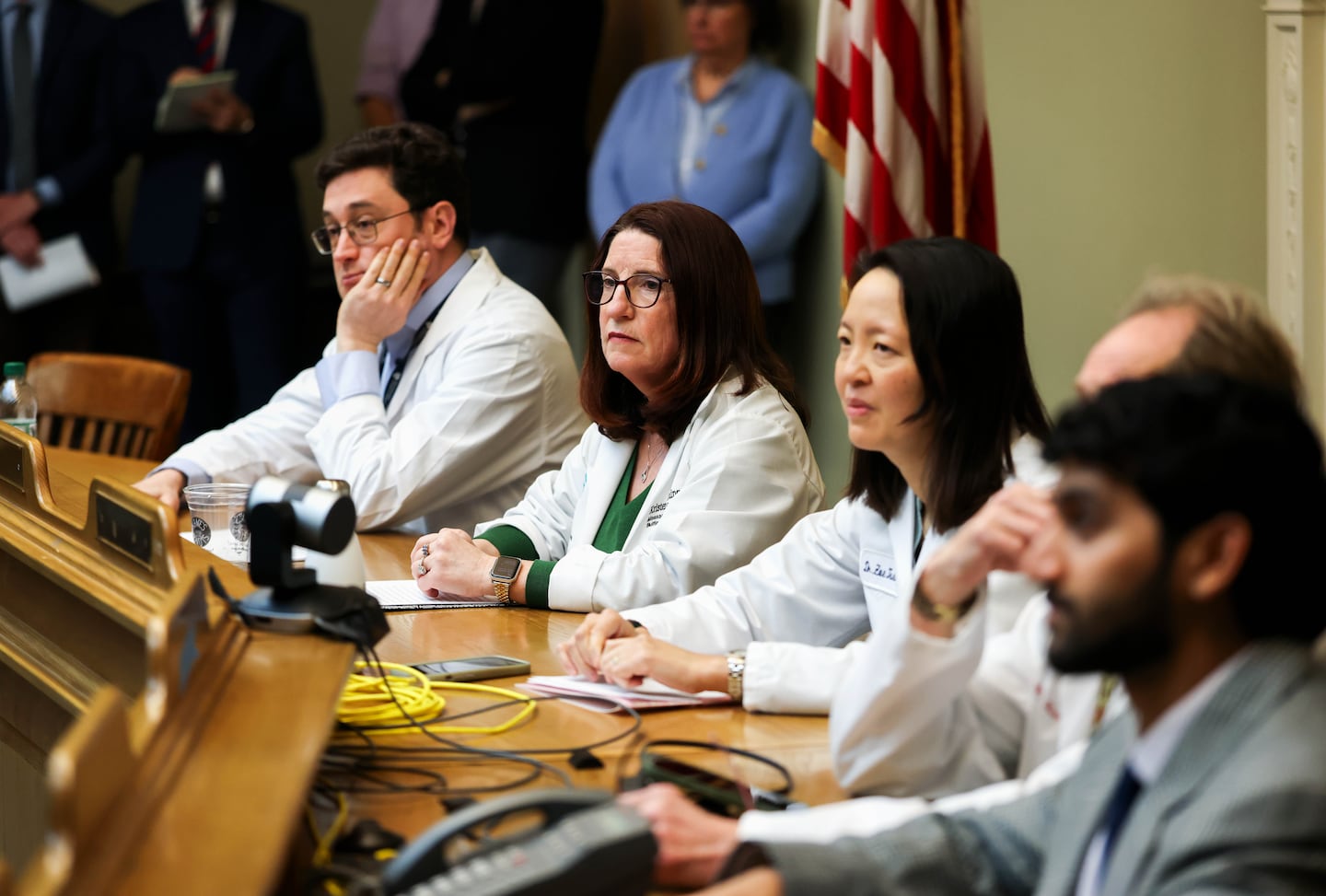
The letter was addressed to Dr. Anne Klibanski, chief executive of MGB, and to Scott Sperling, chairman of the health system’s board of directors and co-chief executive of THL, a private equity firm. Doctors had visited the State House to gather the lawmakers’ support.
“We’re fighting the giant, and so we need help,” Dr. Kristen Gunning, who has practiced medicine at Massachusetts General Hospital for 18 years, said in an interview.
In the first letter sent to MGB in late February, Senator John F. Keenan, a Quincy Democrat, said the health system “continues to delay union recognition.” By dropping its appeal and negotiating with the doctors, he wrote, MGB can help address the “mounting strain on primary care across the Commonwealth.”
MGB, for its part, has contended that as many as three-quarters of the doctors who voted 183-26 last May to form the union chapter were ineligible to do so under NLRB rules.
The health system says most of the doctors work in practices integrated into acute-care hospitals with other kinds of physicians. Under the rules, MGB says, the chapter would have to include all physicians at those hospitals, an argument the regional director of the NLRB in Boston previously rejected.
“Ahead of the May 2025 election, we asked the National Labor Relations Board to determine whether the proposed bargaining unit is legally appropriate for an acute care hospital,” MGB spokesperson Jessica Pastore said in a statement. “That review is still underway. From the beginning, we have followed the Board’s process and will continue to do so.”
MGB, the parent corporation of Massachusetts General Hospital and Brigham and Women’s Hospital, has also said it has been trying to address the shortage in primary care doctors. In May, it pledged what Klibanski called an “unprecedented” investment of nearly $400 million over five years in primary care. The health system has so far declined to give the Globe a detailed breakdown of where that money is going.
For about a year and a half, primary care physicians at MGB have publicly said they are overworked, underpaid, and demoralized by the “corporatization of medicine” and lack input in making decisions at the health system. In November 2024, many of them filled out cards notifying the NLRB that they wanted to join the Doctors Council, which describes itself as the country’s oldest and largest union of attending, or fully trained, physicians. That was the first step in the unionization effort.
In doing so, the primary care doctors at MGB joined a wave of doctors unionizing nationwide, including others in Greater Boston. Much of the unionizing has taken place at MGB, easily the biggest health care system in the state, with about 86,000 employees.
In June 2023, about 2,600 doctors-in-training at multiple MGB hospitals voted to join the Committee of Interns and Residents of the SEIU. (Last May, the union approved its first contract with MGB, a three-year deal that will raise wages by a total of 7.5 percent.)
In March 2024, the 112 physicians at Salem Hospital, part of MGB, joined Council 93 of the American Federation of State, County, and Municipal Employees. Those doctors, who said their ability to make independent decisions had dwindled, were the first attending physicians at MGB to unionize.
Home care clinicians at MGB have also voted to unionize and have been negotiating their first contract with the health system for more than a year. The clinicians say they want to cap caseloads and improve working conditions and patient safety, the Globe has previously reported.
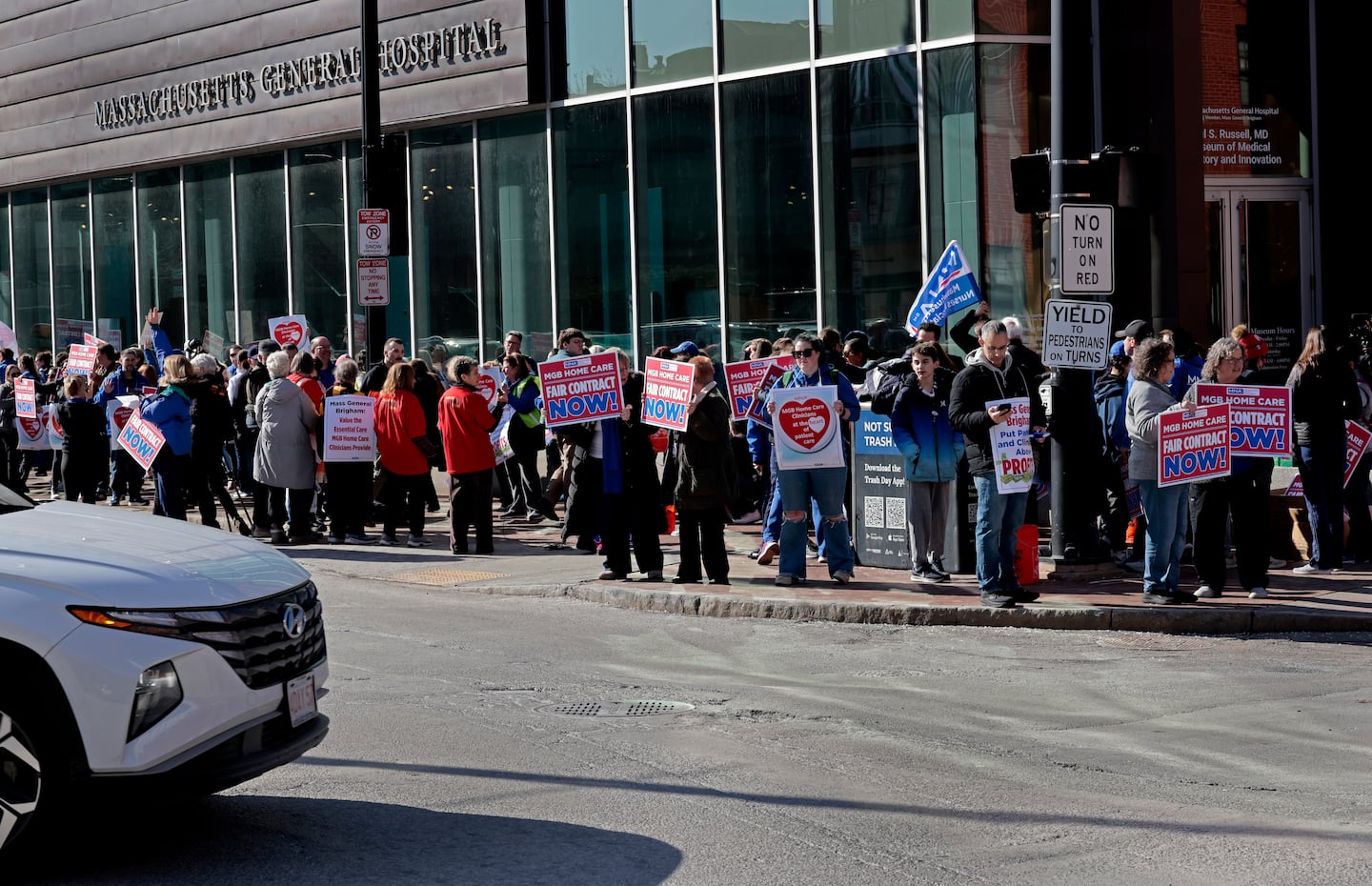 Home care clinicians at MGB have also voted to unionize.Pat Greenhouse/Globe Staff
Even before the votes by the primary care physicians were tallied last May, MGB sent a memo to employees saying it was challenging the election to the NLRB. It said the appeal wasn’t “about the outcome of the election — it’s about making sure the bargaining unit follows established legal guidelines.”
The health system said the NLRB regional director in Boston erred by allowing as many as 237 primary care doctors at 29 practices to vote on whether to form a union. In fact, MGB said, up to three-quarters of those physicians were ineligible to vote under NLRB rules.
The appeal was in limbo for more than six months because the five-member NLRB lacked a quorum when the doctors approved the union. But in December, the Senate voted to confirm President Trump’s two nominees to serve on the board Scott Mayer and James D. Murphy, restoring a quorum. It’s unclear when the board will take up MGB’s appeal.
Without specifically mentioning the appeal, the letter from lawmakers on Tuesday said MGB should accept that the union has a “clear mandate” and begin negotiating. The legislators said “there has been a breakdown in communication and trust between hospital leadership and frontline clinicians.”
A legislator who signed the letter, Representative Sally Kerans, a Danvers Democrat, said she has “great regard” for MGB, “but I felt I need to speak up for our primary care physicians.”
She said the doctors are burned out from their many responsibilities, including entering notes on electronic medical records while seeing patients, and need better working conditions.
“The fact that they voted overwhelmingly to unionize is so striking to me,” she said in an interview.
No one disputes that primary care faces a crisis in Massachusetts, as it does in much of the nation.
Four in 10 Massachusetts residents reported difficulty accessing primary care, according to a study by the state Health Policy Commission in January 2025. Wait times for a new patient appointment in Boston stretched to 40 days — twice the average of 15 other cities studied.
The primary care workforce is aging, with an estimated half of physicians over the age of 55, the report said. Meanwhile, the pipeline for new primary care doctors is running dry, with only one in seven new Massachusetts physicians in 2021 going into primary care — among the lowest share in the country.
Many young doctors are eschewing primary care because they can make far more as specialists and pay off loans for tuition for college and medical school, which can easily total $200,000 to $300,000.
Many specialists also tend to have a better work-life balance than primary care doctors, whose immense workload often includes several hours of nightly “pajama time” to return phone calls or online queries from patients, review lab results, and do administrative tasks.
MGB acknowledges that there is a shortage of primary care doctors and in September rolled out an online platform that harnesses artificial intelligence for the 15,000 patients in the system without a primary care doctor. Called “Care Connect,” it features a chatbot that is available 24/7 that interviews the patient and then sets up a telehealth appointment with a physician in as little as half an hour.
But the legislators said MGB rolled out the app and then expanded its use to other types of patients without consulting physicians.
“We believe the many challenges facing our health systems are best addressed by including doctors in the discussion and decision-making, not by sidelining them,” the lawmakers wrote.
Jonathan Saltzman can be reached at jonathan.saltzman@globe.com.