
It sounds paradoxical at first. Light, after all, is the gold standard of speed in the universe. But the rule Einstein laid out in 1905 was never quite so absolute, he specified that information cannot travel faster than light, not that everything is bound by that limit. Massless phenomena that carry no information, it turns out, are under no such obligation. Darkness, in a very precise scientific sense, qualifies.
The distinction matters because it reframes what “faster than light” actually means in practice. This is not science fiction, and it is not a loophole that upends physics. It is a measurable, observable property of wave structures that researchers had long suspected but never directly captured, until now.
Dark Points Inside Light Waves
The team, led by researchers at Technion–Israel Institute of Technology in Haifa, Israel, did not attempt to measure “darkness” in any abstract or philosophical sense. Their focus was narrower and more technical: they tracked what are known as “dark points,” or null points, embedded within light waves. These are specific locations within a wave structure where amplitude drops to zero, tiny pockets of complete absence of photons nestled inside an otherwise active light field.
These null points, also called zero points or optical phase singularities, give rise to vortices. According to the study published in Nature, the authors describe this dynamic as analogous to a vortex in a river that overtakes the flow of water itself. It is within these vortex structures that motion becomes, technically, superluminal, faster than light.
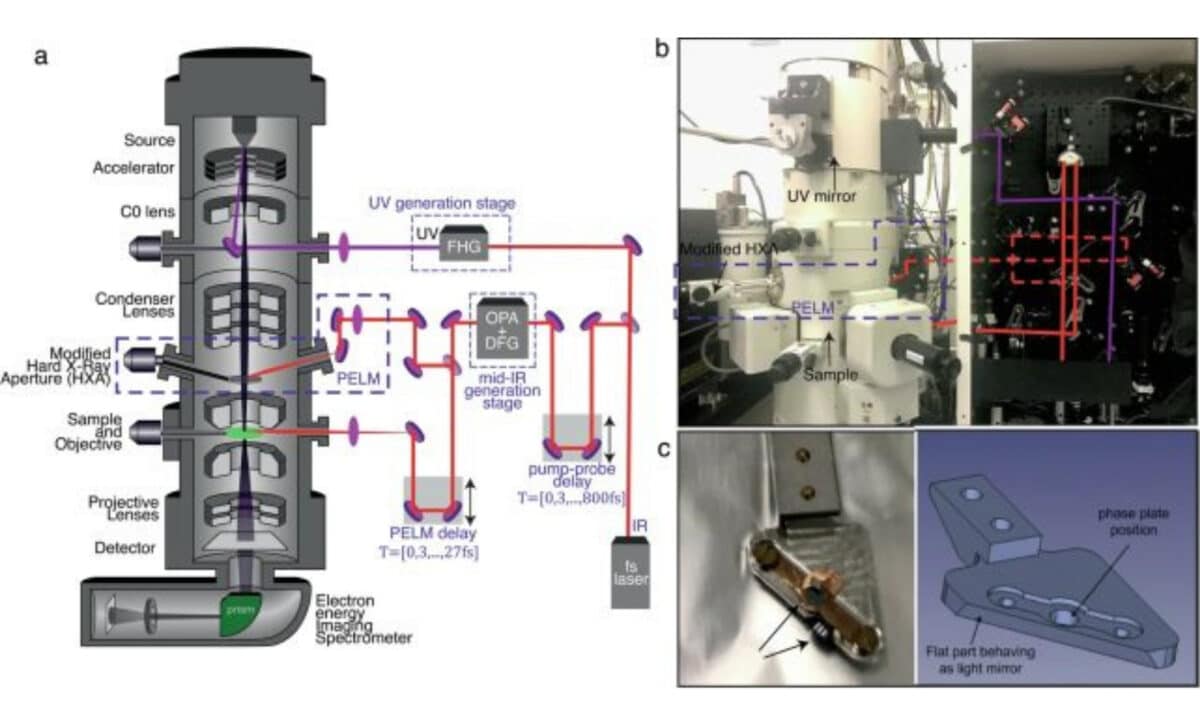 The apparatus used to generate and record the optical vortices – © Nature
As the researchers themselves wrote: “Theory has long predicted that optical singularities can exhibit superluminal motion, particularly at moments close to their creation or annihilation, where their velocities can become unbounded. We monitor the ultrafast dynamics of optical phase singularities with deep sub-wavelength spatial and deep sub-cycle temporal resolutions, revealing their acceleration near annihilation events.”
A Microscopy System Built for the Extreme
Capturing this phenomenon required purpose-built tools. The experimental setup combined an advanced laser system with a specialized opto-mechanical apparatus, allowing researchers to gather data at exceptionally precise spatial and temporal resolutions. This level of accuracy was not incidental , it was the prerequisite for observing something as fleeting and localized as the acceleration of a dark point vortex.
A key element of the experiment was the use of a thin hexagonal boron nitride flake, a material with an unusual optical property: inside it, light transforms into what are known as polaritons, quasiparticles that function as light-matter hybrids. According to Popular Mechanics, these polaritons slow the effective speed of light by roughly 100 times compared to its speed in a vacuum, though still far exceeding the speed of sound. It is within this slowed-down light environment that the dark point vortices were observed surpassing the speed of light.
Universal Laws, Hidden Processes
The implications of the discovery reach beyond optics. Ido Kaminer, senior author of the study from Technion, stated in a press release: “Our discovery reveals universal laws of nature shared by all types of waves, from sound waves and fluid flows to complex systems such as superconductors. We believe these innovative microscopy techniques will enable the study of hidden processes in physics, chemistry, and biology, revealing for the first time how nature behaves in its fastest and most elusive moments.”
The researchers see this not only as a confirmation of long-standing theory but as the beginning of a new observational framework, one capable of illuminating phenomena that have, until now, moved too fast or too subtly to be seen.