
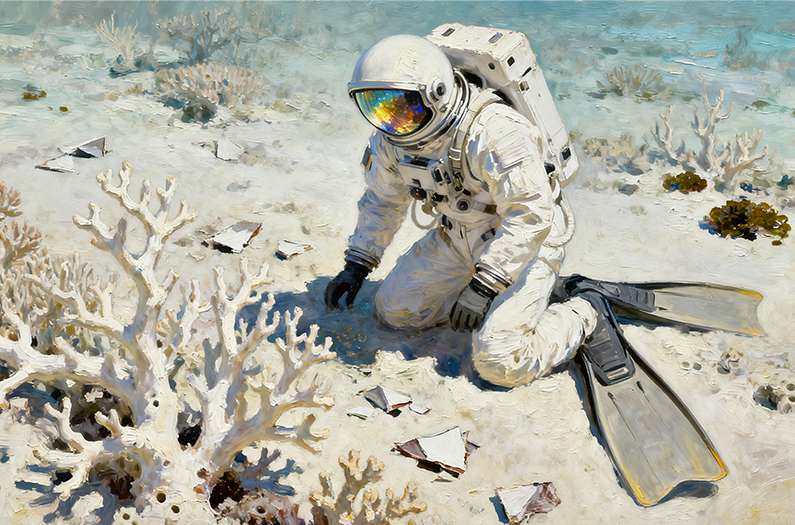
There’s an archetypal nightmare where a dreamer is being pursued by some menacing creature, but they can only run in slow motion, as if stuck in syrup. That’s how some coral scientists might be feeling right now.
Researchers have been rushing to find ways to help coral evolve quickly enough to withstand underwater heatwaves super-charged by global warming. But much like that nightmare scenario, without a more ambitious and coordinated campaign, current efforts are moving too slowly to outrun the heat, an international team of top coral researchers warned last week in Nature Reviews Biodiversity.
“At today’s pace of research and development, and without rapid emissions reduction, solutions will arrive too late for coral reefs,” said Adriana Humanes, a marine ecologist at the United Kingdom’s Newcastle University and the paper’s lead author.
The new paper spells out both the daunting knowledge gaps and the herculean effort it will take to overcome them in time to help rescue at least some of the world’s coral reefs. While the scientists don’t put a dollar figure on it, it’s probably safe to liken it to the coral science equivalent of the moon-shot research initiative of the 1960s, which landed the first humans on the moon in 1969.
It’s not that scientists haven’t been doing anything. In labs around the world, particularly coral hotspots such as Australia, Florida, the Caribbean, Saudi Arabia, and Hawaii, people have been working to identify what enables some coral to better tolerate high temperatures and to figure out how to breed them.
But the new paper spells out the pressures scientists and reefs face. In 2023, the planet crossed the threshold of a global average temperature 1.5°C warmer than during preindustrial times, before greenhouse gas pollution from fossil fuels began heating the Earth. If that temperature level is sustained in the coming years, an estimated 75% to 90% of reefs are expected to encounter deadly levels of heat stress, the scientists report.
If temperatures rise by 2.7°C, a likely scenario by the end of the century if we continue on the current pollution trajectory, some Pacific reefs will experience heatwaves every two years comparable to the most extreme ever recorded today.
Coral are vulnerable to heat in several ways. In the most extreme cases, such as a 2023 heatwave in Florida, coral colonies quickly die, essentially cooked. More commonly, overheated polyps eject the symbiotic algae that live inside their bodies, causing the coral to bleach white. Because the photosynthesizing algae are a critical energy source for the corals, the polyps can weaken or die unless they reabsorb the algae quickly enough.
While in some ways the search for solutions resembles work to cultivate heat-tolerant crops such as corn and rice, corals are far more complicated and less well understood. In the new paper, the scientists spell out yawning knowledge gaps that stand between them and solutions.
What we call coral is actually a complex assembly of organisms. There are the coral polyps that form colonies, often in stony exoskeletons. Then there are the algal symbionts, plus a stew of bacteria and viruses. All of these might affect heat tolerance. In many cases, scientists don’t even know the identities of all the species involved, the scientists noted. The genetic basis of heat tolerance isn’t fully understood, nor are the potential genetic problems that might come with greater heat tolerance. It’s possible that if some part of the coral equation, such as a symbiont, becomes more heat tolerant it could come with an added problem, such as being more vulnerable to disease. Scientists don’t even have a strong grasp of how different variables drive the long-term state of a coral population, making it tricky to predict outcomes from tinkering.
“Critical knowledge gaps around the biology of coral heat tolerance are hindering progress”, said Juan Ortiz, a lead coral researcher at the Australian Institute of Marine Science (AIMS).
To bridge those gaps, the scientists recommend a more coordinated, sustained research program. A cornerstone of that vision is a network of research hubs where scientists from various institutions can work in a unified way on large-scale experiments that might stretch for years.
“Establishing large-scale field hubs would foster collaborative, multidisciplinary research across coral species and life stages, increasing experimental power and efficiency,” said James Guest, a coauthor and Newcastle University coral researcher.
These coral hubs would need special protection to avoid having valuable coral wiped out by a typhoon or heatwave. That might include systems to lower coral nurseries into deeper, cooler water, or methods now being tested to artificially cool a patch of the ocean by, for example, spraying fine droplets of water into the air to reflect sunlight.
If the experimental coral is “lost during disturbances, the financial investment loss could be huge and delays catastrophic,” said Humanes.
While the new paper lays out key problems and possible solutions, it doesn’t resolve critical questions that must be answered for this vision to become a reality. Where would these research hubs be based? How much will they cost? And who’s willing to pay for it?
A group of astronauts are circling the Moon this week, a testament to the technological marvels that humans can accomplish with enough dedication and money. Coral reefs are some of the planets most valuable ecosystems. They are estimated to provide benefits to people, whether from fishing, storm protection or tourism, worth $2.7 trillion per year. It remains to be seen if the effort to rescue the reefs will get resources even remotely close to space travel.
Humanes, et. al. “Accelerating coral assisted evolution to keep pace with climate change.” Nature Reviews Biodiversity. March 30, 2026.
Image: ©Anthropocene Magazine, AI-generated