
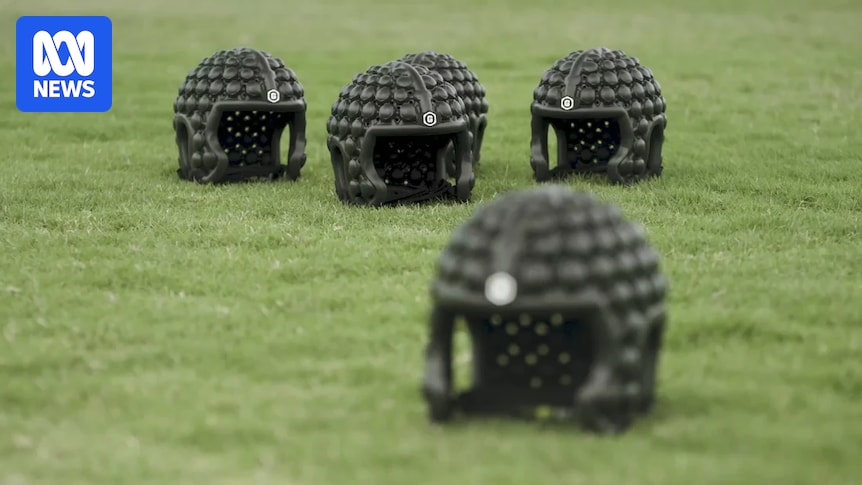
Two world-leading sports neuroscientists have slammed the AFL’s move to back a new helmet being tested to determine its capacity to reduce “the incidence of concussion”, despite numerous previous studies dismissing headgear’s ability to do so.
The helmet, known as GameGear, is already being sold online even though a study into its efficacy is yet to be completed.
GameGear is funding an $800,000 two-year Monash University-led trial on 600 athletes across Australian Rules football and rugby league, to see if and how it reduces concussion risk
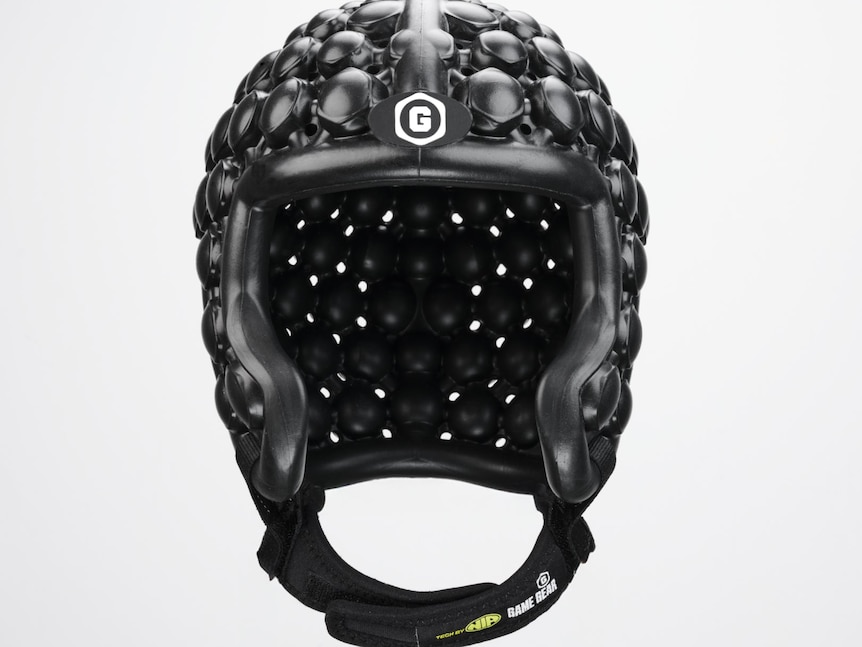
GameGear is funding research on concussion. (GameGear Headgear)
Selling the headgear before the study outcome is known has been branded as “potentially dangerous” by leading sports neuroscientist Alan Pearce.
“I am also concerned that parents are buying this headgear thinking it will protect their kid from concussion,” Professor Pearce, of Swinburne University, told the ABC.
“Athletes can also get a false sense of safety from wearing headgear: I think it is potentially dangerous.
“The scientific study on the efficacy of this helmet has not been undertaken, which suggests to me bad science.
“We’ve known for decades that helmets don’t protect the brain from concussion.”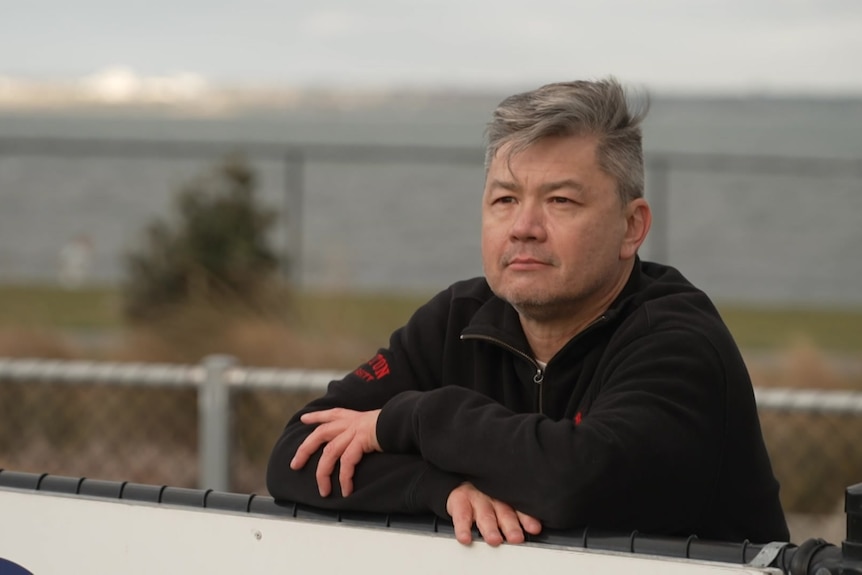
Alan Pearce predominantly studies sports-related concussion. (ABC News: Billy Draper)
Another sports neuroscientist, Chris Nowinski, pointed out the number one sport for the degenerative brain disease chronic traumatic encephalopathy (CTE), which is linked to repetitive hits, is American football, whose athletes wear helmets.
GameGear currently retails for $215.
GameGear’s official website states the headgear will “Protect, Perform and Prevail”.
GameGear inventor Graeme Attey maintains he intends for his headgear to do what “seatbelts did for road safety”.
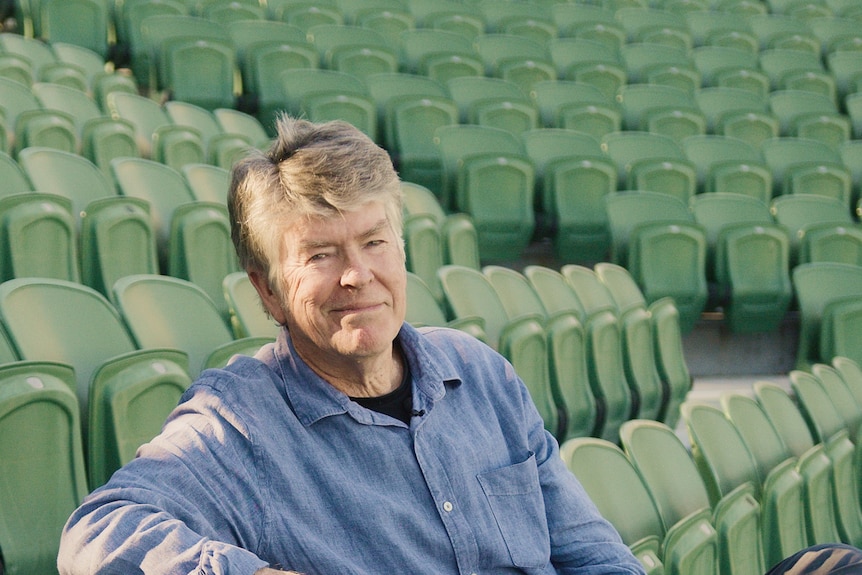
Graeme Attey maintains he intends for his headgear to do what “seatbelts did for road safety”. (Facebook: GameGear)
Mr Attey said GameGear was tested in the Transport for NSW Crash Lab — where the likes of motorcycle and bike helmets are also tested — and he said the results showed his invention provided “reduced head acceleration by 91 — 94 per cent compared to the four leading brands of commercial headgear”.
However, Mr Attey stated to the ABC his invention did not currently claim the headgear reduced concussion — although it ultimately aimed to determine if it did via the two-year Monash University study.
“We don’t claim anything in terms of concussion,” Mr Attey told the ABC.
“We’ve done some impact reduction [testing] in the lab which has shown some promise.
“But in order to take it to that next step, we need to fund this trial, [to] understand if there are real-world effects”.
Studying the impact of CTE
The impact of repetitive hits on athletes has been a growing area of concern in recent years for the major codes.
CTE has been found in the brains of contact sport athletes exposed to repetitive concussive and sub-concussive head injuries. Several Australian Rules footballers — including St Kilda great Danny Frawley, Eagles premiership player Adam Hunter and Richmond player Shane Tuck — have been diagnosed with CTE.
If you or anyone you know needs help:Lifeline on 13 11 14Aboriginal & Torres Strait Islander crisis support line 13YARN on 13 92 76Beyond Blue on 1300 224 636Headspace on 1800 650 890ReachOut at au.reachout.comMensLine Australia on 1300 789 978SANE on 1800 187 263
AFLW Adelaide Crows premiership player Heather Anderson — who wore a helmet for most of her playing career — was also found to have CTE post-mortem.
Anderson died by suicide in 2022 at just 28.
Dr Nowinski is a leading voice on the issue in America and he says that helmets are useless in preventing CTE.
Last year it was reported that Boston University’s CTE centre had diagnosed 345 cases of CTE in the 376 former NFL players’ brains it had studied since 2008 — a rate of 91.7 per cent.
“The number one sport for CTE is American football, more than any other sport worldwide — and two thirds of brains in the Boston brain bank are American Football — and they have the best and most advanced helmet,” said Dr Nowinski, who co-founded the UNITE Brain Bank at Boston University.
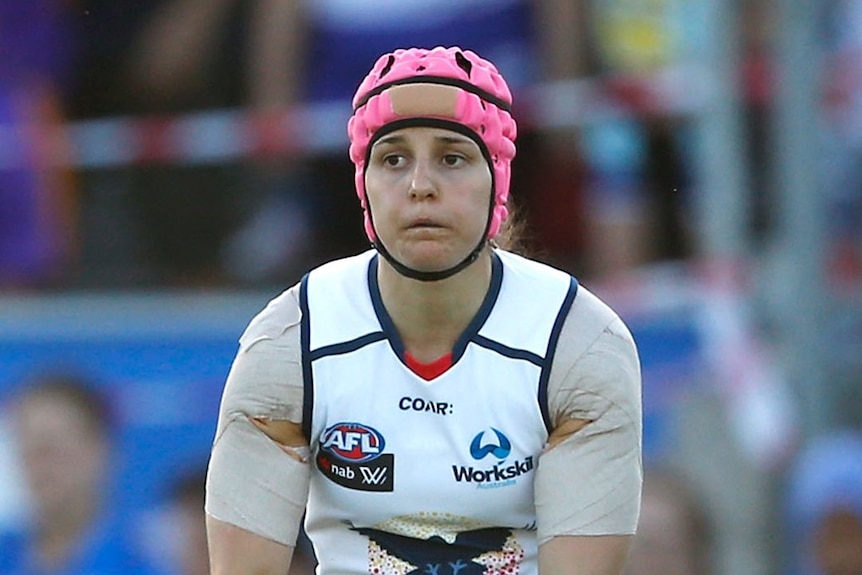
Heather Anderson was found to have CTE after her death at age 28. (Twitter: Adelaide Crows AFLW)
“The idea that a helmet is going to save you from CTE is simply untrue.”
But Mr Attey argued his soft-shell helmet would better protect players from these hits than hard-shell helmets and that he invented this headgear to attempt to stop “bad health outcomes”.
“I don’t think it’s acceptable that we go out there bashing bare heads together like bricks,” Mr Attey said.
“We’ve got to reduce the impact and the acceleration so that we have a chance of reducing short- and long-term injuries.
“The real danger is continuing to use this ineffective headgear or no headgear at all,” Mr Attey said in an email.
Mr Attey also said there had already been “14 years of study, design, prototyping and lab testing” behind his invention.
“When lab results are as encouraging as ours, we then have an implied obligation to make our headgear available [to retail],” he said.
He added that he was not an owner or shareholder in GameGear, and they were a licensee of his “technology”.
In a statement to the ABC, GameGear’s owners said they were proud the “medical trial” was underway.
They said it was being administered by Professor Lindy Fitzgerald, who is also the chief executive of not-for-profit Connectivity Traumatic Brain Injury Australia, and being independently conducted by associate professor of Monash University, Dr Stuart Macdonald.
“No other headgear has undertaken this scale of medical trial or undergone this level of rigour in Australia or globally,” a GameGear spokesperson said.
Endorsing headgear
Despite the lack of scientific proof that headgear is effective at preventing concussion, the AFL has forged ahead to develop its “first ever Australian Football Headgear Standards”.
GameGear is the only helmet to have passed the new AFL’s standards so far.
Do you know more?Contact Jessica Halloran at Halloran.Jessica@abc.net.auIf you require more secure communication, please choose an option on the confidential tips page.
GameGear has confirmed talks with several AFL clubs, which the ABC understands has included Fremantle, West Coast and Hawthorn, and says some players have agreed to trial it in training.
Last November, Nine News Perth in Western Australia first reported that the new GameGear helmet was about to be “put to the test on professional athletes”.
On January 11 this year, The Sydney Morning Herald reported that GameGear was a revolutionary new helmet that “could be a game changer” in the “fight against concussion”.
Two weeks later, the AFL announced its new Australian Football Headgear Standards — released in January — but stipulated in the fine print that even if a helmet met the standards, it did not “constitute a guarantee” it would actually protect the player from “sustaining a head or brain injury”.
“The AFL is not responsible or liable for the claims made by suppliers to meet these standards, nor is the AFL acting in a regulatory capacity regarding supplier claims,” the AFL’s headgear standards state.
“Nothing in these standards, nor in the headgear prototypes found to meet even the Advanced Head Standard, constitute a guarantee against a player using headgear approved under these standards from sustaining a head or brain injury whilst competing in the game of Australian football.”
In early February, GameGear was revealed as the first helmet to meet the AFL headgear standards via a major media launch.
On February 20, the ABC’s BTN High — a program targeted at young people — reported on GameGear and “whether a new helmet will significantly reduce risk of concussion in football players”.
When the ABC sent the AFL a list of questions regarding GameGear headgear and the lack of protection that headgear had historically provided, the AFL did not answer them.
An AFL spokesman instead referred to a media release from January 29 which included comments from the AFL’s chief medical officer, Michael Makdissi.
In the January statement, Dr Makdissi said the standards were: “another important step in our ongoing work in the prevention and treatment of concussion”.
Another leading expert on concussion for the AFL is Andrew McIntosh.
Dr McIntosh is a key member of the AFL’s working group who helped develop its “advanced” headgear standards. He is also the bio-mechanist and ergonomics expert who led the testing at the NSW Crash lab on GameGear.
He says there was no conflict of interest in his role in testing headgear and consulting to the AFL.
“I have no financial interest in GameGear headgear, SAIG [a company that provides voluntary product safety certifications for headgear] or the test lab. It is a complete misrepresentation to describe my role assisting the AFL as a conflict of interest,” Dr McIntosh wrote to the ABC.
He commended GameGear’s “enormous” effort to meet the AFL’s advanced headgear standards.
“I would like to see as many headgear models as possible certified to the standards, but at the moment there is only one model,” Dr McIntosh told the ABC.
“In my opinion, it is great that GameGear has developed the headgear and gone to considerable trouble and expense to demonstrate its compliance with the standards.”
Players making the choice
Over the years, headgear has often been worn by concerned AFL footballers in the latter stages of their careers.
Former Melbourne star Angus Brayshaw, who had a history of head injuries, wore headgear before he was retired because of repeated concussions.
Brayshaw, along with nearly 100 AFL footballers, is currently pursuing an insurance claim to compensate him for his post-career struggles because of concussion.
In late March, 500 AFL players were informed they would no longer be covered for head trauma in their AMP Superannuation fund — of which Zurich provides the insurance — from May 1.
Zurich told the ABC there was “widespread uncertainty” about the potential magnitude of CTE and the long-term health effects of concussion.
While no player in the AFL is yet wearing GameGear on game day, in the NRL Manly player Jake Trbojevic has decided to.
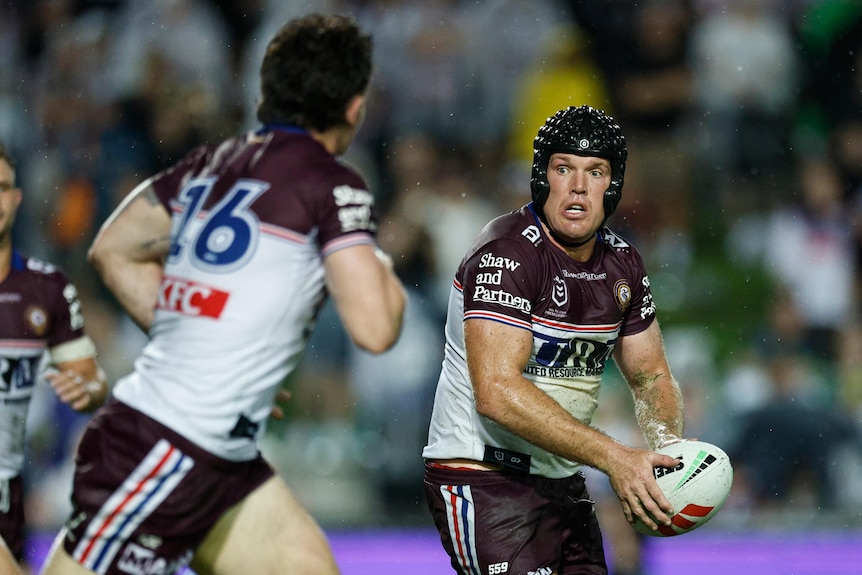
Jake Trbojevic has opted to wear headgear because of the “research” behind it. (AAP: Mark Evans)
Trbojevic, who suffered three notable concussions last season and had concerns about his playing future if he were to sustain another, said he was wearing it because of the “research” behind it.
“The fact that there is research behind it, when you get head knocks that your brain doesn’t accelerate as much, I think that sort of just won me over the line,” Trbojevic told the Daily Telegraph earlier this year.
The ABC sent questions to Trbojevic via the Manly Sea Eagles, but they are yet to respond.
While Mr Trbojevic wears it, several NRL sources have told the ABC they do not publicly endorse the use of any headgear to prevent concussion because the research has not established that it protects players from brain injuries.
Loading…