
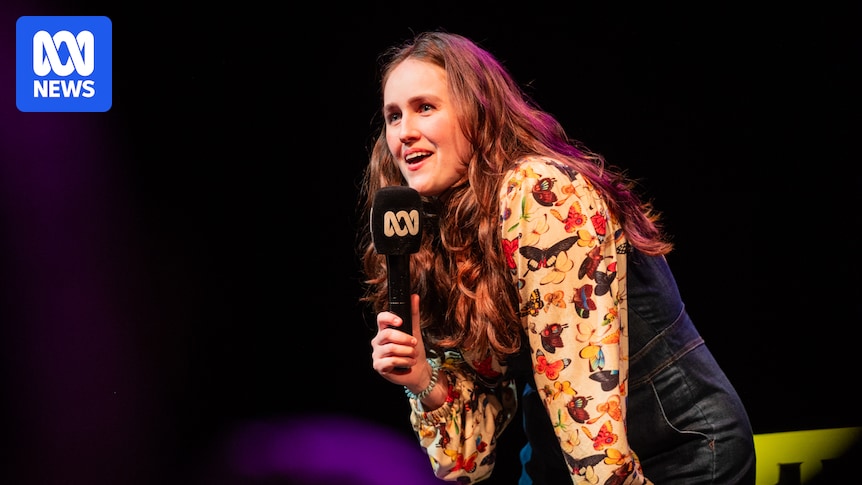
Grace Jarvis is a comedian who works in a sex shop.
Yes, those jokes practically write themselves.
But look a little closer, and you’ll see why Rolling Stone last year dubbed this rising Queensland comic a must-see at the Edinburgh Fringe Festival.
The self-described “autistic glamourpuss” (“it’s just that I have autism and a lot of dresses, basically”) is back for another run of performances at the 40th Melbourne International Comedy Festival (MICF).
‘What’s the lowest number you’ll perform for?’: Rove’s awkward MICF gig
Her latest offbeat autobiographical stand-up show, Getting Dragged Backwards Through a Hedge, is ostensibly about falling in love and the Edinburgh Fringe.
But there’s also a darkness to it, with Jarvis offering the kinds of insights on life that can only come from a very specific set of lived experiences.
We caught up with the London-based comedian — who also hosts a podcast exploring her and others’ experiences with pain — to find out how she got her start, what made her want to work in a sex shop, and why one element of her identity is noticeably absent from her work.
What was your first time doing stand-up like?
I was in Brisbane and it was the end of my first year of university, where I had not made a single friend.
I was following a bunch of comedians and writers I admired on Twitter and one of them was posting about doing an open mic near me, and I realised going was an option because I was 18 and allowed into bars.
It was 4:00pm on a Sunday in the back room of a bar in West End called The Bearded Lady and there were only other open mic comedians in the audience and I went, “I can do this.”
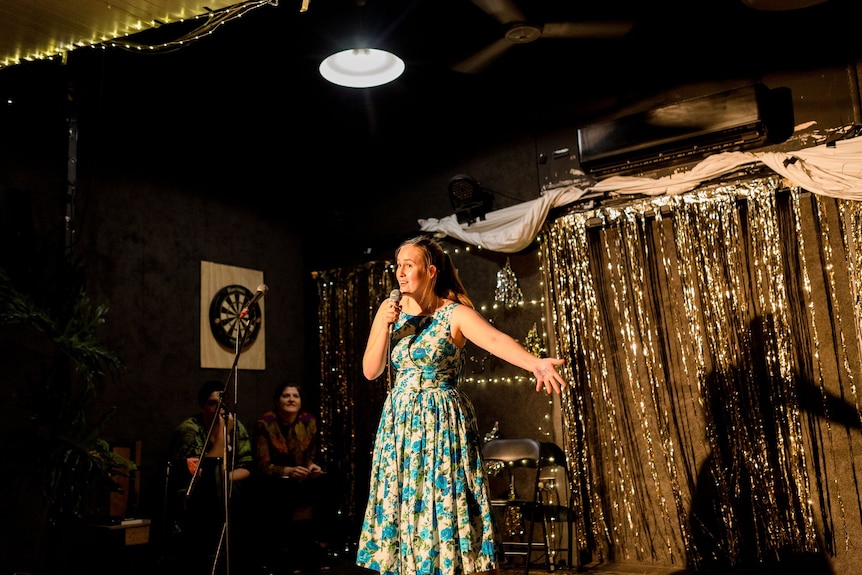
Jarvis says her dad was “annoyed” she didn’t let anyone see her first standup comedy performance because he’d watched her in every musical, play and choir she’d been in up to that point. (Supplied)
So, I went home to Toowoomba and I had my friend and my dad listen to me practise, and then I went back the next week alone, did my set, people laughed and I went, “Oh, this is the only thing I want to do forever, basically.”
I gigged in Brisbane until I finished university, then I moved to Melbourne and then there was a pandemic and now this is my sixth MICF, I believe.
Somewhere along the way, you swapped Melbourne — which technically has the world’s biggest comedy festival — for London. What prompted the move?
Loading Instagram content
A bigger pool of opportunities.
There are very few comedians in Melbourne who are full-time outside of the festival because it’s quite unsustainable to make a living; Australia still has quite a small arts industry.
I thought I might as well try to see what it is to be in a city that has gigs that pay every night.
So far, it’s pretty good. I still have a part-time job [working at the] sex shop, which has been very good for material and it’s quite an enjoyable retail job.
I also met my boyfriend over there and I’ve gigged at some very iconic clubs like The Comedy Store, and I opened for Aunty Donna at the Apollo.
We’ve got to circle back to the sex shop, obviously. Was that something you sought out for your stand-up?
I kind of had the idea on a whim.
I expected to have to apply for a lot of jobs, but I walked past this sex shop in October 2024 that said they were hiring and handed in my resume.
I put quotes from my show reviews on it because I don’t have a huge amount of other work experience and I had no references in the right time zone.
I was like, “I feel like it’s useful and relevant to retail experience that The Scotsman thinks I’m a delight.”
They just gave me the job.
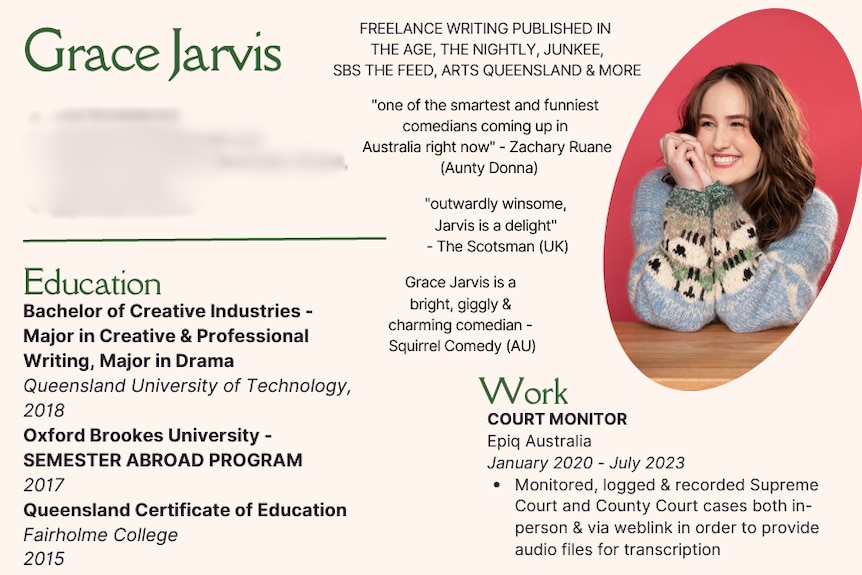
Who wouldn’t hire someone described as an “outwardly winsome … delight” by The Scotsman? (Supplied)
What’s the most bizarre interaction you’ve had with a customer?
I’ve had someone come in and they were really frantic and said they urgently needed a lot of lube. I only had four 250ml bottles, but it wasn’t enough.
And I was like, “A litre? You need more than a litre of lube?”
The more I think about it, they must have been hosting an orgy, but at the time I was like, “Is your friend stuck in a hole? Is this an emergency?”
Hidden costs mean many comedians make ‘zero profit’ from festival runs
It’s interesting, working in a sex shop, because it’s kind of the only place in the world where the autistic and neurotypical experiences are swapped.
I feel perfectly comfortable and everybody else is kind of on edge, refusing to make eye contact and not communicating clearly with me. And I’m not good at subtext, so I have to ask them to spell things out when they try to say, “I’m looking for, you know …” and it’s like, “No, I really don’t”.
But honestly, all the material I have is from when I started working there, because the longer I work there, the more I forget that any of this is odd or interesting. It’s just the job I do, I stopped taking notes.
Part of the reason I’m still working there is they don’t need me for many hours. I’m disabled, and in the past I’ve had casual jobs where I’ve tried to work the amount they expect or want you to work.
But I’ve completely wrecked myself to the point where I’ve had to stop because I’ve been completely fatigued and in pain.
When did you stop trying to force yourself into that box?
The pandemic, really. It made me realise I was more disabled than I’d been admitting to myself … that was when I got diagnosed with autism as well.
I remember saying, “You guys know how we’re all forgetting how to make eye contact?” and everyone was like, “No”.
Loading Instagram content
And I was like, “Oh, right, that was a skill that was meticulously taught to me, that I was only managing to continue due to forced practice.”
Then, a year-and-a-half later, I was also diagnosed with ADHD.
I just completely lost all tolerance for so much stuff that was causing me pain and discomfort that I’d been masking for so long.
I then had to reassess what I was able to do and acknowledge that I had been disabled the whole time and I’d been kind of killing myself to pretend that I wasn’t, and then I stopped being able to pretend that I wasn’t.
My parents have been very, very supportive, luckily. So it was kind of a blessing in disguise where I got to rejig my life and figure out what was possible for me based on what my brain and body were actually capable of achieving without imploding.
It’s truly crazy I didn’t get diagnosed earlier. I used to tell teachers and adults I felt like a cartoon character in a movie about real people. And they were like, “Oh wow, she’s so creative! What a writer.” That’s the reddest flag ever.
You’re very open about your autism and ADHD in your work — do you ever get any negative reactions?Stream the Melbourne International Comedy Festival on ABC iview
For the most part, when I say I’m autistic, people go, “Oh yes, I know what an autistic woman looks like and the way you’re describing the world and the way you’re behaving makes sense.”
But sometimes I get feedback I shouldn’t be joking about this, like, “My nephew has very high support needs and it’s very stressful on the family.”
And it’s like, “Hey, have you considered thinking at all from your nephew’s perspective? Or the fact that I’m not your nephew, and therefore autism is going to simply look different?”
Why do you think comedy attracts so many neurodivergent people?
My experience of autism is feeling like you’re being a person wrong, but when you get on stage it’s like, “This is my show and this is the character and the performance I’m doing, so I can’t be doing it wrong, because no-one else is doing it.”
And stand-up comedy is an autistic art form. It’s basically algorithmic social interaction where “this plus this equals laughter” and people don’t traditionally talk back.
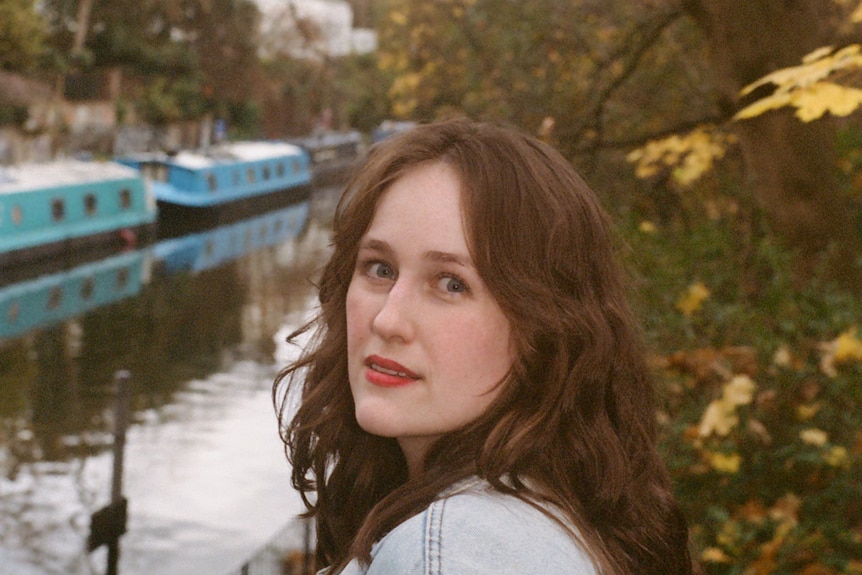
Jarvis loves that there’s “more first-person disability advocacy … as opposed to someone else describing what they think the experience of other people is” in comedy these days. (Supplied: Michael Julings)
It’s also the perfect ADHD art form, because the adrenaline that comes with it causes immediate dopamine. And it turns masking — a skill developed for survival — into a craft.
It’s crazy to think comedy wouldn’t be almost exclusively populated by neurodivergent people.
 Your podcast, The Agonies, explores your experiences with chronic illness, but this doesn’t come up in your comedy so much. Why’s that?
The premise of the podcast is about pain, but what I’ve noticed happen is that when I get people on who have disabilities or chronic illness, we’re all so sick of talking about it — explaining it to doctors and trying to get people to listen — that we end up chatting about something else.
And [with my comedy], people honestly want to hear about it even less than autism.
Here’s who you should see at comedy festivals across Australia
They don’t know how to respond and the laughing becomes a sympathy response really fast even if I’m only bringing it up for context, like why I’m walking the way I am or why I can’t work certain hours.
There’s nothing worse — I don’t need people to feel sorry over it.
So, half the time I don’t bother doing the material because it’s too much work to navigate other people’s emotional responses to pain that I’m having.
It’s also really hard for me to write material about it.
I have the ability to make so much stuff funny. But I think I’m still so traumatised by no-one believing me when I told them I was in pain all the time, that the audience doesn’t feel safe, and you need to make the audience believe you’re fine in order for them to laugh at your material.
Why does queerness feel safer to talk about?
Loading Instagram content
My experience coming out as queer was really similar to discovering I was autistic. It felt like there was this thing in me that was wrong and broken but as soon as someone told me what it was and that it was OK, I was like, “Oh, well, if that’s all it is, I can move forward with my life.”
They were both things I had to come to terms with, and realise the knowledge was actually positive … I grew up in country Queensland, and I went to an all-girls school, and it was not a great time or place to be queer.
I think that bisexuality and audiobooks are very similar in that both are wholly more enjoyable when you stop thinking about whether weirdos on the internet think they count.
Whose show are you most excited for this MICF?
I just saw Lena Moon last night, and it was really good. Celia Pacquola directed her show.
And Jack Knight — he’s from Brisbane as well and I think he’s one of the funniest comedians in the country.
And Olga Koch! She’s doing such cool and interesting stuff about men’s mental health.
Quotes lightly edited for clarity and brevity.
The Melbourne International Comedy Festival runs until April 19, where Grace Jarvis is performing Getting Dragged Backwards Through a Hedge. Watch the 2026 MICF Gala and All Stars Supershow on ABC iview.