

The University of Technology Sydney (UTS) spent nearly $1.5 million on an executive leadership coach in the lead-up to drastic cuts to jobs and courses to manage what its vice-chancellor considered to be a financial crisis.
Documents obtained by Four Corners through the Government Information (Public Access) Act (GIPA) show UTS vice-chancellor Andrew Parfitt and his leadership team spent hundreds of thousands of dollars a year on executive coaching company Beyond Excellence from 2021.
About $783,000 — more than half the total amount — was spent in 2024 when the university began planning substantial budget cuts to deal with the perceived financial crisis.
At the time, Professor Parfitt was on a mission to save $100 million a year after recurring deficits. UTS spent about $7 million on external consultants from KPMG to provide advice on how to save money, ignoring in-house expertise from its highly regarded Business School.
Professor Parfitt had been planning to slash 400 jobs, representing about 10 per cent of its workforce, along with 167 courses and more than 1,100 subjects.
A revised plan has seen annual savings of $85 million, with about 120 academic jobs axed, 143 courses and 839 subjects discontinued and an announcement of cuts to professional staff delayed.
The spending by UTS on a leadership coach has further angered the National Tertiary Education Union (NTEU), which has been pushing back on the university’s job and course cuts.
“UTS executives paid for Beyond Excellence coaching, yet delivered anything but excellence in leadership,” NTEU NSW secretary Vince Caughley told Four Corners.
Referring to the decision to implement the cuts, he said “the result has been reputational damage, regulatory scrutiny, and real harm to staff — and a collapse in confidence in the vice-chancellor and his team.
“They spent big on coaching, promised excellence and delivered chaos.”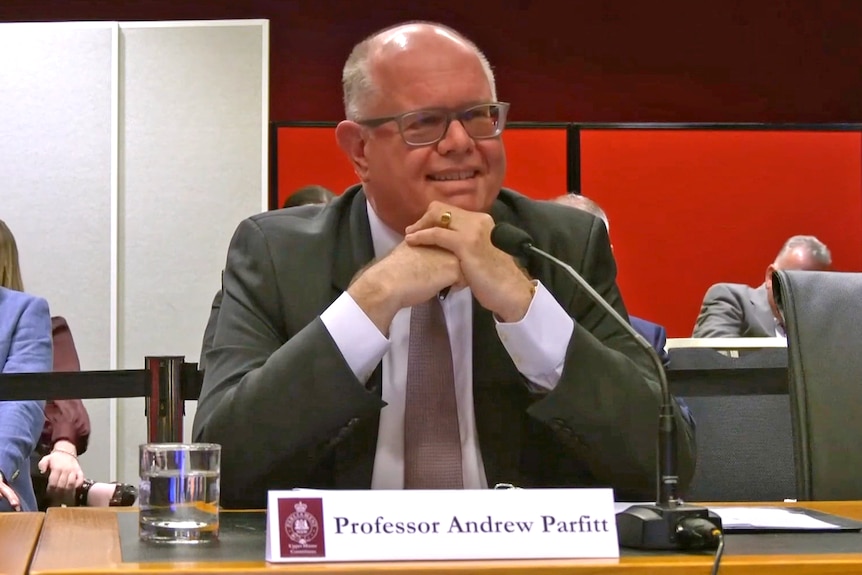
Professor Andrew Parfitt is UTS’s vice-chancellor and president. (Supplied: NSW Parliament)
‘Dear Andrew’
The documents accessed under GIPA date back to 2021 and show that in that year, UTS contracted Beyond Excellence for a six-month executive coaching program with the company’s founder, Julie Birtles.
Her workload rapidly expanded.
Insiders have told Four Corners Ms Birtles was often hot-desking near the vice-chancellor’s office and that she managed to convince the university’s leadership to expand her consulting work, despite UTS’s leadership arguing they were in a financial crisis.
The documents include letters Ms Birtles wrote to Professor Parfitt, making the case for her ongoing services.
“Dear Andrew”, each letter began.
“Key success factors lie in your ability to lead a senior team through transition and for the ULT [university leadership team] to work together to overcome historical differences,” a letter from June 2022 said.
She billed for services she said would “catalyse deep change” including “executive transition support,” “leadership circle feedback,” and even “confidential” interviews with Professor Parfitt’s colleagues about his leadership, while reporting back to him the “key themes” of those conversations.
“Recent feedback identified a shift in the organisational tone and a need for sophisticated leadership to foster trust, engagement and to steer the organisation through continuing change and transformation,” Ms Birtles wrote to Professor Parfitt in October 2023.
The consultant’s reach trickled through to the science faculty, for whom she ran leadership retreats in February 2024 and 2025.
She was present at a two-day retreat at Manly Beach last year when the university’s full leadership team first heard about the scale of the cuts UTS would make.
One UTS insider told Four Corners Ms Birtles ran a “collaborative leadership” workshop with UTS’s leadership team because its leaders did not get along.
“If you look at the paper trail, Beyond Excellence has worked with the leadership team since December 2021 — to be still spending half a day on listening and collaborative leadership exercises at the executive retreat nearly four years later is insane,” they said.

Staff say it’s hard to understand why UTS spent money on a leadership coach. (Four Corners: Nick Wiggins)
By 2025 UTS had paid Beyond Excellence $1,487,461 over the four-year period covered in the GIPA documents.
The same year a motion of no confidence in the vice-chancellor’s leadership passed with support from 95 per cent of the more than 1,500 UTS staff who voted.
Ms Birtles declined to comment.
The revelations of UTS’s almost $1.5-million splurge on an executive coach has outraged staff who have seen jobs and courses slashed.
The School of Public Health, which teaches the next generation of health workers in areas such as pandemic preparedness and indigenous health, has lost more than half its academic staff and two degrees in the cuts.
Professor Andrew Hayen is taking voluntary redundancy from the School of Public Health and says “students are bearing the impact” of the cuts.
“It’s very hard to reconcile those priorities. It’s dismaying to see,” he said.
“People are asking how there’s money for external leadership consulting and travel at that scale, but not to sustain core public health teaching and research.
“It seems like there is one rule for the executives who can spend as much as they like and another for the core staff of UTS who have to bear the consequences through job losses and austerity.”

Julie Birtles’s consulting business received almost $1.5 million from UTS between 2022 and 2025. (Supplied)
Thousands spent on interstate travel
The university also paid more than $126,000 for airfares and hotels for Ms Birtles, whose business is based in Geelong, Victoria.
The documents show that in the last four years, the university paid for 91 airfares between Melbourne and Sydney and more than 80 hotel reservations.
Universities paying consultants and contractors nearly $2b a year
Three quarters of the total travel expenses were between 2024 and 2025, with Ms Birtles’s visits continuing into February this year.
UTS said no invoices have been received from Beyond Excellence as of February 11, 2026.
The university did not respond to questions about why it chose to engage a consultant from interstate with such frequent travel needs.
A UTS spokesperson said the university only used consultants where it did not have the internal capacity or skills required for specific projects.
“It is common practice for organisations to undertake leadership team development to enhance collective performance, collaboration and the effectiveness of senior leadership to support delivery of strategy,” they said.
However, UTS does have internal capacity to provide leadership coaching.
UTS has a School of Professional Practice and Leadership and an Executive MBA Course. It has also previously boasted of its own in-house leadership program for emerging leaders.
Exemptions from the norm
The documents also reveal that much of the work performed by Beyond Excellence was exempt from UTS’s usual tender processes.
University staff approved six applications for procurement exemption, including two for contracts worth more than $250,000.
Executives, including the vice-chancellor himself, argued that “trust between the coach and the coachee, which takes time to establish” justified the exemption.
“The expected outcomes and impact measures from this work have been discussed confidentially between Julie and the Vice-Chancellor,” Professor Parfitt wrote to procurement officers.
Money spent on external consultants is disclosed in UTS’s annual reports.
A UTS spokesperson said Beyond Excellence was engaged in line with the university’s procurement policy.
“UTS’s procurement policy provides a framework for transparent and ethical purchasing while ensuring value for money, fair competition and compliance with legal standards,” they said.
The federal government has vowed to implement a new set of university governance principles that would force universities to properly disclose any consultancy spending, its purpose and value.
Watch Four Corners’s full investigation into Australia’s universities on ABC iview.