
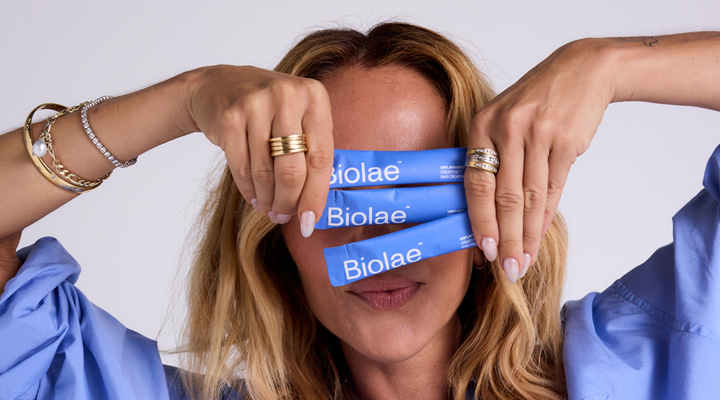
At 39, Pip Edwards found herself confronting something millions of women experience, yet few are prepared for. “We know all about periods, we know about fertility and yet we get to midlife and no one knows a thing,” she told Inside FMCG. Instead, the PE Nation founder found herself navigating it alone, in what she described as a “wild goose chase” for answers, an experience that would ultimately lead her to partner with women’s supplement brand Biolae. The result is a product suite des
Unlock indepth features,executive
interviews and quarterly magazines

At 39, Pip Edwards found herself confronting something millions of women experience, yet few are prepared for. “We know all about periods, we know about fertility and yet we get to midlife and no one knows a thing,” she told Inside FMCG. Instead, the PE Nation founder found herself navigating it alone, in what she described as a “wild goose chase” for answers, an experience that would ultimately lead her to partner with women’s supplement brand Biolae. The result is a product suite designed to address some of the most common symptoms of perimenopause, including a supplement targeting hot flushes, mood and sleep, a hormone-free vaginal insert for discomfort, and a creatine-based body composition formula.This is where the retail story begins. Perimenopause is emerging as a category in its own right, not fully claimed by healthcare, yet too complex to sit comfortably within traditional wellness. For retailers in pharmacy and supplements, it presents both an opportunity and a challenge; how to sell into a life stage that has historically gone unspoken, underdiagnosed and poorly served. Booie Beauty, founded by Celeste Barber and Claire Greaves, helped move the conversation toward more honest, age-inclusive narratives, opening space for brands now addressing midlife more directly. Biolae sits within the next phase of that evolution, where the conversation moves from visibility into treatment. Founded by Briella Brown and Maryalic Rosa in 2024, Biolae’s premise was quite simple: perimenopause is not simply a lifestyle inconvenience, it is biology and like any other stage of health, it needs to be easier to access and talked about more openly.Trial and errorEdwards decision to join as a shareholder rather than an ambassador supports that ambition. “There was a lot missing. Information, guidance, clear diagnosis pathways and solutions with real clinical integrity,” she said. “For me, it was a lot of trial and error.” The women’s health market is becoming crowded, with many personalities lending their names to products. Edwards’ decision to invest, rather than simply endorse, signals a deeper level of belief, not just in the message, but in how the brand is built. For her, that bar had to be higher, shaped by her own experience of being dismissed.That bar, according to Brown and Rosa, begins with clinical validation, a term that has become ubiquitous to the point of dilution. The pair found GPs struggled to recommend non-hormonal options, leading them to believe something more robust was needed. With a TGA-approved medical device set to launch, aimed at a symptom affecting up to 90 per cent of women, it is not incidental that this was previewed at the Australasian Menopause Society Congress. Dual channel approachHere, the company is building its category across two fronts, using direct-to-consumer as a way to educate and form a closer relationship with its audience, while turning to physical retail to signal credibility and embed the products within everyday healthcare routines. For now, that presence in-store remains early, with initial placements across independent pharmacies and specialist retailers.For Edwards, the role remains focused on amplification. “I’m deeply focused on widening the conversation, igniting it in every room I enter, and using my platform to help normalise the experience,” she said. Evidently, the conversation is moving out of clinics and into society, and subsequently, onto shelves. What remains uncertain is who ultimately defines the category, whether it is led by clinically grounded brands, scaled by retail or diluted by the speed of its own growth. What is clear is that perimenopause is no longer a small player at the margins. It is becoming visible, commercial and contested.