
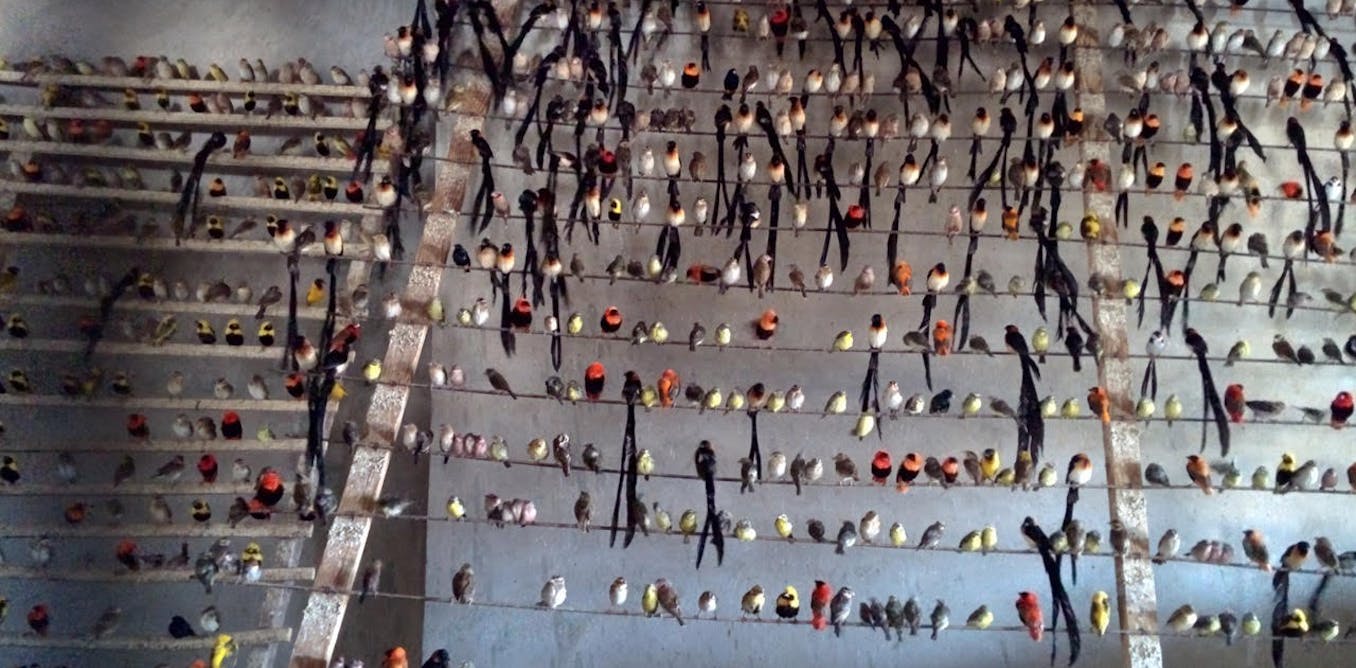
Birds have, for centuries, been captured from the wild to be kept in cages – valued for their looks, songs and ability to imitate sounds. Data compiled by the Convention on International Trade in Endangered Species (CITES), the global agreement that regulates trade in threatened animals and plants, indicate that in the 1990s and early 2000s Africa was a leading supplier of live birds to global markets. Most were captured from the wild and sold to western European countries.

Cut-throat finch for sale in Hong Kong.
Sam Inglis/ ADM Capital Foundation
This trade was permitted under rules at the time, despite concerns raised by conservationists about animal welfare and public health. Then in 2005, a global outbreak of avian influenza prompted a suspension on imports of all wild birds into the European Union, saving millions of birds from being captured and sold.
Shortly after, in 2007, 114 of the most traded bird species were removed from the CITES lists. These species had accounted for over 70% of the global bird trade. Currently, over 80% of bird species are not listed by CITES and very few countries publish data on trade in non-CITES species.
This means that when these birds are sold across borders, trade is not systematically recorded in global wildlife databases. Decision-makers tasked with managing risks to people, wildlife and ecosystems lack information on the scale or scope of trade or its impacts.
Read more:
Big tech, regulators and conservationists must unite to tackle online wildlife trade
As a group of scientists with knowledge of the bird trade in both Africa and Asian trade hubs, we set out to explore how customs data compiled by the United Nations Comtrade database could address this blind spot. This database records the trade of many commodities reported by national customs authorities, including live animals not listed on the CITES appendices.
We focused on trade between 2006 and 2020 in live birds from African countries to Hong Kong and Singapore – well known hubs in global trade networks, with some of the most complete customs data.
Read more:
Goldfinches need protection – migrating songbirds might be vanishing from North Africa
Public attention often focuses on illegal trade in charismatic species such as parrots. But our research found that a vast international trade is taking place in species that rarely make headlines.
The overlooked trade in wild birds is important. It carries risks for wildlife conservation, animal welfare and human health.
More than a million birds
Our research found that the scale of bird trade has been significantly underestimated. Since 2006, 1,085,326 birds have been imported into Hong Kong and Singapore from around the world.

Yellow-fronted canary for sale in Hong Kong.
Sam Inglis/ADM Capital Foundation
This number excludes parrots (including popular exotic pets such as budgies and cockatiels) as well as birds of prey and poultry. Our focus was on birds that are not commonly bred in captivity and for which trade is not regulated through CITES permits.
Of these, we found that more than 700,000 birds – about 65% of all imports – came from African countries. Most exports originated from a handful of countries, including Mali, Guinea, Mozambique and Tanzania. But the main exporters changed over time, with Mali and Mozambique becoming more prominent.
Most were likely captured from the wild, posing particular risks to wild populations, and from the spread of infectious diseases and invasive species.
Read more:
Does parrot farming protect wild species? Wildlife trade researchers review the evidence
Although striking, these figures only represent a snapshot of the African bird trade. Another recent study revealed export markets for African birds in a range of countries, across the Middle East and Asia. South Asian countries such as Bangladesh, Pakistan and India, which were not a focus of our study, featured prominently. Many west African birds were also exported to the US.
Songbirds are at the centre of trade
The Comtrade data we used does not provide information on the exact species being sold. However, when we examined detailed import records from the Hong Kong government, we found this trade was dominated by small songbirds.
In particular, canaries in the genus Crithagra accounted for the vast majority of imports to Hong Kong. Two species – the yellow-fronted canary and the white-rumped seedeater – made up around 84% of birds imported from Africa between 2015 and 2020. These birds are popular in the caged-bird trade and are kept in homes because of their ability to sing.
Read more:
Global trade in wild animals is soaring – South Africa’s laws aren’t doing enough to prevent harm
Most of the species listed in the import records to Hong Kong are currently classified as “least concern” on the IUCN Red List. But this does not necessarily mean the trade is harmless. Trade is considered be contributing to declines in the wild for several of these species.
Read more:
TikTok’s online wild meat sellers – study finds endangered species on offer in west Africa
A recent study found that beyond songbirds, at least 83 bird species from 26 avian families are being advertised for export from Africa. Among them are turacos, hornbills and various water birds. The risks that this trade poses were highlighted by the listing of several species of African hornbills on CITES in November 2025 following concerns about impacts on numbers in the wild.
Other species may require similar protections but we lack reliable information about how many birds are being taken from the wild and whether this is sustainable.
Risks for wildlife and people
There are multiple other risks associated with the trade in wild birds.
Bird trade has been linked to the transmission of pathogens including avian influenza, psittacosis and other diseases that affect both wildlife and humans. Countries involved are therefore exposing themselves to zoonotic diseases and other biosecurity risks, particularly when large numbers of species are housed together in stressful conditions.
Wildlife trade can also lead to ecological problems if animals are released or escape and set up populations outside their native area.
Read more:
What makes mountain birds sing at dawn – and why are they sometimes quiet? Ecologists explain
Because of the risks, many countries have taken action to ban or heavily restrict the commercial export of their native wild birds. Tanzania was once one of the largest exporters of birds globally but in 2016 ended exports. The impact of this decision was evident in our study, which showed a dramatic reduction in trade from Tanzania.
Similarly, many countries, such as Australia, EU member states and India have moved to prohibit imports of wild birds to protect wild populations, and reduce disease risks.
Better monitoring and stronger protections needed
Our findings highlight a major gap in how wildlife trade is monitored globally. Millions of animals move across borders every year, but if they belong to species that are not formally protected under national or international rules, this passes unnoticed.
Better monitoring is needed to understand the scale and impacts of this trade. Improvements could include customs reporting systems that record data at the species level, rather than grouped into broad categories, and listing more species under CITES.
Read more:
Bad gift ideas: ferrets and other exotic wild mammals as pets
The international bird trade is far larger and more complex than many realise. Without better monitoring and stronger safeguards, a trade that is largely invisible and unregulated will continue to pose risks to wildlife, ecosystems and people.
Alisa Davies and Sam Inglis co-authored this article and were part of the team who wrote the research paper that this article is based on.