
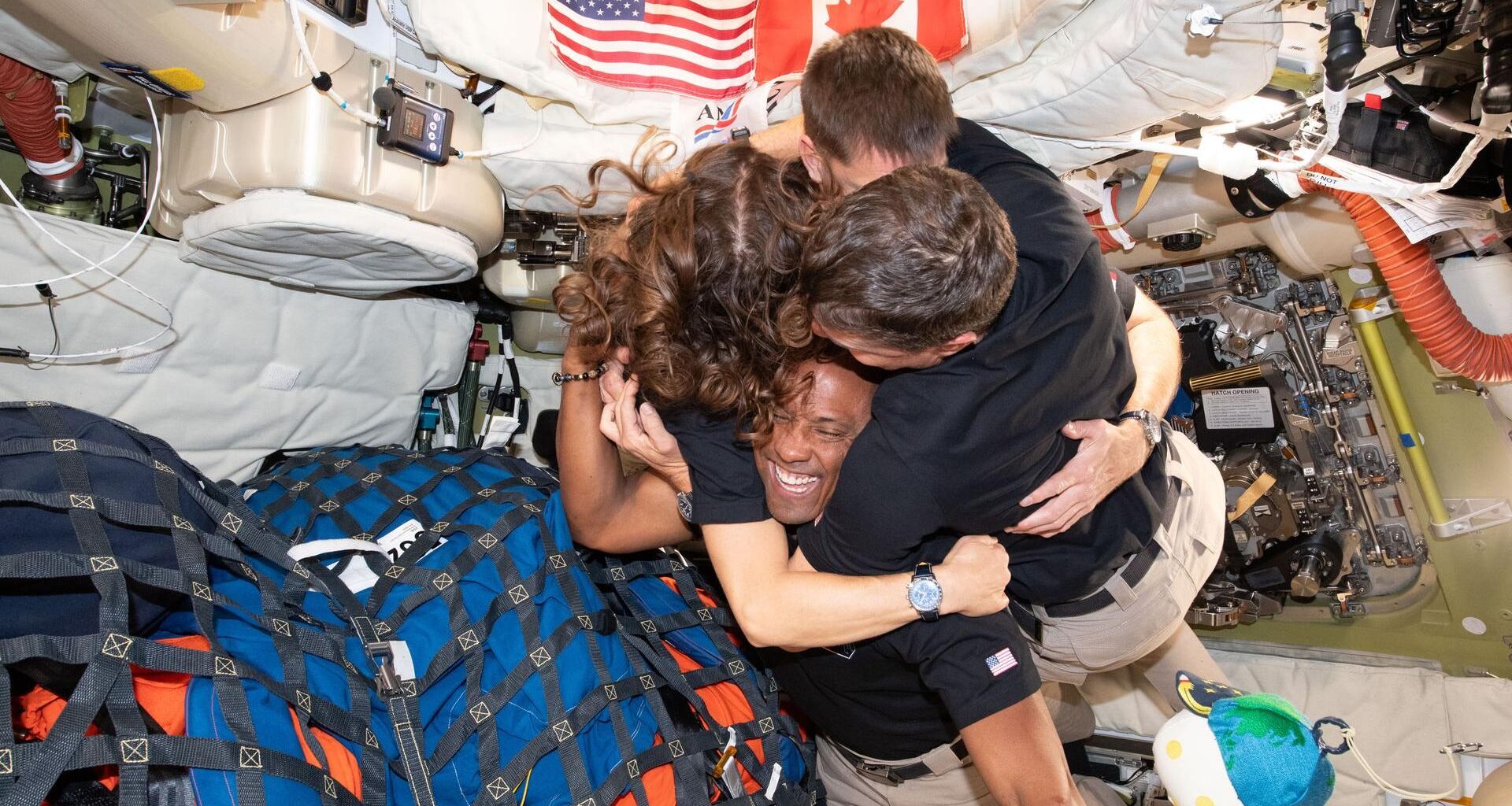
Just after they broke a 56-year-old spaceflight record, the Artemis 2 astronauts shared a powerful moment that deepened their already profound bond.
The astronauts marked the occasion by celebrating a lost loved one — Artemis 2 commander Reid Wiseman’s late wife, Carroll Taylor Wiseman, who died of cancer in 2020. Mission specialist Jeremy Hansen radioed down to Mission Control, asking permission to name a moon crater after Carroll.
You may like

Artemis 2 commander Reid Wiseman and his wife Carroll Taylor Wiseman. (Image credit: Wiseman Family)
“There is a feature in a really neat place on the moon, and it is on the near side-far side boundary,” Hansen said.
“In fact, it’s just on the near side of that boundary, and so at certain times of the moon’s transit around Earth, we will be able to see this from Earth,” he added. “It’s a bright spot on the moon. And we would like to call it Carroll.”
That beautiful moment had been in the works for more than a week, Wiseman revealed on Wednesday night (April 8) during a call that he and the other Artemis 2 astronauts — Hansen, Victor Glover and Christina Koch — held with reporters.
“My crewmates approached me when we were at Kennedy in quarantine,” Wiseman said, referring to NASA’s Kennedy Space Center in Florida, the site from which Artemis 2 launched on April 1. (The astronauts arrived at KSC to prep for that liftoff on March 27.)
“They said the three of them had talked, and they would like to do this,” he added. “That was an emotional moment for me. And I just thought that was just a total treasure, that they had thought through this, and they had offered this.”
Wiseman gave them his approval. But he had one request.
“I can’t give the speech,” he said. “I can’t give the talk. And Jeremy, the kind of guy he is, he said he would do it. And it was getting emotional there.”
What to read next
Wiseman said he really lost it when Hansen spelled out Carroll’s name for Mission Control on Monday, to make sure the crater would be properly identified.
“I think for me, that’s when I was overwhelmed with emotion,” Wiseman said. “And I looked over and Christina was crying. I put my hand down on Jeremy’s hand as he was still talking — it was right there on that rail — and I could just tell he was trembling, and we all pretty much broke down right there.”
That was “the pinnacle moment of the mission” for him personally, Wiseman said.
“That was, I think, where the four of us were the most forged, the most bonded, and we came out of that really focused on that day ahead,” he added.
And that was a very busy and remarkable day: The astronauts flew around the far side of the moon on Monday, seeing some areas that had never been viewed by human eyes before. They were also treated to a celestial marvel, witnessing a total solar eclipse from beyond the moon.
The flyby also charted the astronauts’ journey home, as lunar gravity slingshotted their Orion capsule back toward Earth. The quartet will arrive here Friday evening (April 10), with a splashdown in the Pacific Ocean off the coast of San Diego.
Here is a labeled image so you can see the craters more clearly! pic.twitter.com/H2dHIdKXcvApril 7, 2026
The Artemis 2 astronauts were already close before Carroll Crater was a thing — far before launch, in fact. They were selected for the mission in April 2023, so they’ve been training together intensely for the past three years.
But their experiences off Earth have deepened and tightened those bonds, which extend beyond their Orion capsule to the entire mission team.
Koch, for example, was asked on Wednesday night what she will miss most about being in space after she comes home. This was her response:
“I will miss this camaraderie. I will miss being this close with this many people and having a common purpose, a common mission — getting to work on it hard every day, across hundreds of thousands of miles with a team on the ground. This sense of teamwork is something that you don’t usually get as an adult. I mean, we are close, like brothers and sisters, and that is a privilege we will never have again.”
The Artemis 2 crew also proposed naming a moon crater after their Orion capsule, which they christened “Integrity.” Mission Control greenlit both suggestions, but that’s not the end of the story. Before Carroll Crater and Integrity Crater can get added to official lunar maps, they must be approved by the International Astronomical Union.