
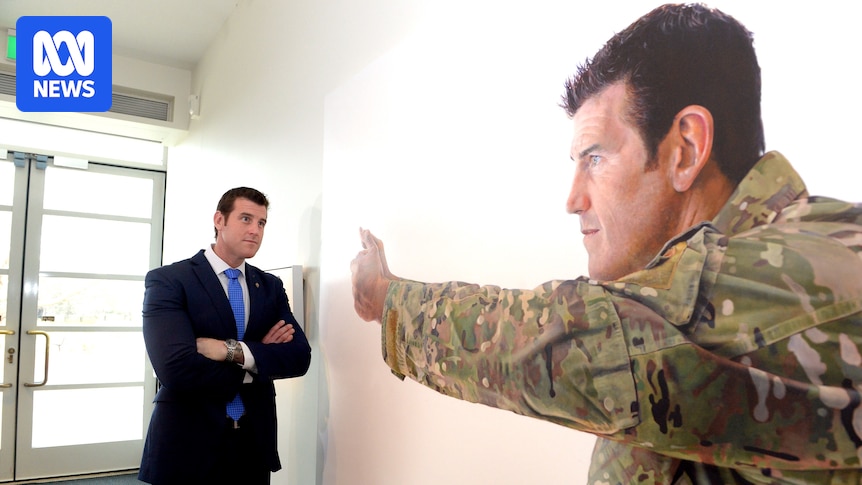
On Anzac Day in 2014, Ben Roberts-Smith took to the lectern at the Australian War Memorial’s dawn service.
At this point, just under 12 years ago, he was unquestionably a national hero.
He was Australia’s most decorated living soldier — a recipient of the Victoria Cross, a Medal for Gallantry and a Commendation for Distinguished Service.
Any one of those medals would mark an extraordinary achievement.
Memorial to review Ben Roberts-Smith display following war crimes charges
In 2013, he was named Father of the Year.
Later in 2014, he would be named chair of the Australia Day Council, tasked with finding the next Australians of the Year.
Standing over 2 metres tall, Mr Roberts-Smith’s imposing figure had become — as former prime minister John Howard recently described — the “modern personification of the great Anzac tradition”.
In the pre-dawn gloom of that cool Canberra morning, Mr Roberts-Smith addressed the more than 35,000 people gathered.
“The men and women of the Australian military have on every occasion served with distinction,” he said.
His looming trial will put that statement to the test.
The next trial of the century
For the past four mornings, Ben Roberts-Smith has woken in a single cell at Sydney’s Silverwater jail.
His lawyers did not apply for bail when the case was mentioned in court on Wednesday, but he could apply for bail at another hearing late next week.
He is facing five charges of the war crime of murder and has long denied the allegations since they first emerged in media reports in 2018.
It is alleged he either killed, or “aided, abetted, counselled or procured” a subordinate soldier to kill several unarmed, detained people in three separate incidents between 2009 and 2012.
The maximum penalty for the war crime of murder is life in prison.
These charges are historic for a couple of reasons.
Ben Roberts-Smith becomes just the second current or former Australian Defence Force member to face a war crimes charge under Australian law.
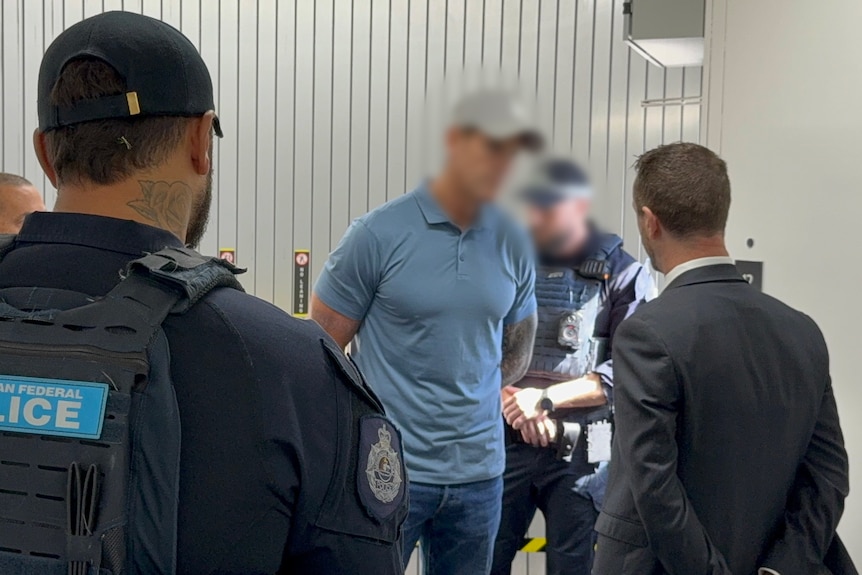
Ben Roberts-Smith was arrested at Sydney airport on Tuesday. (Supplied: Australian Federal Police)
The first is Oliver Schulz, a former special forces trooper charged with unlawfully killing an Afghan villager in a field.
While many would associate the prosecution of war crimes with the International Criminal Court in the Hague, Australia has the jurisdiction, as a signatory to the court, to prosecute its own cases locally.
But Emily Crawford, a specialist in international law at the University of Sydney, said countries bringing charges against their own servicemen and women remained rare.
“There have been plenty of examples of states bringing charges against foreign personnel, or foreign fighters or things like that,” Professor Crawford said.
“But there hasn’t been a history, especially with regards to what took place in Afghanistan, of charges being brought against the state’s own personnel.
“We’re starting to see a really encouraging trend domestically, which is a contrast to what we’re seeing internationally.”
But Mr Roberts-Smith has, of course, been through the courts before.
Ben Roberts-Smith’s fight to clear his name just got more perilous
In May 2023, Mr Roberts-Smith lost a years-long defamation battle with Nine Newspapers, when the federal court ruled the newspapers had established “substantial truth” to published allegations of war crimes.
That civil test is different to the criminal test now before the courts, where prosecutors must prove allegations beyond a reasonable doubt.
That defamation case, brought on by Mr Roberts-Smith and funded in part by billionaire Kerry Stokes, was labelled at the time as the “trial of the century”.
After his defeat, it was considered by many a spectacular own-goal.
Mr Roberts-Smith and his backers had hoped the case would clear his name.
Instead, the federal court ruled Australia’s most decorated soldier might also be its highest-profile war criminal.
A force divided
Should he be found guilty, these criminal charges would be a personal reckoning for Mr Roberts-Smith.
But inside the ADF, it is also something of a culmination of a long and tortuous reckoning over what happened in Afghanistan.
For four years between 2016 and 2020, the inspector-general of the ADF ran the Afghanistan Inquiry, looking into what it described at the outset as “rumours and allegations” of war crimes committed by special forces soldiers while serving in Afghanistan.
It found that “overwhelmingly, [those deployed] performed skilfully, effectively and courageously”.
But in its final report, known as the Brereton report, it said the “short and sad” answer was “there is substance to those rumours”.
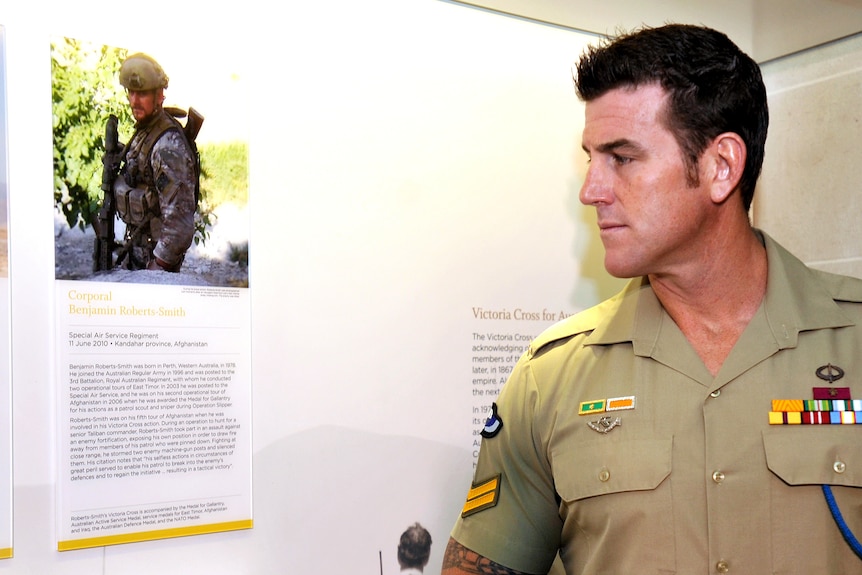
The decorated soldier, who was awarded a Victoria Cross, was celebrated with a display at the Australian War Memorial. (AAP: Alan Porritt)
There was credible information of 23 incidents where one or more people had been unlawfully killed, in what would amount to a war crime if proven in court.
Across those 23 incidents, 39 people had been killed and two more cruelly treated, by 25 special forces operators.
That inquiry heard evidence from 423 witnesses.
The inquiry found “credible information that junior soldiers were required by their patrol commanders to shoot a prisoner, in order to achieve the soldier’s first kill, in a practice that was known as ‘blooding’.”
It found credible evidence of the use of “throwdowns”, where weapons, grenades or radios were placed on the bodies of people killed “in order to portray that the person killed had been carrying the weapon or other military equipment when engaged and was a legitimate target”.
But it is the question of blame that still stirs fury among some current and former ADF members.
The report found that knowledge of what was going on was effectively contained below the rank of patrol commander (corporal or sergeant).
“It is overwhelmingly at that level that responsibility resides,” it found.
Fewer than a fifth of those now working in Special Operations Command served in Afghanistan.
But former members speak of “intergenerational distrust” that has seeped through the ranks of Australia’s most elite military units, as younger members, who did not serve in Afghanistan, take a cynical view of how they might be held accountable for their actions in future, versus those in higher office.
Shouldering the blame
Former special forces operators spoken to by the ABC view the crimes alleged to have been committed by Ben Roberts-Smith with quiet disgust.
“Never in my mind did it become apparent that committing a war crime was justifiable, ever,” one said.
Some others have argued that judging actions from a complex battlefield, years after the fact and a long way removed from that reality, doesn’t sit well.
But there are some common complaints.
One is the time taken to reach the point of laying charges.
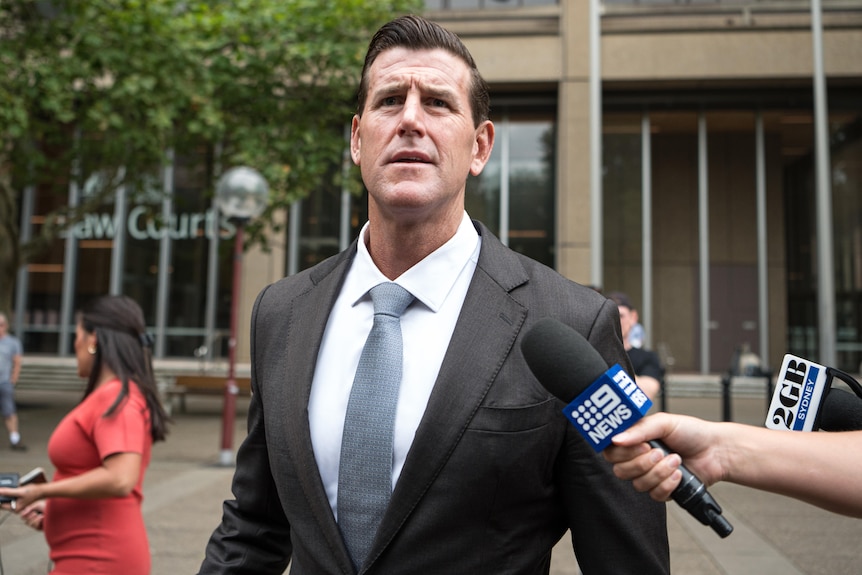
Ben Roberts-Smith has previously received the backing of billionaire Kerry Stokes. (AAP: Flavio Brancaleone)
The Office of the Special Investigator, tasked with investigating the allegations made in the Afghanistan Inquiry, has spent more than five years and more than $250 million on its work.
But another is the question of accountability.
Some view the Brereton report as having provided cover for senior officials to avoid scrutiny of their actions — if not with direct knowledge of what was going on, providing an environment where what was alleged to have happened could take place.
And they say while a “warrior” culture was allowed to take hold within the ranks of non-commissioned officers, as the Brereton inquiry found, there should be scrutiny of those whose job it was to reign it in.
That said, those at the highest levels of the ADF insist lessons have been learned from the Afghanistan inquiry.
There is a wide recognition of a massive over-reliance and over-deployment of special forces throughout that period.
Former defence force chief Chris Barrie said that should be one of the primary lessons.
“I know people in special forces deployed 12 times into Iraq and Afghanistan. I think it’s unconscionable,” he said.
“The fact of the matter is they were doing tasks, and most of them were doing it very well, that could have been given to others [in the broader military],” he said.
“Government thought that only special forces could do these jobs … you’ve got a lot of highly trained people in the defence force and you should use them all.”
But there is another view high up in the ADF — that the overuse of special forces cannot be used to justify alleged war crimes.
What is being alleged did not occur in the “fog of war”, they argue, but after combat had ceased — and that creates a clear distinction.
Billionaire backers and taxpayer dollars
The arrest of Mr Roberts-Smith has sparked a significant community response too.
Many have avoided commentary on the case — like Prime Minister Anthony Albanese, and others in government who have warned of jeopardising the court process.
Others, particularly on the conservative side of politics, were deeply critical.
Nationals MPs like Michael McCormack, Pat Conaghan and Bridget McKenzie aired concerns, while One Nation leader Pauline Hanson said she remained “steadfast in her support” of Mr Roberts-Smith.
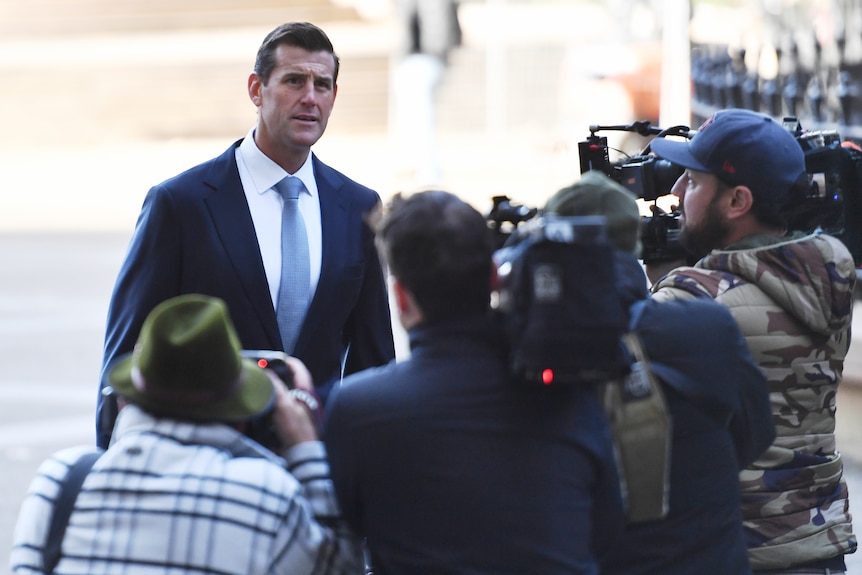
Ben Roberts-Smith has been charged with five counts of the war crime of murder. (AAP: Dean Lewins)
Mr McCormack questioned if the public was right to judge those who had fought abroad.
“We must also remember the realities of war are not understood by those who have never worn the uniform,” he said.
Opposition Leader Angus Taylor has been critical of the manner of Ben Roberts-Smith’s arrest, with AFP cameras capturing his arrest while travelling with his family at Sydney Airport.
“It was a very public arrest, and it was done in front of his kids,” he said.
“There are reports that he offered to hand himself in, in advance of that occurring.
“There are questions here for the government: What did they know about this, were they informed about this, and were they part of supporting that decision to make that very, very public arrest?”
Speculation has also begun on who might help fund Ben Roberts-Smith’s legal bills this time around.
Billionaire Kerry Stokes, who previously employed Roberts-Smith at Seven West Media, has been silent on his arrest.
But another billionaire, Australia’s richest person, Gina Rinehart, was quick to ask that “compassion” be extended to Mr Roberts-Smith and his family.
She questioned the time and taxpayer money spent on his prosecution.
A spokesman for Mrs Rinehart would not comment on whether she had helped fund his legal bills before, or intended to do so in future.
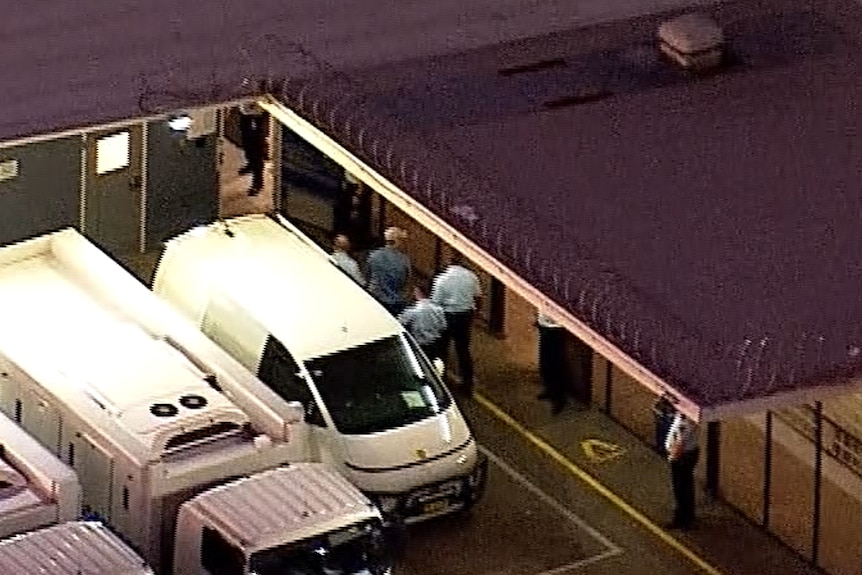
Ben Roberts-Smith was taken to Sydney’s Silverwater Prison after his arrest. (ABC News)
One avenue of funding appears readily available.
At the time the Office of the Special Investigator was launched in 2021, so too was a Commonwealth fund set up to help those being investigated cover the cost of legal expenses.
Criteria for accessing the Afghanistan Inquiry Legal Assistance Scheme extended to anyone “charged with a crime in relation to matters that are the subject of the AFP or OSI Afghanistan investigation”.
Legal expenses are capped, but would appear to be open to Mr Roberts-Smith to take up.
Scores seek compensation
It’s not the only funding scheme established in the wake of the Brereton inquiry.
In 2024, the federal government set up the Afghanistan Inquiry Compensation Scheme, born of a recommendation from the inquiry.
It offers family members of those “unlawfully killed”, or individuals who suffered “unlawful assaults or property damage” either financial compensation, help with repairs like the construction of new buildings, or simple letters of apology.
That assistance is limited to those incidents set out in the Brereton report, where credible information was found that incidents took place.
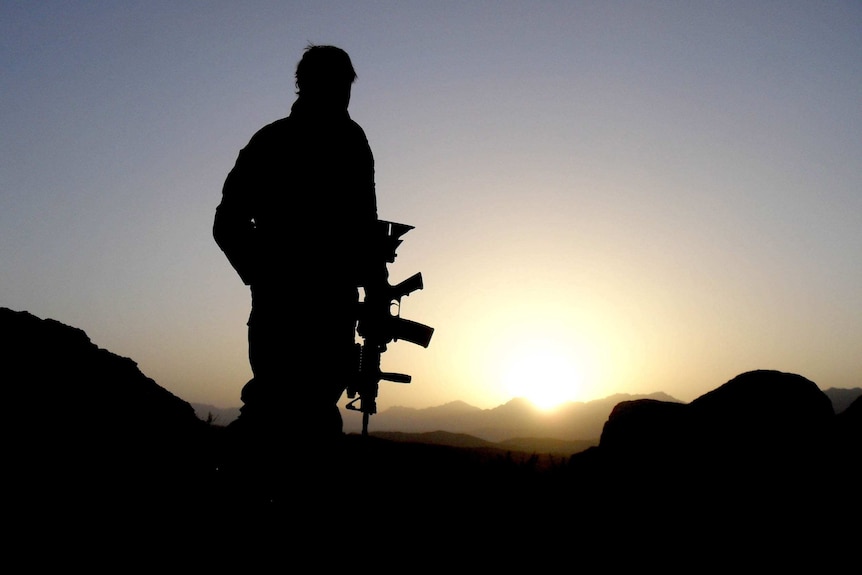
A Commonwealth fund was established to help cover legal costs for anyone charged as a result of the AFP and OSI investigation. (Supplied: Defence Force)
According to the ADF, so far about 100 applications have been made.
Due to privacy concerns, it is not known how many have been found to be valid.
Asked for his views on those who argued that civilians could not understand the realities of war, or pass judgement on those who have been there, former defence chief Mr Barrie had a simple message.
“Being a force for good is really very important to the underpinnings of service to the nation,” he said.
“I also think that’s what the majority of people in our community expect.”