
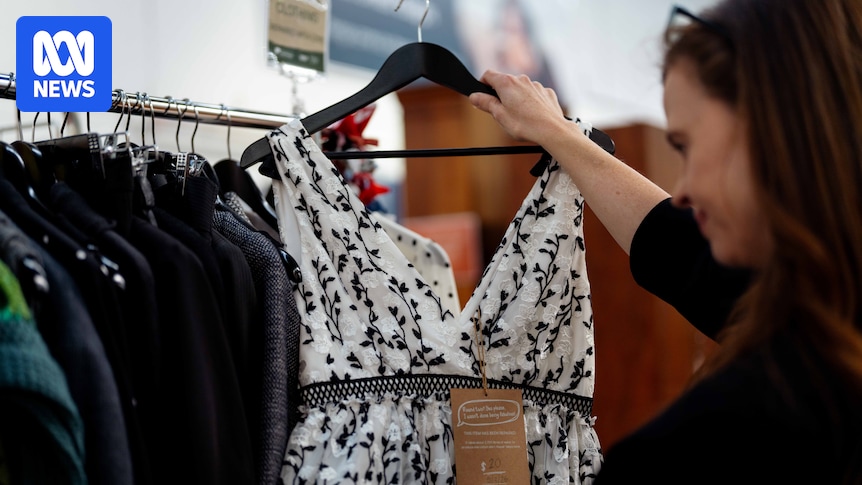
In the warehouse of a Hobart op shop, volunteers are sorting through bags of donated clothing items.
Not all of the donations will end up on the store’s sale racks.
A pink sweater with a bleach stain and a dress with iron marks are tossed on a pile that is bound for landfill.
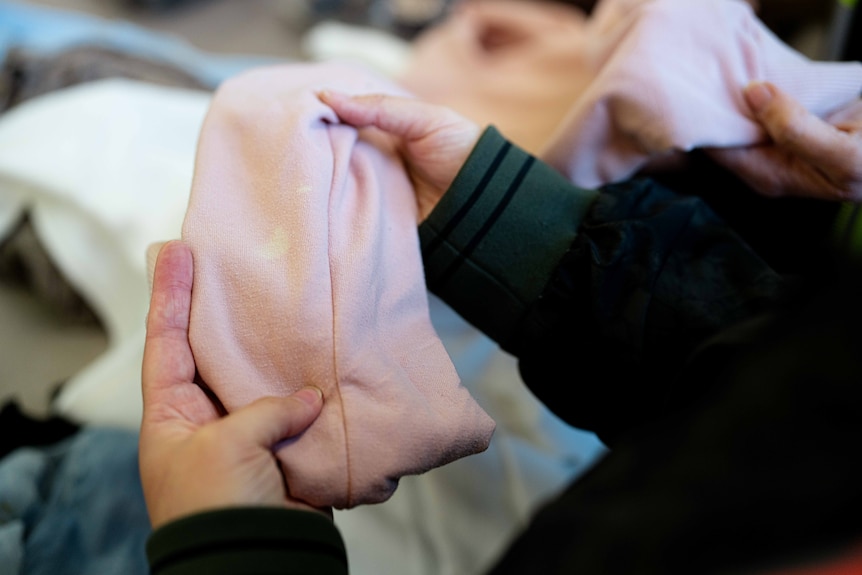
Garments must meet certain standards to be sold in second-hand stores, including being stain-free. (ABC News: Ebony ten Broeke)
At Hobart City Mission, retail manager Taryn Townsend says the amount of textile wastage she sees can be overwhelming.
“In a bag, we’d see about 20 per cent is good [and] ready for sale and 80 per cent we’d either have to rag or [send to] landfill,” she said.
While donating clothes to op shops is largely seen as a way to support sustainability, in reality only a fraction of the pre-loved items are rack-ready for sale.
“It’s over consumption. It’s low-quality clothing [as a result of] people wanting to change up their styles almost on a daily basis. It all comes to us,” Ms Townsend said.
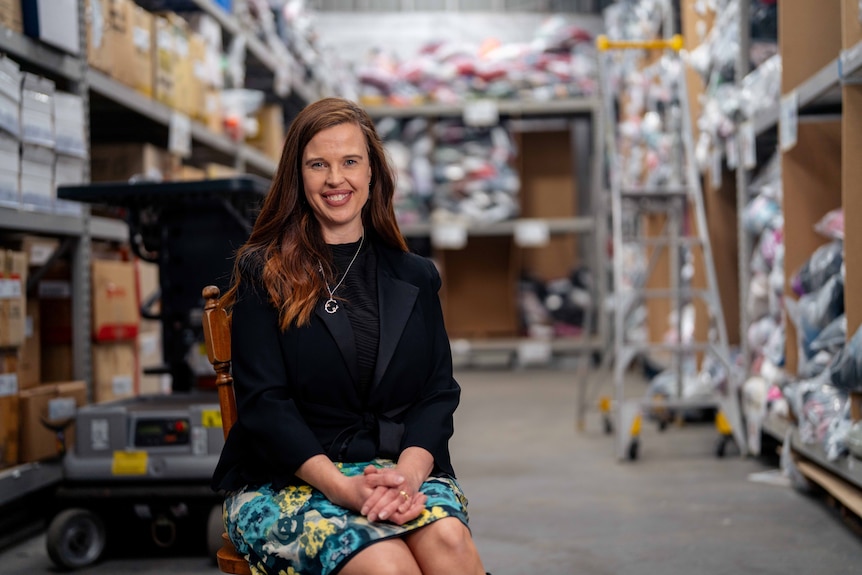
Taryn Townsend and the Hobart City Mission team will be washing and repairing some items for the charity’s Moonah Mega-Store. (ABC News: Ebony ten Broeke)
In Australia, approximately 310,316 tonnes of clothing is donated to charity shops each year — according to Charitable Reuse Australia, a national group that measures the benefits of the charitable second-hand economy.
It says about a third of Australia’s donated clothing is sent overseas for use, 36 per cent is repurposed into new materials such as rags, 14 per cent is sent to landfill, 0.4 per cent is provided as welfare, with 16.5 per cent sold in charity stores.
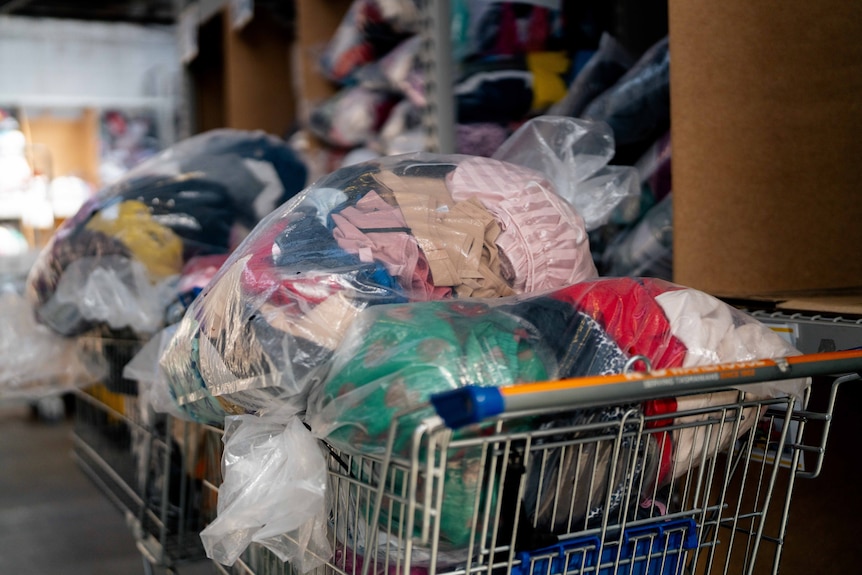
The project makes important steps in diverting clothing from landfill. (ABC News: Ebony ten Broeke)
Minor repairs divert items from landfill
Claire Dollan, Hobart City Mission’s project repair lead said donated items were often in too poor a state to sell on.
“I would say it’s kind of overwhelming to actually see how much goes in a bin on a daily basis that just cannot be sold or repaired,” she said.
“It’s dirty, [there’s] giant holes in it that … you couldn’t even begin to repair.
“You have that level [and then there are] the ones that are missing a button or they have a little stain on them.”
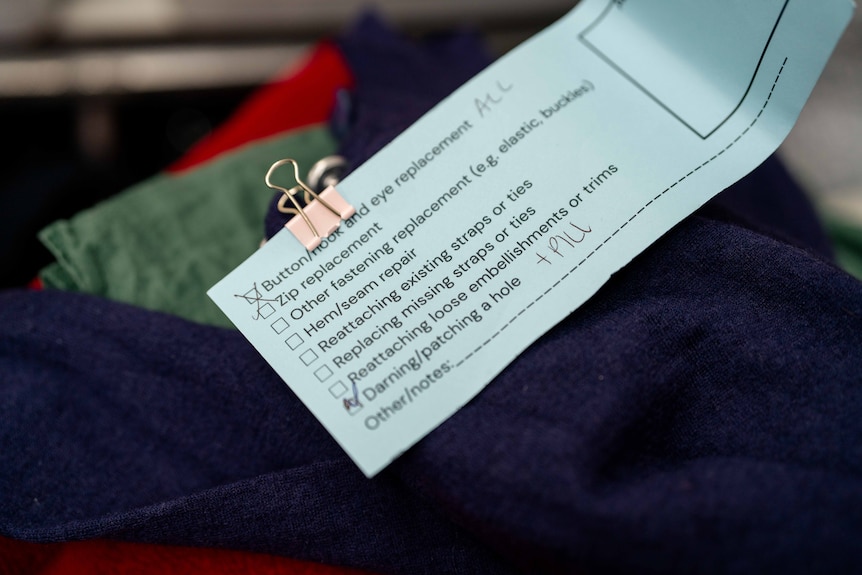
Textiles are triaged by staff and volunteers, who flag what repairs are needed. (ABC News: Ebony ten Broeke)
Due to limited resourcing for repairs, she said items requiring minor care such as a button replacement or a small stain removal would typically be discarded.
But a recently launched project, funded by the Tasmanian Waste and Resource Recovery Board, aims to divert items from landfill.
Through the Rinse, Repair and Rewear six-month pilot, volunteers and op shop workers will wash and repair donations for sale.
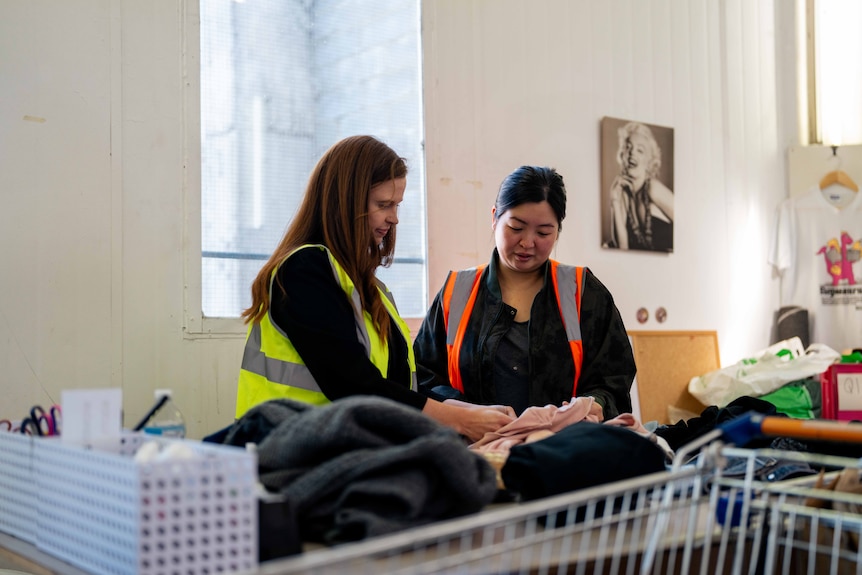
Taryn Townsend and a volunteer, Melissa, sort through clothing donations, much of which will end up in landfill. (ABC News: Ebony ten Broeke)
An early audit of the project covering 2,945 items of clothing found an increase in items diverted from landfill with 42 per cent recovered for washing and 11 per cent for repair.
“We did just mend a beautiful fur stole that was quite old but just had a few holes in it … Something that valuable just should not be in landfill,” Ms Dollan said.
“[The volunteers who are] constantly sorting and throwing all of these things in the bin are thrilled to now have some other option available to them.”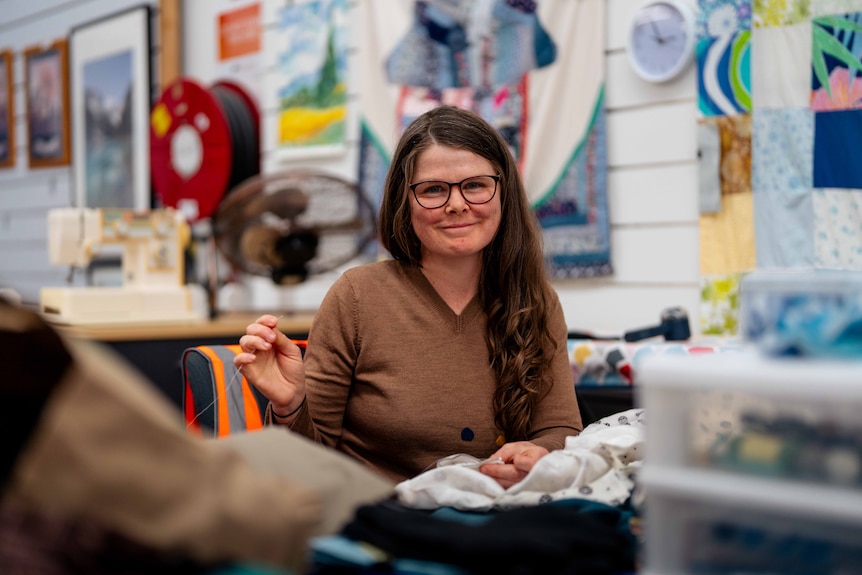
Claire Dollan hopes the repair project will inspire op shops across the country. (ABC News: Ebony ten Broeke)
Items that cannot be repaired are re-imagined, preventing valuable fibres from being wasted.
“Silks, woollens, linens … we don’t want them to go into the bin,” Ms Dollan said.
One example of re-imagined use was silk scarves with holes repurposed into scrunchies.
Yassie Samie, a postdoctoral fellow as RMIT’s school of fashion and textiles, said Australians need to shift their thinking on how to rehome unwanted textiles.
“For about 87 per cent of Australians, when they want to say goodbye to a textile belonging of theirs, the number-one strategy they can think of is to donate it to charity organisations,” Dr Samie said.
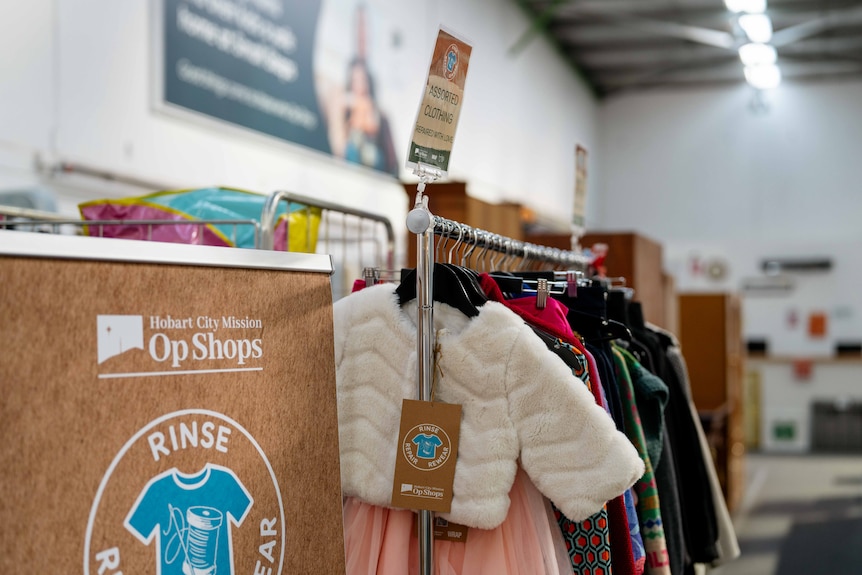
Charity Reuse Australia found just 16.5 per cent of donated items could be onsold in opportunity stores. (ABC News: Ebony ten Broeke)
But for low-quality clothing items, she suggested that commercial recycling options may be more suitable.
“There’s a vast number of commercial collectors and recyclers who are willing to take those textiles and send it to the recyclers to turn it into fibre or perhaps sometimes turn it into a different type of material altogether,” she said.
As well as textile recyclers, some fast fashion retailers accept clothing donations instore.
Impact of fast fashion and diversion options
Dr Samie explained that overconsumption and overproduction were the leading causes of wastage.
“There is simply too much of everything,” she said.
“Every year, lots of new textile items are imported to the Australian market … about 1.55 billion new items.
“[In fast fashion] the material that is used is often of lower quality and they come with lower prices … [that] impacts the relationship that we have with our textile belongings and makes it a very disposable sort of product to use.”
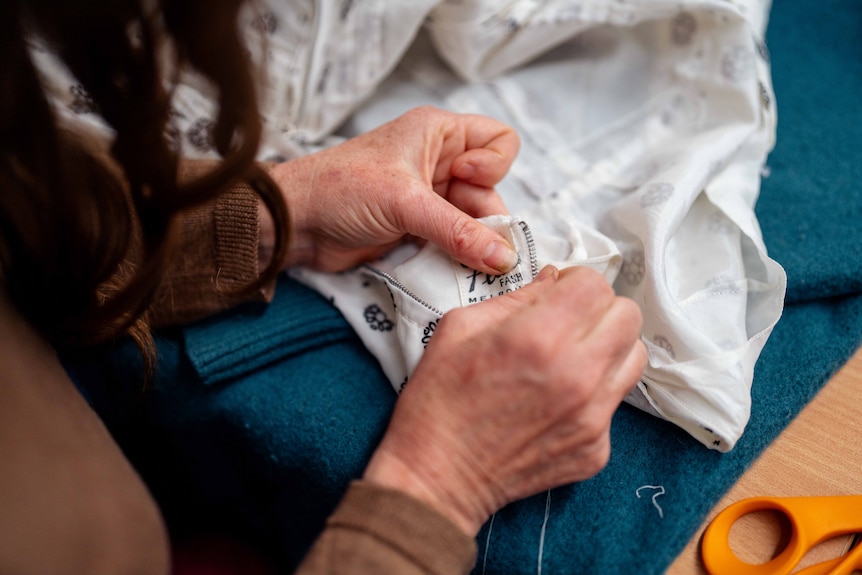
Many fast fashion items are not worth the time to repair. (ABC News: Ebony ten Broeke)
Hobart City Mission’s repair project offers one solution that it hopes will inspire op shops across the country, and there are plans to create a handbook to support national implementation.
“[This project] shows that it can be done. It’s not going to solve all of those problems, but it’s just this small thing that we can demonstrate to save all of these valuable things from landfill that will hopefully ripple out to the rest of all of the op shops,” Ms Dollan said.
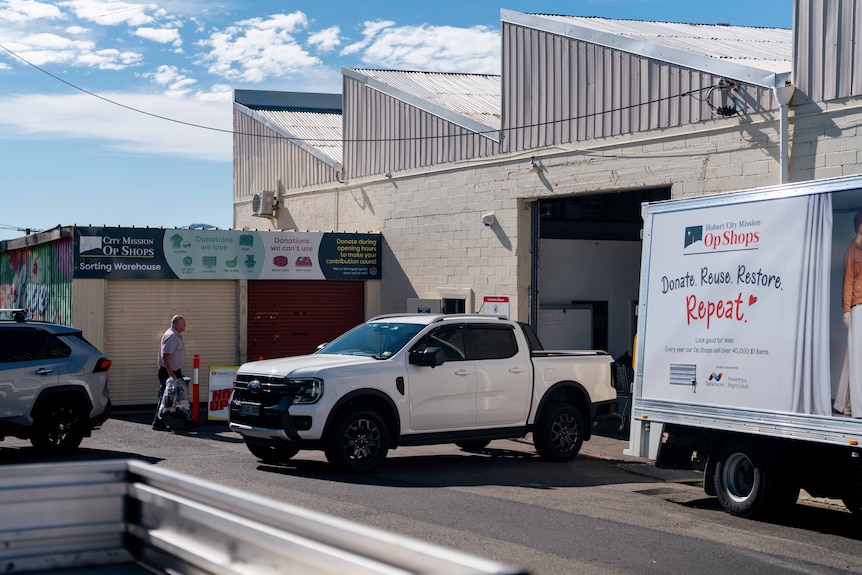
Some donated items are in such poor condition that op shops have limited alternatives than to send them to landfill. (ABC News: Ebony ten Broeke)