
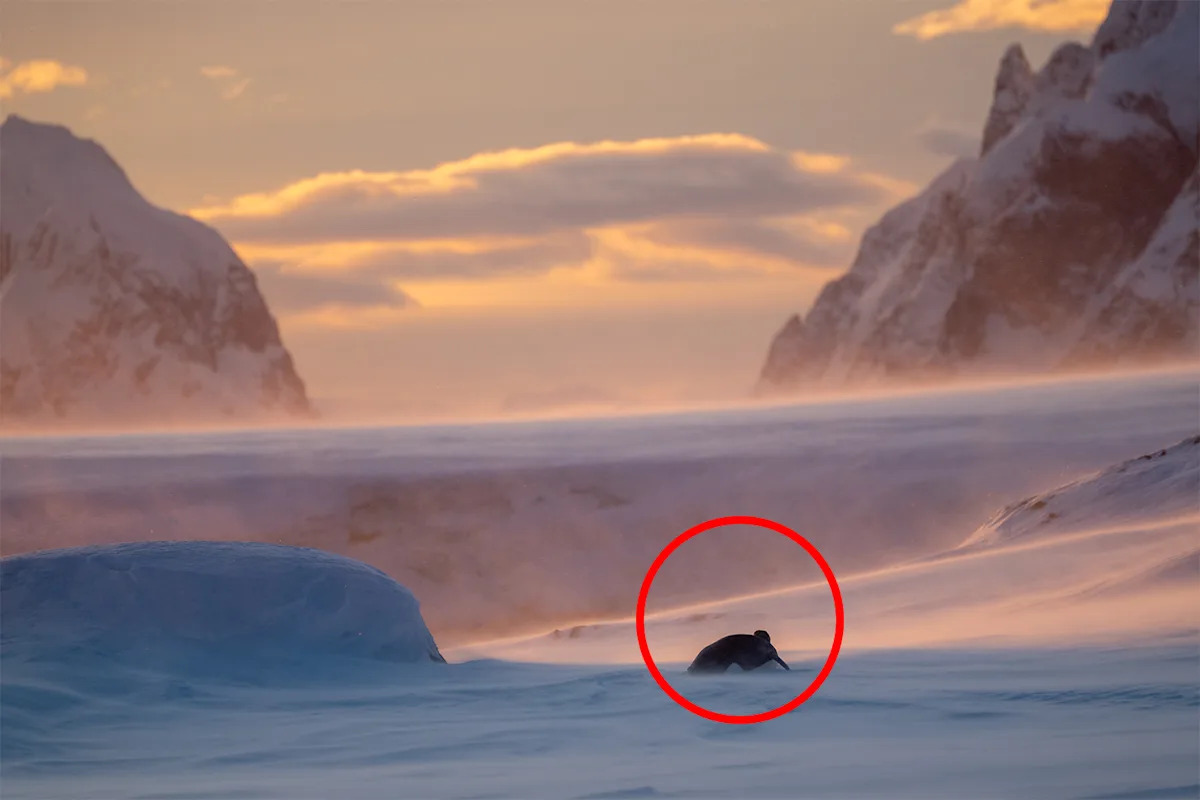
The iconic emperor penguin is closer to joining a grim list that includes the Tasmanian tiger and dodo, threatening another stain on human history.
Overnight, the towering 1.3-metre-high bird was recognised as endangered on the Red List of threatened species by the International Union for Conservation of Nature (IUCN) following a projection it will be functionally extinct in less than 75 years.
But all is not lost.
A leading expert is calling on the world’s wealthiest individuals to make history and save it.
Dr Philip Trathan, a member of the IUCN SSC Penguin Specialist Group, worked on the reassessment of the emperor penguin’s listing, alongside Birdlife International and experts from Australia, New Zealand, Europe, South Africa and the United States.
The global team singled out the worsening impacts of climate change as the single biggest threat, as sea ice rapidly melts around the penguin’s Antarctic homeland.
“Being optimistic is important,” Trathan told Yahoo News from the remote Scottish Island of Coll.
But with hope comes a pragmatic idea about who is in a position to achieve real change.
“It only takes one tech billionaire to decide he’s going to be the one who will be remembered forever as the guy who switched his resources into looking at how we reduce greenhouse gases,” he said.
“And we’ll remember his name better than Donald, or Jeff, or any of the other guys we hear about now.”
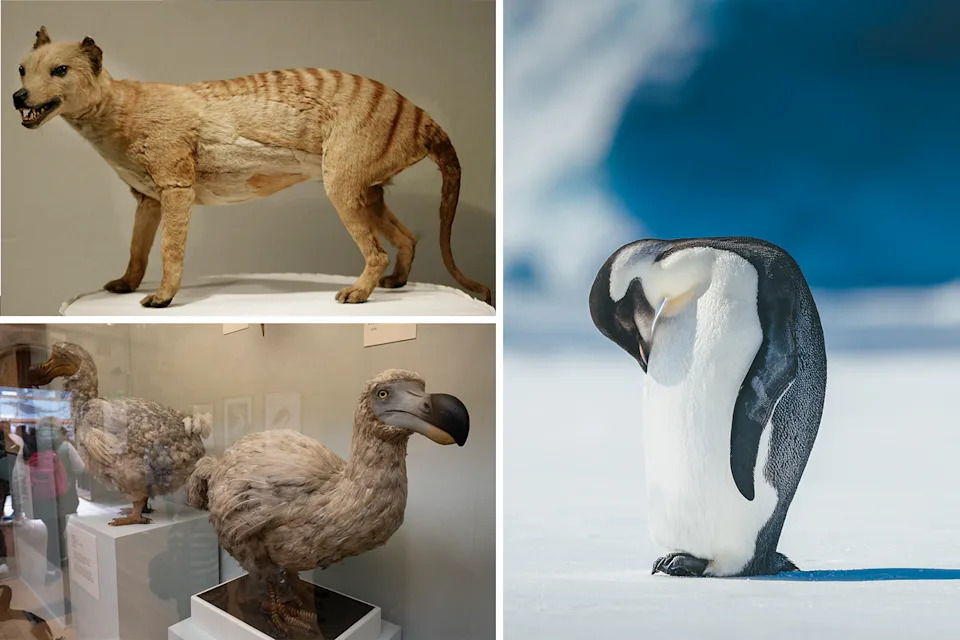
Without intervention, the emperor penguin (right) could face the same sad fate as the Tasmanian tiger and dodo. Source: Getty
Two simple reasons emperor penguin numbers are dropping
Trathan recognises the emperor penguin’s trajectory has been worrying.
Using satellite images, experts can see changes in the density and number of colonies, and the species has declined by 10 per cent between 2009 and 2018.
Modelling suggests the population will halve by the 2080s, and be all but wiped out by 2100.
Emperor penguins congregate along the coastline for breeding, but the fragile sea ice they nest on is melting earlier due to climate change.
“It’s not just one or two colonies affected, it’s a large number of colonies, some multiple times,” Trathan said.
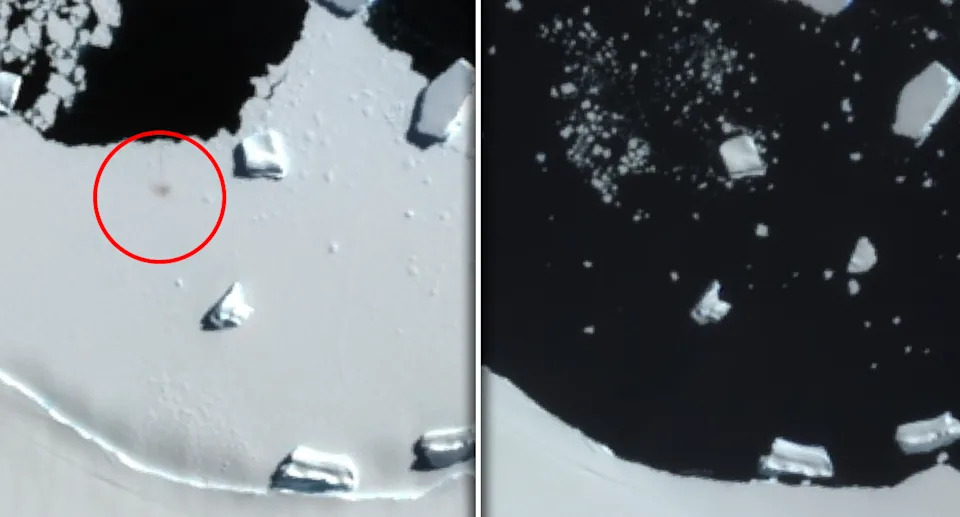
The brown dot circled in this satellite image (left) is a large group of emperor penguin chicks. Sea ice melted (right) before they were waterproof. Source: Communications Earth & Environment,
When the melting occurs, the new generations of chicks are plunged into freezing Antarctic waters before they’re fully feathered.
The situation is comparable to the Great Barrier Reef, where climate change-induced mass-bleaching events are killing off coral faster than it can recover.
In the case of the emperor penguins, not enough chicks will survive to replenish the population, and so they’ll age-out and vanish from the landscape.
But chick deaths are just one of the problems caused by melting sea ice.
It’s also killing the adults, because it’s vanishing before they complete their annual moult, causing their feathers to thin.
“They need a couple of months of stable sea ice conditions, and can’t enter the water because they’re not thermally able,” Trathan said.
Future generations will see 2020s as a ‘sad period’
Megafauna in hotter climates, like giraffes, elephants and buffalo have already declined, and around the Arctic polar bears are listed as vulnerable to extinction.
Now it appears the catastrophe has spread.
“It’s concerning. Antarctica is one of the remotest areas of the planet,” Dr Trathan said.
It’s not just the emperor penguin that’s in trouble in the south — the Antarctic fur seal numbers have declined by more than 50 per cent between 1999 and 2025 and it has also now been listed as endangered.
The problem has primarly been attributed to a reduction in the availability of krill due to climate change.
A third species, the southern elephant seal had been designated a species of least concern, but it is now listed as vulnerable to extinction due to the threat of avian influenza, which has spread to Antarctica.
In the future, many of these species may only survive in captivity in zoos or, worse still, stuffed in museums.
Asked what these declines say about humanity, Trathan said his focus was penguins, and he was no expert on human psychology.
But after a pause, he said, “I think our grandkids and their grandkids will look back on this period as a really sad period in human development.
“We depend on biodiversity for our own existence, and if that biodiversity is impoverished, then spiritually, and in terms of nutrition, we’re going to be at a disadvantage.”
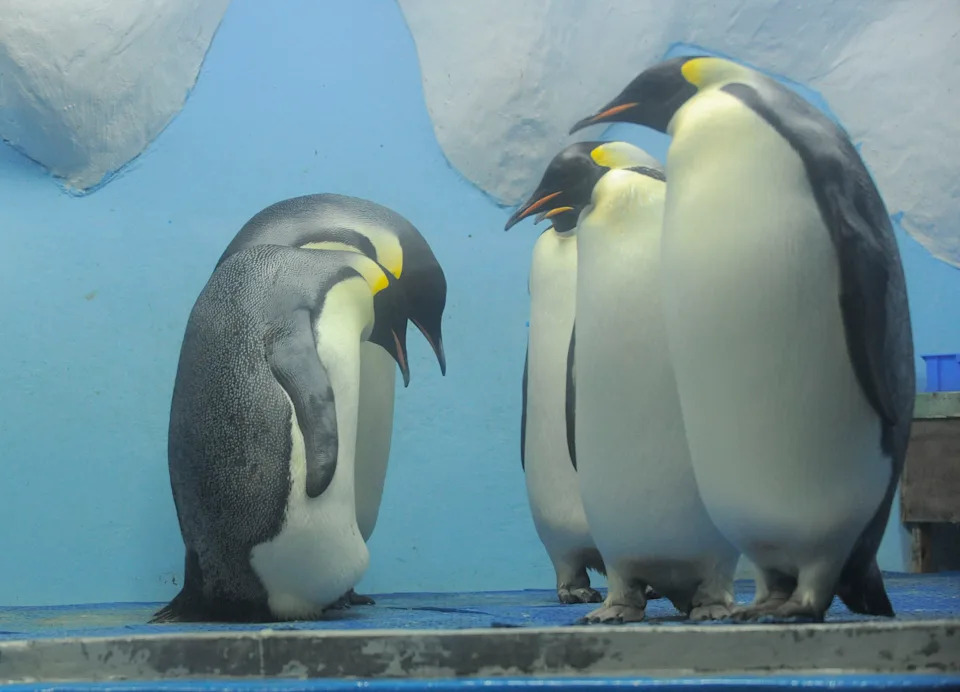
Zoos and aquariums could be the only places emperor penguins exist if climate change is not rapidly slowed. Source: Getty
(Visual China Group via Getty Ima)Global reaction to emperor penguin listing
Leading wildlife experts have responded to the news of the penguin’s listing.
The IUCN Director General, Dr Grethel Aguilar, said the endangered listing is a “wake-up call” about the realities of climate change.
“Antarctica’s role as our planet’s “frozen guardian” is irreplaceable – offering untold benefits to humans, stabilising the climate and providing refuge to unique wildlife,” she said.
World Wide Fund for Nature-Australia’s ocean conservation manager Emily Grilly said humans have marvelled at the emperor penguin’s ability to “survive some of the harshest conditions on Earth”, but now our industry is “pushing them to the brink”.
She’s hoping new protections will be ratified within the Antarctic Treaty, of which Australia was one of the original 12 parties.
When members meet in May, she has urged them to build upon the IUCN listing and declare it a Specially Protected Species, to help reduce other threats to the species.
“This would reduce pressures like fishing and tourism that add additional stress on colonies,” she said.
“There would also be targeted actions to support their recovery.”
Do you have a story tip? Email: newsroomau@yahoonews.com.
You can also follow us on Facebook, Instagram, TikTok, Twitter and YouTube.