
Loading…
The rise of solar power shows no sign of slowing down, with the International Energy Agency predicting it will overtake coal as the world’s biggest source of electricity next year. Behind its success is a little-known Australian inventor.
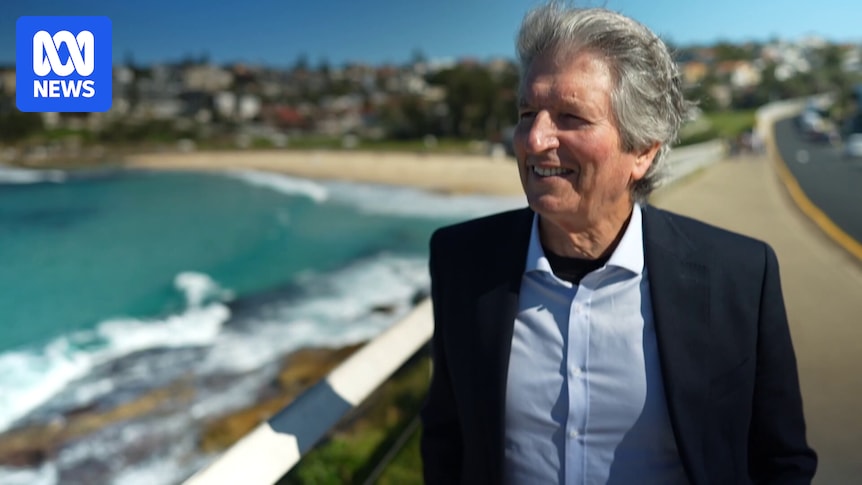
On a crisp, sunny morning overlooking the beachfront at Bronte, in Sydney, a smartly dressed man strolls along the pavement.
The glorious winter weather has brought out a crowd as he navigates the bustling footpath.
He has to step between surfers carrying boards, mums pushing prams and any number of other passers-by.
His kindly bearing draws smiles and acknowledgements, which are returned in kind.
But seemingly nobody recognises him.
Loading…
“I’m Martin Green from the University of New South Wales in Sydney,” he tells the ABC in an interview at his home nearby.
“And I’ve been researching on solar cells for over 50 years and had a bit of success in developing new technology and having it commercialised.”
Others regard Green as the godfather of modern solar power.
The man behind the technology that’s in nine out of every ten solar panels around the world today.
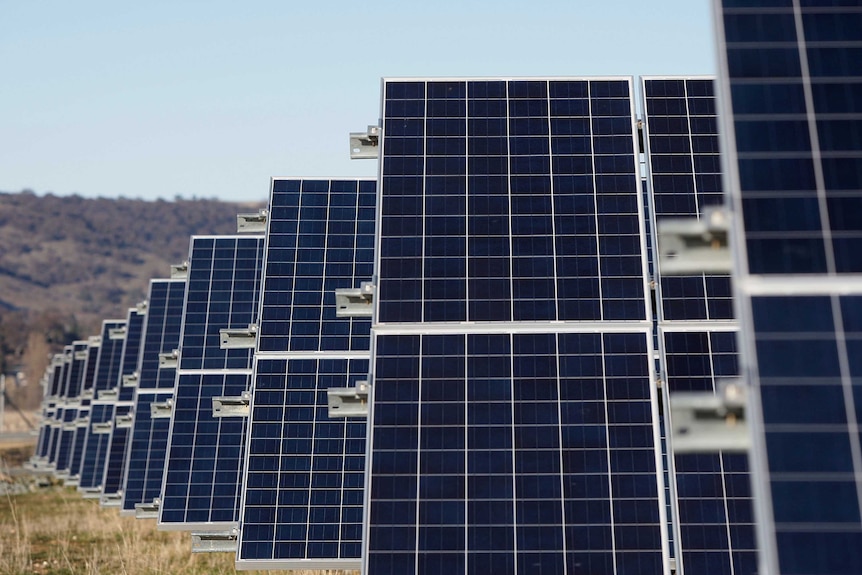 Billions of dollars are being invested in large scale solar PV and wind power(Lisa Maree Williams/Getty Images)
To understand the explosion in the adoption of solar one can look no further than the basic economic principle of supply and demand.
Since the late 1970s the cost of solar has fallen roughly 400 times.
Fierce competition between Chinese manufacturers has led to an oversupply, causing prices to plummet.
Which in turn has seen installations of the green technology outstrip expectations at every turn.
Australia’s former chief scientist — and top energy adviser — Alan Finkel says none of that would be possible without Martin Green, who, arguably, has done more to advance solar research than anyone else.
Former prime minister Malcolm Turnbull describes Green as “really one of the handful of people that ultimately made the transition” towards renewable energy possible.
And Zhengrong Shi, a protégé of Green’s who was the world’s first solar billionaire, says the global solar industry would not be what it is today without Green’s contribution.
So, how is it that Green can enjoy virtual anonymity in his own country?
In his own, adopted home town, no less?
Sunny beginnings
Turnbull says it’s no coincidence Green has largely escaped the limelight.
“Well, look, he is by nature a little bit shy,” the former PM says.
“There’s no sort of Elon Musk personality in the photovoltaic department at the University of New South Wales.”
Another with a clue is Renate Egan, a professor at UNSW who runs the Australian Centre for Advanced Photovoltaics.
To understand Green, Egan says it is necessary to understand that he is, first and foremost, a scientist.
“Martin Green started in 1974 to do research into solar energy in Australia, when the concept that we would be powering our homes from solar was just basically a dream,” Egan explains.
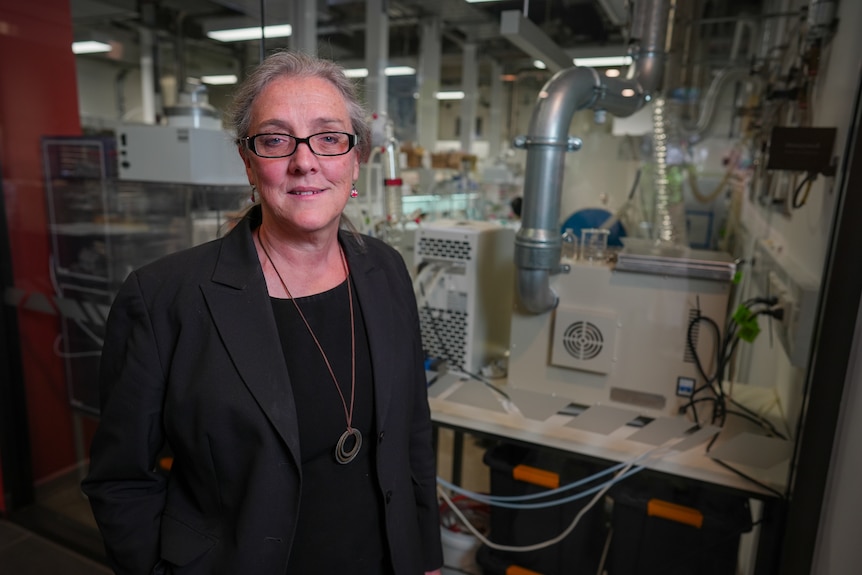 Renate Egan is executive director of the Australian Centre for Advanced Photovoltaics at UNSW.(ABC News: Billy Cooper)
“Martin was from Brisbane, he was a child of the sun and the Sunshine Coast.
“It was the same thing that attracted me into solar.
“And that was to do something in the sciences where it made sense in Australia and where I could see a net positive from the research that was being done.”
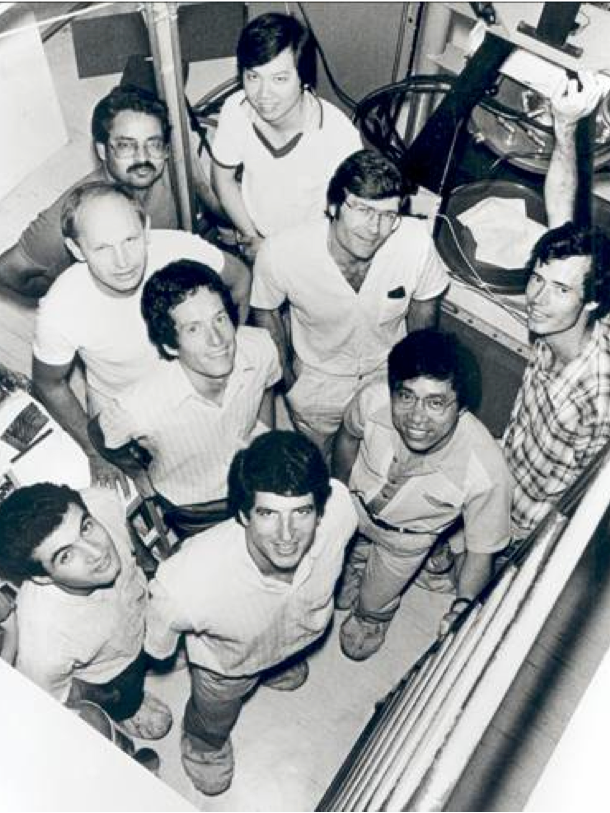 Martin Green (front, middle) was part of the UNSW team that made the first 20 per cent-efficient silicon cell in 1985.(Supplied: Martin Green)
At the time, solar research was in its infancy.
Green might have been chosen to lead a new team investigating the field, but resources were scarce, as were expectations.
Egan says the first of the big oil shocks — in which Arab petrostates cut supply to the US and its Western allies in 1973 — had given the first impetus to solar research.
But as the shock eventually wore off, she says dependence on — and investment in — oil returned with gusto.
Conversely, she says interest in solar power as an alternative source of energy sharply fell away.
There was one exception, however.
“What they found was there was one place where you couldn’t rely on oil, and that was in space,” she says.
“So space solar has had continuous amounts of research for a long time.”
Indeed, Green notes that space had been a proving ground for solar power in ways that defied expectations.
“Actually, the fourth satellite to go up worldwide, and the second US one, had some solar cells on it,” Green explains.
“This is in 1958.
“And they worked really well.
“In fact, they worked too well in that they didn’t put an off button on the satellite, and the solar cells kept powering the satellite, sending out radio signals for the next six or seven years, blocking up the airway.”
Loading…
For all the practical success of these early photovoltaic cells, fundamental obstacles remained.
Green says the technology was simply too expensive to produce competitively.
In the titanic world of energy, he says it was barely at the margins.
“Probably quite rightfully, you know, the cells were so incredibly expensive, and the numbers being made for these satellites were so puny,” he says.
“And this was the era when nuclear was very highly regarded.
“One of the nuclear scientists or administrators of that era is on record as saying the impact of solar would be like a flea on an elephant’s back in any energy future.
“So the prospects weren’t regarded too highly.”
The second oil crisis
In a development with eerie echoes to the present, Green says it was the Iranian Revolution in the late 1970s — and the resulting oil crisis — that gave renewed vigour to solar research.
Governments across the developed world poured money into research programs.
Then US president Jimmy Carter famously installed solar panels on the White House.
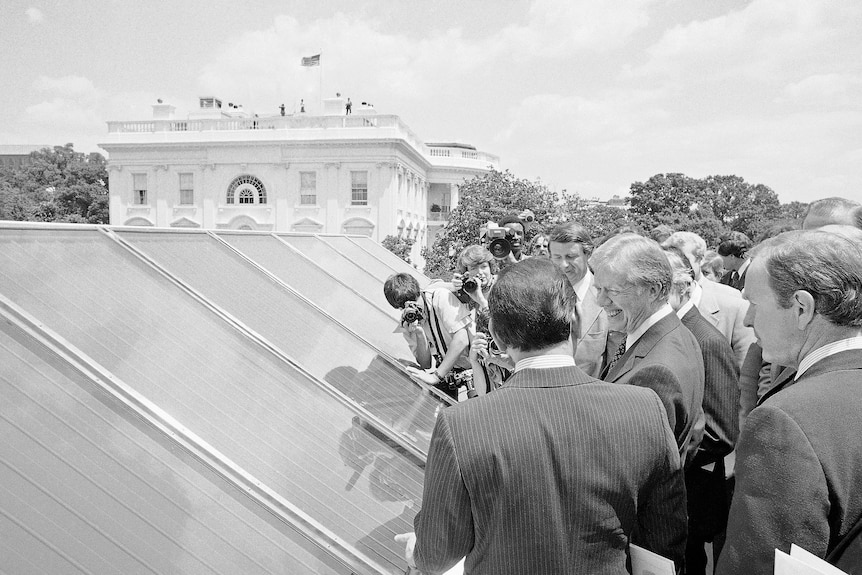 President Jimmy Carter inspects solar panels on the roof of the White House’s West Wing in 1979.(Supplied: Harvey Georges)
Meanwhile, Green and his colleagues were making breakthroughs that would ultimately have profound consequences for the cost problem bedevilling the technology.
These breakthroughs centred on a key theory Green had been mulling for years.
Boiled down, the theory amounted to adding an extra layer to solar cells to trap more of the escaping light and electrons, making them far more efficient.
“The biggest eureka moment was a couple of years into the project,” Green says.
“When I first drew my first sketch of that structure, I said, ‘well, this has got to be the ultimate solar cell’, and that’s probably proved to be correct.”
Finkel, who has spent much of his distinguished career communicating science to the layman, says Green and his collaborators have achieved many milestones in solar research.
But his development of passivated emitter and rear cell technology — otherwise known as PERC — was perhaps his crowning achievement.
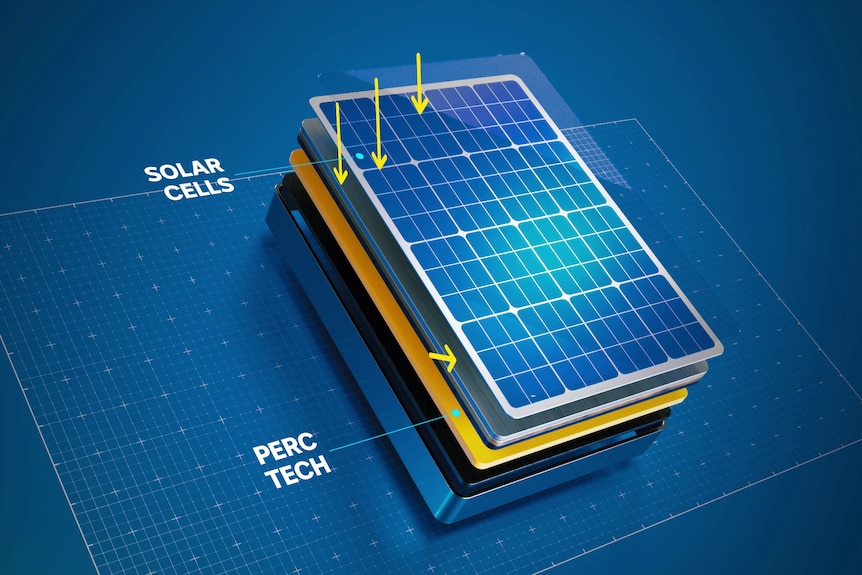 Martin Green’s design adds a reflective layer to the back of the solar panel, allowing beams of sunlight to pass through the solar cells twice instead of once.(ABC News: Ario Rasouli)
It is a technology that is used in about 90 per cent of solar panels installed worldwide today.
“It was one of many breakthroughs, but it’s a very significant one for cost and efficiency,” Finkel says.
“It’s in a sense like having a double shot.”Beating NASA
The breakthrough catapulted UNSW — and Green — to the cutting edge of solar research.
From “just battling to keep the team growing” and using “very rudimentary equipment”, the school carved out a reputation for excellence.
Such was their momentum, they even streaked ahead of NASA — a patron and pioneer of solar development — before going on to claim the world record for cell efficiency.
As they pushed the efficiency of solar cells ever higher — from 16.5 per cent to as much as 26 per cent — the record stayed in their hands for more than three decades.
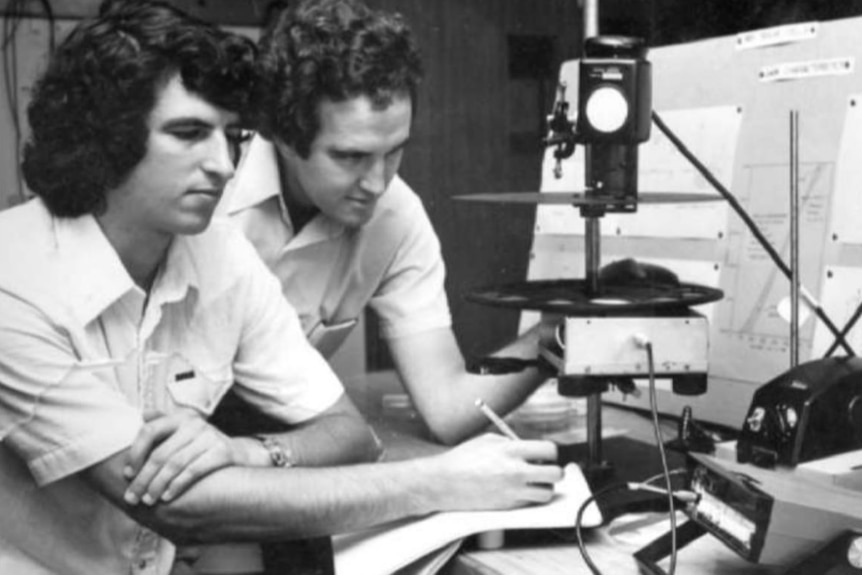 Martin Green with his first PhD student, Bruce Godfrey, in 1976.(Supplied: UNSW)
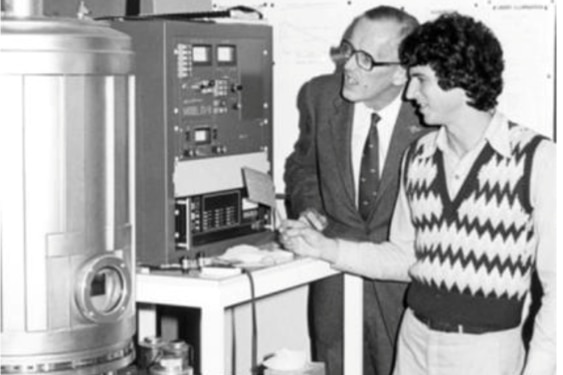 Martin Green with department head Louis Davies, in UNSW’s first solar research lab in 1977.
(Supplied: UNSW)The rise of China
More importantly, perhaps, the centre’s burgeoning reputation began attracting some of the best and brightest researchers in the world.
Among them was a young student named Zhengrong Shi, who capitalised on reforms to open up China to the world in the 1980s by moving to Australia to study.
“At the time, my intention was actually quite simple,” Shi says.
“Just do my PhD and later on maybe get a tertiary position or professorship in the university as an academic. It was very simple.
“But sometimes you never know in your life. Sometimes just opportunity pops up. If you are there and ready, you can grab them.”
Shi did more than grab his opportunities.
With the lessons he learned at UNSW, Shi moved back to China in 2002 with “$US6 million in his kitty” according to Green.
From there, he set up the country’s first commercial solar manufacturing line.
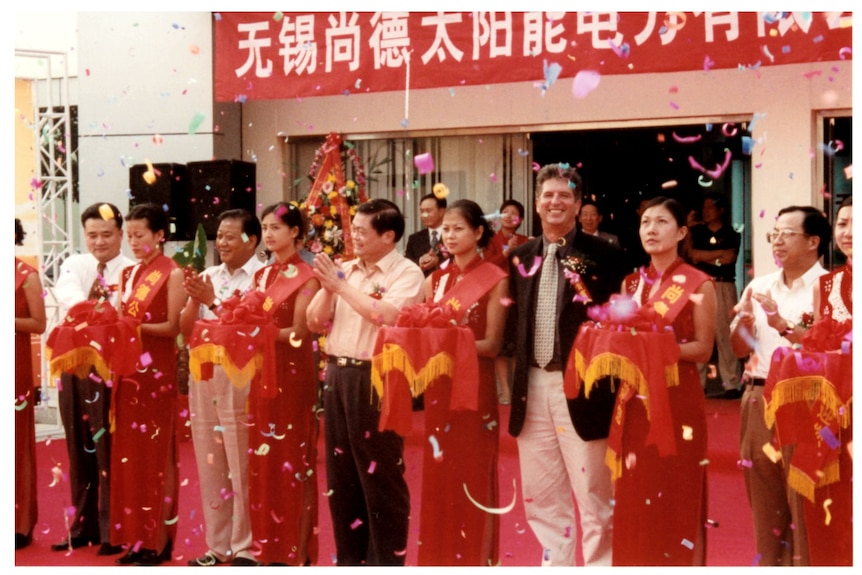 Dr Shi opening China’s first solar module production line in 2002 alongside UNSW staff.(Supplied: Martin Green)
“I sometimes slept on the desk because I had to deal with Europe and the US at different times,” Shi recalls.
“I had to build a factory. I went to Europe and Japan to look for all the equipment. Because I designed the process myself, I had to look for the equipment. So that’s what I did.”
Shi’s venture was called Suntech and it became an enormous success, tapping into rapidly growing demand for solar power fuelled by subsidies in rich countries such as Germany.
Green says the measure of Shi’s success came when Wall Street bankers started throwing money at his business.
“Zhengrong’s became the first private Chinese based company to list on the US on the New York Stock Exchange in 2005,” Green explains.
“And he listed and raised $400 million by listing.
“Only part of his company was up for offer … he still held the majority of the company. So he became, overnight, the first solar billionaire on that listing.”
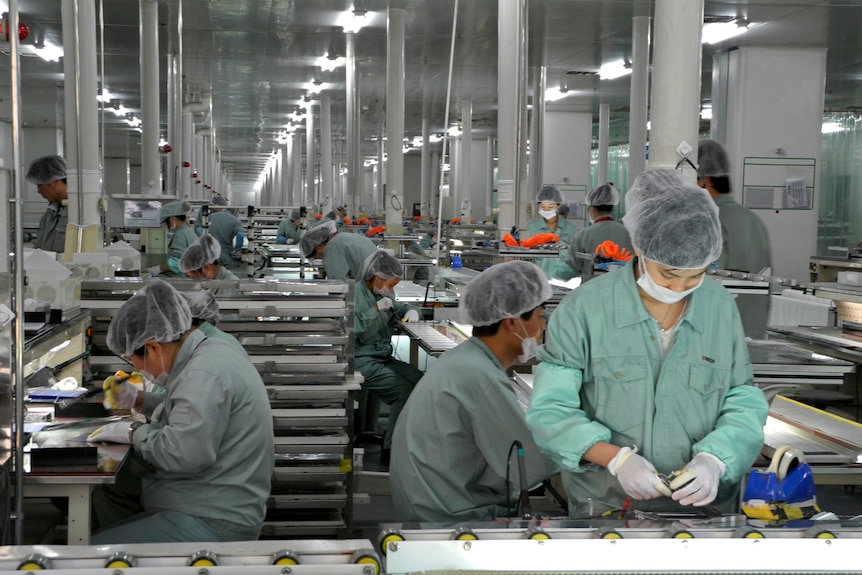 Suntech was the first company in China to commercialise solar panel manufacturing.(Reuters)
According to Green, the stunning success of Suntech triggered an “avalanche” of other listings by Chinese solar manufacturers eager to expand and grab a share of a rapidly growing market.
He says more than $7 billion was injected into 10 Chinese solar companies which listed in America around that time, pumping up the industry and super charging growth.
Prices plunge
As is with way with such breakneck growth, however, he says supply quickly started to exceed demand as Chinese firms competed fiercely for business.
“The competition between these companies, these cashed up companies, the only way to sell what they were making was to drop the price,” Green says.
“So that’s what they did.
“And it caused a rapid price reduction. It dropped by a factor of four over four years or something like that.”
The cut-throat competition was devastating for many of the fledgling solar companies, including Suntech, which went bankrupt in 2013.
Crucially, however, it entrenched prices at levels that had once been unimaginably low.
“They’ve driven the price down in manufacturing by a factor of 100,” says Egan from UNSW.
“It’s just phenomenal change, absolutely phenomenal change.”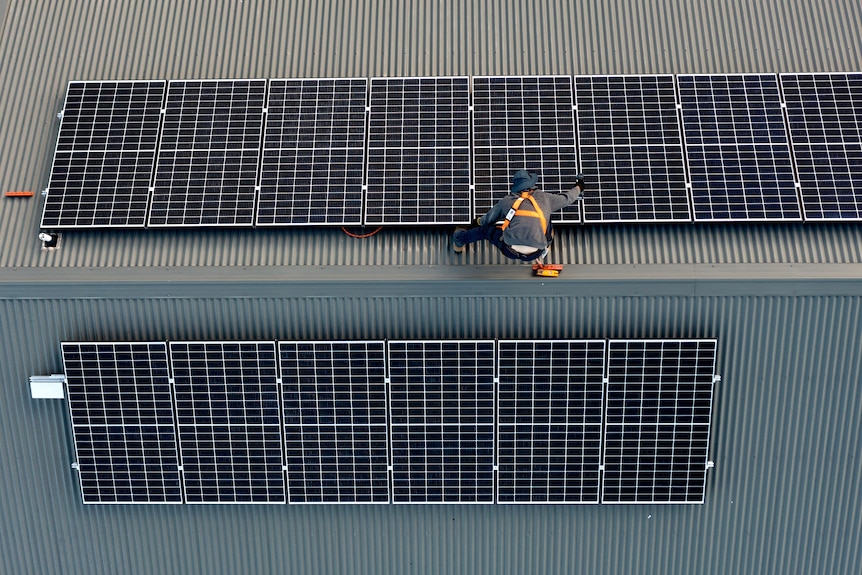 Cheap solar panels have led to a massive surge in installations.(Getty Images: Brendon Thorne/Bloomberg)
Egan says the secret to the stunning falls in the cost of manufacturing solar lies in its simplicity.
“The silicon technology is really quite simple, and it’s infinitely scalable,” she says.
“Once you’ve got it right, you can just perfect it by doing it over and over and over again.
“And what’s also happened in the last 20 years is automation of the processes.
“So the automation of the processes in China, there’s basically very little human interaction in the manufacturing processes in China now.”
Turnbull, Australia’s prime minister between 2015 and 2018, agrees.
“The remarkable thing about solar photovoltaics is that a solar panel is the same panel regardless of where it is,” Turnbull says.
“Whether it’s one panel sitting on somebody’s caravan or their hut somewhere and just being there to charge their phone perhaps or run a light bulb, or whether it’s one of a million or 10 million solar panels in some vast industrial solar farm.”
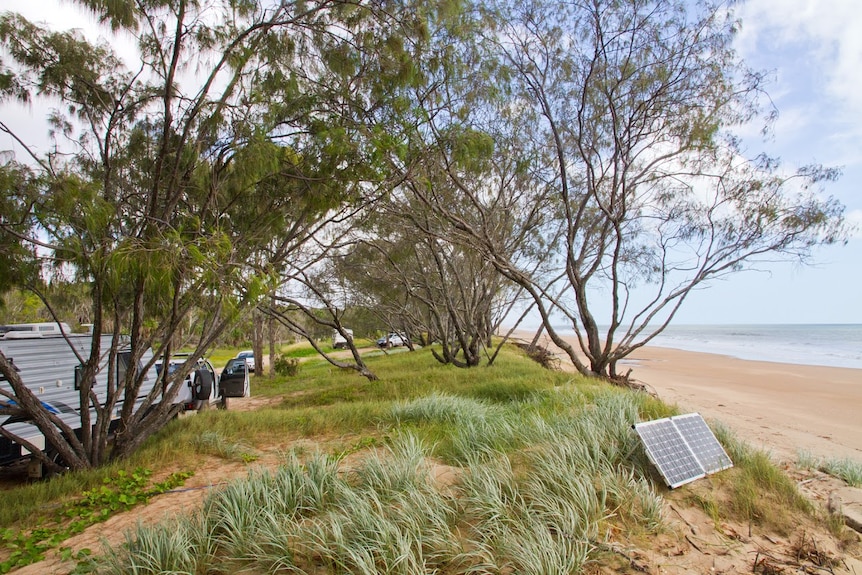 A camper uses a solar panel.(ABC Wide Bay: Brad Marsellos)
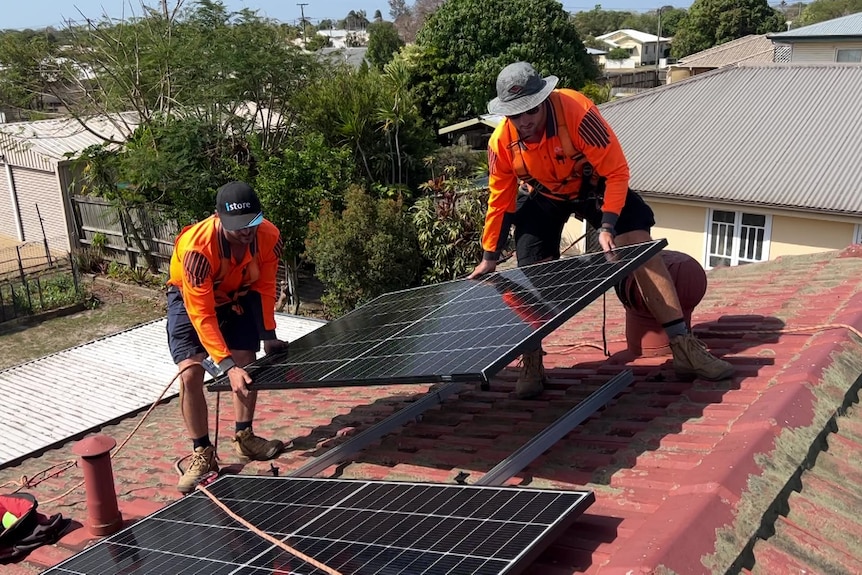 A rooftop solar system being installed in Bundaberg, Queensland.(
ABC News: Johanna Marie
)
He says those lamenting solar manufacturing a lost opportunity for Australia ignore the reality.
Australia, he says, could never have competed with China in developing an industry that requires such deep pockets — and such manufacturing muscle — to establish.
“It’s difficult to think of any mass commodity product like solar PV where it is going to make sense to be manufacturing in Australia,” he says.
“The idea that the global solar supply could be built out of a couple of factories in Australia — that was never going to happen.”
Solar’s bright future
Imbued with so many of the lessons learned by Green, his collaborators and his pupils, the Chinese solar industry now sits astride a global market worth hundreds of billions of dollars a year.
As Finkel notes, when people refer to extraordinary growth in the uptake of solar around the world, they are not exaggerating.
The amount of solar installed has been doubling roughly every three years, becoming 10 times what it was in a decade.
A planet-wide solar boom is beating expectations
Last year, about 650 gigawatts of solar was installed worldwide — a figure more than 10 times’ the size of Australia’s main electricity grid.
“The number of solar panels is just exploding,” Finkel says.
“We are looking, literally, globally at exponential growth of the manufacturing and deployment of solar panels.”
Analysis from energy think tank Ember suggests solar contributed 6.9 per cent of global electricity supply in 2024, compared with practically nothing 20 years ago.
UNSW’s Egan says for all these gains, its share of supply will need to rise much further if the world is to have any chance of meeting emissions reduction goals.
“We need that to get to around 50 per cent by 2050,” Egan says.
“We need almost tenfold growth.
“So there’s still a lot of work to do to get that much extra solar produced sustainably and integrated.”
 Martin Green says he is not surprised Australia is leading the world in rooftop solar adoption.(ABC News: Daniel Mercer)
Given the technology’s low cost — the International Energy Agency says it’s the cheapest source of power in history — Shi doesn’t doubt this will happen.
The man once dubbed the “Sun King” says solar power is not without its limitations — the most obvious one being it only generates when the sun is shining.
But he argues its extremely low cost — and the rapid development of technologies that will complement it such as batteries — make solar a compelling choice.
“You look at the demand for electricity globally with artificial intelligence and data centres,” Shi says.
“You look at the US, the natural gas turbine, you have to wait five years to get the equipment.
“They talk about nuclear, but that will take maybe 10 plus years to develop.
“What can be done now is solar. It’s so fast and cheap.”
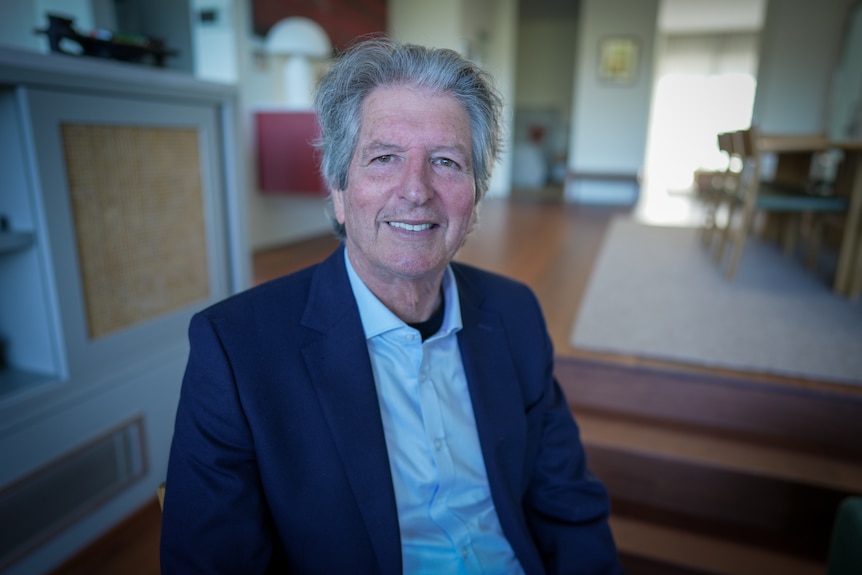 Martin Green’s peers have heaped praise on the scientist.(ABC News: Billy Cooper)The little-known Australian connection
It’s a view echoed by Turnbull, who says the rise and rise of solar is nothing short of a “revolution”.
“It’s remarkable.
“To be honest, I think this is how important it is — I think the overwhelmingly dominant source of power generation, primary generation, if you like, is going to be from solar in the years ahead.”
That such a phenomenon should have such an Australian story behind it is remarkable, says Turnbull.
It should be, he says, a celebrated story nationally.
But he says Green is far too modest to demand the limelight.
“Well, I don’t think Martin Green’s work is recognised enough by the general public, but this is not to say he is hard done by,” he says.
“Martin is laden with honours of every type.”
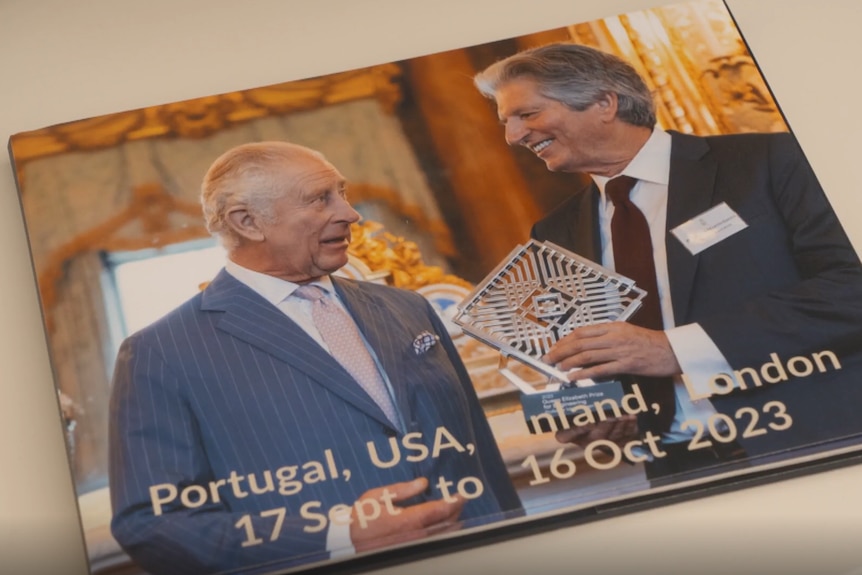 Martin Green is “laden with” honours but relatively unknown in Australia.(ABC News: Billy Cooper)
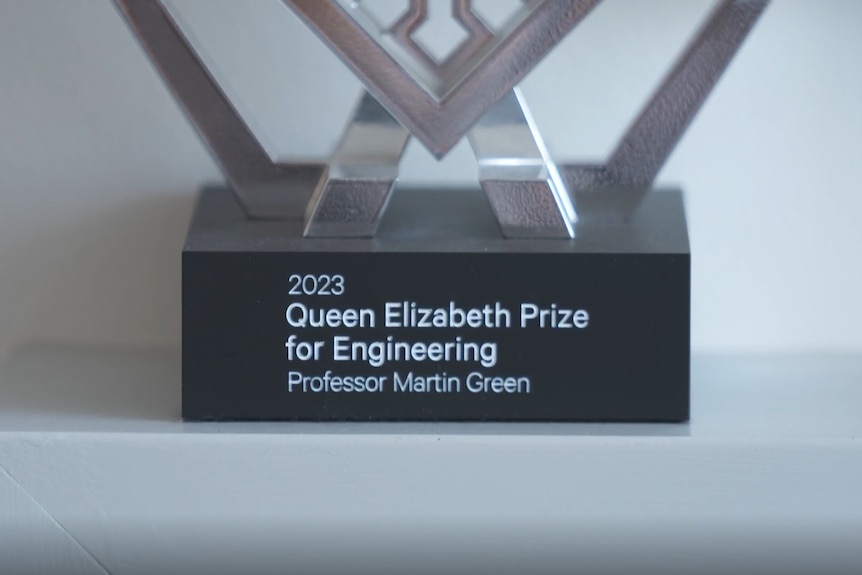 Martin Green’s Queen Elizabeth Prize for Engineering.(Billy Cooper)
Finkel goes one step further.
The former chief scientist knows Green well after they both served together on a board advising Mukesh Ambani, Asia’s richest man, on the energy transition.
He says Green could have sought fortune — and recognition — beyond most people’s wildest dreams.
Instead, Finkel says Green consciously took a path to further solar research in the public interest.
“I think that Martin, you could say, is one of our best kept secrets,” Finkel says.
“Part of the reason… is he chose to stay with the academic and educational training route rather than the commercial route.
“He didn’t chase patents. He promoted publications and sharing of information.
“He’s not strutting around as a billionaire because he chose not to go that route.”
As he sits at his Bronte home, which, of course, has solar panels on its roof, Green is optimistic about the changes he was so instrumental in unleashing.
The septuagenarian notes the solar manufacturing in China capacity is “well over one terawatt” these days.
By comparison, he says a large coal-fired power station has a capacity of one gigawatt.
“So that’s 1,000 large coal-fired power stations a year is what the Chinese industry is capable of manufacturing now,” Green says.
“And that number is growing very rapidly.”
It’s a scale that’s hard to comprehend, even for the man whose life’s work has been dedicated to it.
“People aren’t used to things changing as quickly as they’ve changed in the solar industry or with the speed that the industry has developed from a small industry to one that could now very rapidly provide all the energy that the world needs,” he says.
“20 years ago, even I would not have believed them.
“With a reputation for being overly optimistic, I’ve proved to be overly conservative in my prediction of what the future… of the industry might look like.”
CreditsWords: Daniel MercerProduction: Kit Mochan