
A group of Palestinian human rights organisations is taking the government to the Federal Court seeking answers over Australia’s weapons exports to Israel.
Represented by the Australian Centre for International Justice (ACIJ), the organisations have launched legal action against the defence minister, calling for the release of documentation relating to dozens of military export permits to Israel that remained active throughout the war in Gaza.
After a review, the Department of Defence last year acknowledged at least 30 permits for Australian companies to send “military use” items to Israel were cleared, and another 16 were still under “ongoing scrutiny”.
But it has continuously refused to provide specific information about the nature of the exports.
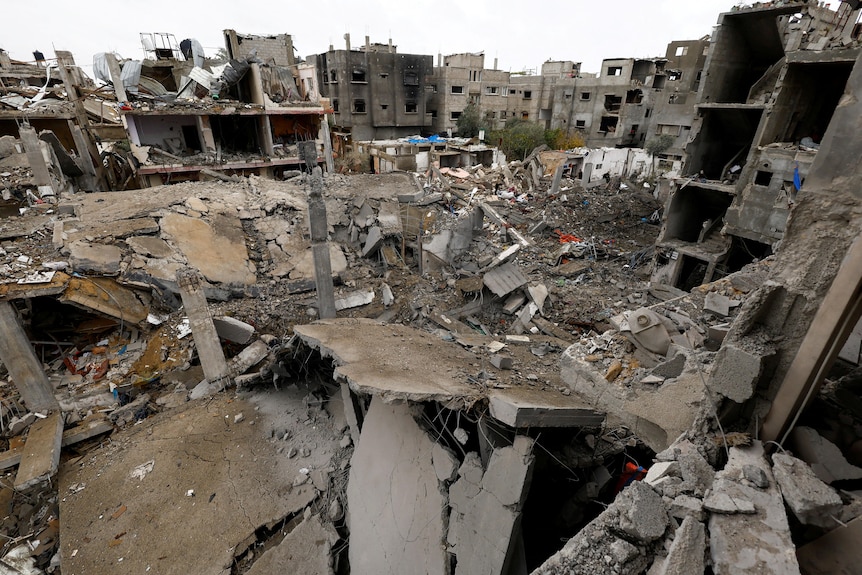
The Palestinian groups are concerned about arms transfers that could have been used in breach of international law in Gaza. (Reuters: Mahmoud Issa)
The groups want to determine whether Defence Minister Richard Marles properly assessed the risk that the military goods “may be used to commit or facilitate serious human rights abuses”, according to ACIJ.
“If the documents show that the minister has not properly assessed such risk, it may pave the way for a legal claim alleging that the minister is in legal error and that exports must end.”
Military exports under scrutiny
Since October 2023, Al-Haq, the Palestinian Centre for Human Rights and Al Mezan Center for Human Rights have been calling for greater transparency about Australia’s arms export regime.
Australia keeps military exports to Israel flowing during Gaza war
“The Australian arms export regime operates with minimal public scrutiny, and no meaningful visibility as to what exports have been approved by the Australian government, and on what basis,” Rawan Arraf, principal lawyer at the ACIJ, said.
Any Australian company wishing to export arms — or military-related goods — must obtain a permit through the Defence Department.
The Department of Defence description of the two permit categories:
Part 1 – Munitions List: items specially designed or modified for military use.Part 2 – Dual-use List: items generally used for commercial purposes, but with potential military and weapons of mass destruction (WMD) application.
The permits fall under two categories on the Defence and Strategic Goods List — either military-specific or dual-use items, meaning they could be used for both civilian and military applications.
That is about as much as the public knows.
The system has been criticised by international law experts, Australian human rights campaigners and the Greens for lacking transparency.
There has been growing pressure in recent years for the government to provide more information about exactly what each permit covers, and how it could ensure the items were not being used in violation of international law in Gaza.
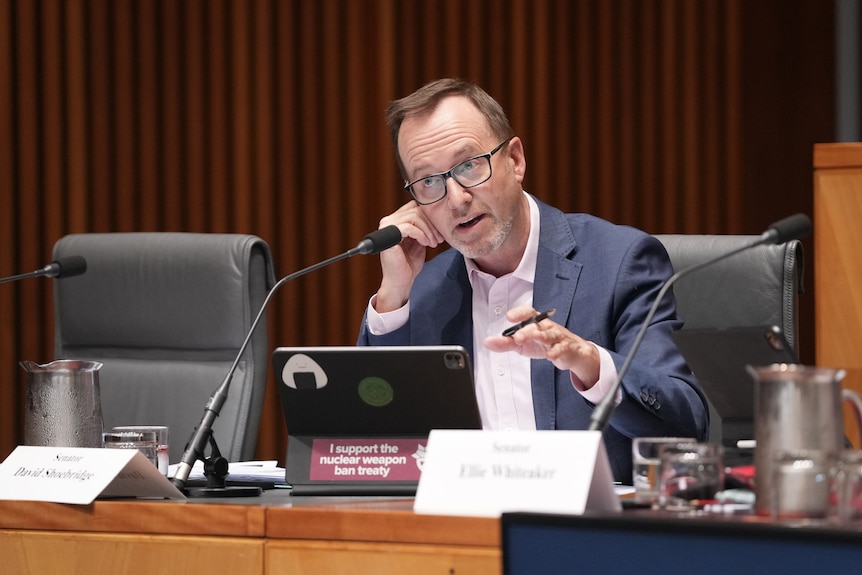
David Shoebridge has been using Senate Estimates to seek answers from Defence Department officials on weapons transfers. (ABC News: Matt Roberts)
Senator David Shoebridge, the Greens’ defence and foreign affairs spokesperson, has been using Senate Estimates to press defence officials for answers.
“Australia has one of the least transparent weapons export regimes on the planet, with no public reporting of which nations Australia sells weapons to or what weapons are sold,” he told the ABC.
“This is in stark contrast even to the United States, where details of weapons sales are openly reported to Congress.”
Senator Shoebridge welcomed the move from the Palestinian rights groups to launch a legal bid, saying it was “a critical legal step to help end Australia’s export of weapons and weapon parts to Israel”.
“Together, with our ongoing work in parliament and Senate estimates, this is how we get the truth,” he said.Concerns over Australia’s F-35 parts
The government has repeatedly denied that Australia supplies weapons to Israel, saying that had been the case “for at least the past five years”.
Australia’s F-35 fighter jet export details ‘quietly’ disappeared
A defence spokesperson reiterated those comments in a statement to the ABC this week.
“Australia is not making weapons or ammunition in this country and supplying them to Israel,” they said.
“Australia maintains a robust and thorough export control regime, which requires each application to be assessed on its merits in accordance with Australian export control legislation.”
The application filed in the Federal Court aims to “compel” defence to provide documents related to permits granted before October 7 2023, and remain active.
It also extends to information about “exports that are not directly supplied to Israel”, the ACIJ said in a statement.
“The arms exports may include components and materials that form part of global military supply chains.
“Australia is known to provide sole-source components, including F-35 fighter aircraft components and material used in armoured military vehicles.”
As it is a pending legal matter, the Defence Department has not provided a comment on the filing.
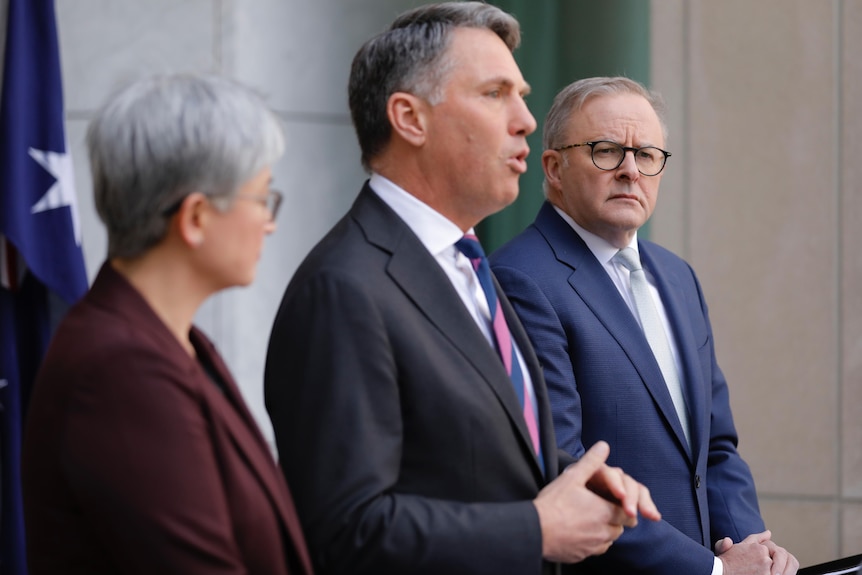
Penny Wong (left) and Richard Marles (centre) argue Australia’s F-35 parts are controlled by the US. (ABC News: Adam Kennedy)
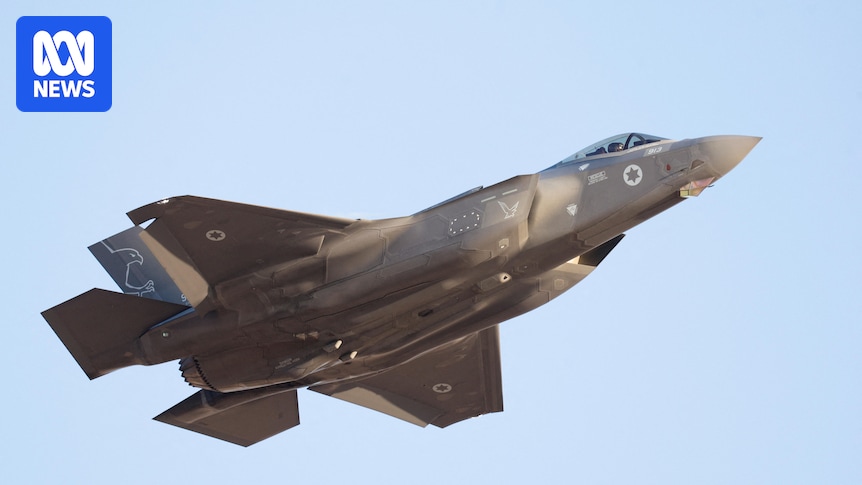
Australia is among a group of US-led F-35 partner countries contributing parts and components to a global supply chain accessed by Israel to keep its fighter jets in the sky.
Defence grilled over reports F-35 fighter jet parts sent directly to Isarel
More than 70 Australian companies have contributed to the jet’s production and spare parts supply.
Some components needed to build and maintain the jets are made exclusively by Australian companies.
Evidence filed in the ACIJ affidavit, seen by the ABC, refers to an Israeli Air Force statement announcing new F-35 jets manufactured by Lockheed Martin that arrived in Israel in January 2026.
Foreign Minister Penny Wong has argued Australia only provides “non-lethal” parts for F-35s, and has placed responsibility for any transfers to Israel on US arms companies.
“They are supplied to Lockheed Martin as part of the F-35 supply chain,” she said.
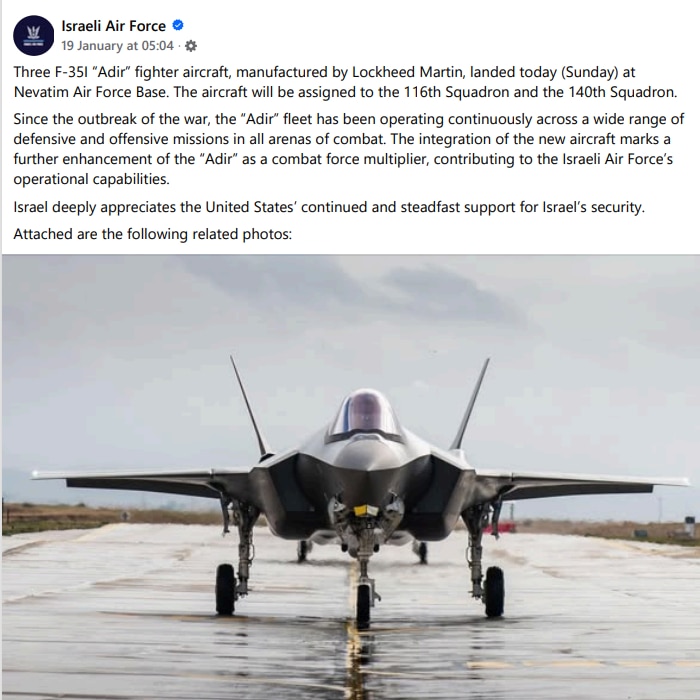
A statement posted to Israeli Air Force social media announcing the arrival of new F-35 jets from the US. (Supplied)
Senator Shoebridge has pointed to international law stipulating Australia still had obligations because “parts of weapons are weapons”.
The United Nations Arms Trade Treaty, to which Australia is a party, applies to all “conventional arms”, including combat aircraft, armoured vehicles, missiles and small to light weapons.
It states that control systems must regulate the export of “parts and components” that provide the capability to assemble conventional arms.
There were also provisions in the treaty that prohibit the sale of goods if there was knowledge, or even suspicion, they would be used to commit “gross human rights violations” such as genocide or crimes against humanity.
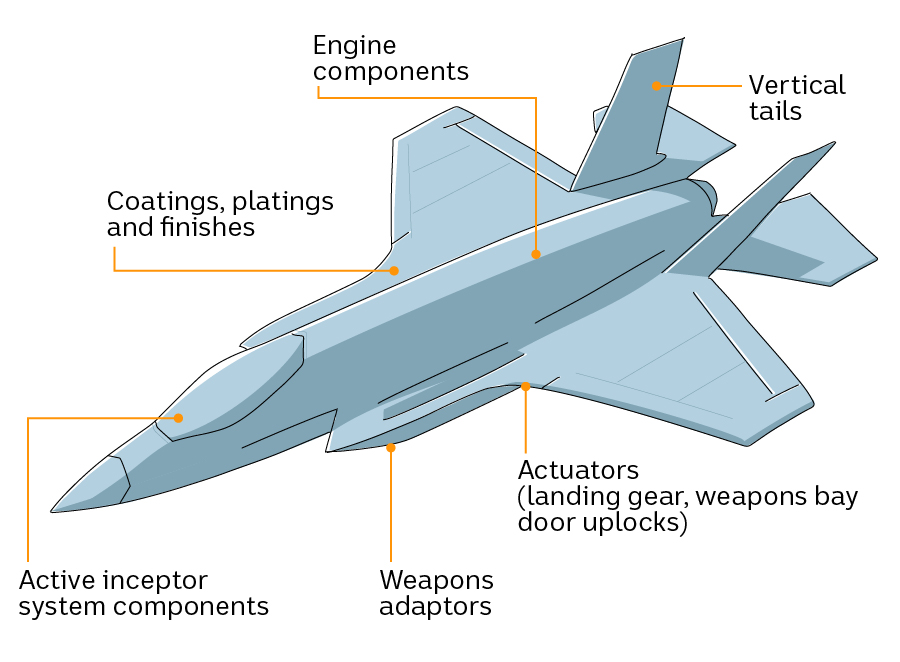
Some of the key components manufactured in Australia for the global supply chain of F-35 fighter jets. (Source: Department of Defence / ABC News: Alex Lim)
A UN commission of inquiry last year found Israel had been committing genocide in Gaza.
The world’s major human rights groups, legal experts and genocide scholars also made the same assessment.
Israel, which has rejected the UN report’s findings, has confirmed it uses F-35 jets in Gaza.
“Australia has to decide which side it will be on, the side of justice, or the law of the jungle,” Raji Sourani, general director, Palestinian Centre for Human Rights, said.
“Gaza has been decimated by weapons willingly supplied by the West, including Australia.
“We have a right to know who armed the Israeli genocidal regime, with what and how they justified making those decisions to permit the export of arms, despite the overwhelming evidence in a live-streamed genocide.”
Australian human rights group support
A group of Australian human rights and humanitarian organisations, including Amnesty International and the Australian Palestine Advocacy Network (APAN), released a joint statement supporting the legal bid.
It said Australian civil society had also spent years seeking “clarity regarding the nature, scope, and oversight” of the military exports.
“This proceeding is an important example of Palestinian-led efforts to seek answers from the Australian government through the courts where other avenues have failed,” the statement said.
“Australians also have a right to know whether Australian military goods or technologies have been exported to Israel, directly or indirectly, in a manner that risks contributing to human rights abuses and grave international crimes.”

Rawan Arraf is the principal lawyer at the not-for-profit legal centre representing the Palestinian groups. (ABC News: Adam Griffiths)
Ms Arraf said pressure from Palestinian legal groups and widespread public concern had resulted in the Defence Department launching a review in 2024 into 66 “active” permits approved before the outbreak of the conflict in Gaza.
It was later revealed that 31 permits on the “Part 1 — Munitions List” were green-lit to remain active.
Part 1 exports are “designed or adapted for use by armed forces” or “inherently lethal”, as outlined by the Defence Department.
Defence has refused to provide further information to the ACIJ, and there has been no update on the 13 permits that remained under review.
Ms Arraf said the court filing was in its early days, and they would need to see how the defence minister responded to the application to determine their next steps.
“Our clients believe they may have a right to obtain relief in the nature of judicial review. But because of secrecy around the process, they cannot know for sure until the cloak of secrecy is unveiled,” she said.
“This is a preliminary discovery application to try and seek those documents.”