Reserve Bank deputy governor Andrew Hauser says stagflation is a “central banker’s nightmare” and the coming months will be challenging for Australia.
He has warned that Australia will soon experience a “big income shock”, due to the war in the Middle East, and inflation will be heading higher.
With stagflation risks rising, what lessons could the treasurer learn from the past?
At the same time, he said, consumer confidence in Australia has already declined significantly and that could potentially impact economic activity this year.
Speaking in New York, Mr Hauser said there wasn’t a lot the RBA could do to stop inflation rising in the short-term.
But he said the “big question” for the RBA was how the current global energy shock, and the coming wave of inflation, would impact economic activity in Australia and how it would feed into inflation over the next two to three years.
“It is a central banker’s nightmare,” Mr Hauser said.
Stagflation is a situation where economic activity is stagnating and you’re dealing with high inflation (stagnation + inflation).
It is a damaging phenomenon that can be accompanied by rising unemployment and recession and a host of other problems.
“The stagflationary shock: inflation up, activity down. Judging the balance between those two is, I guess, how we earn our money,” Mr Hauser said.
He made his comments during a “fireside chat” at the Money Marketeers of New York University, New York.
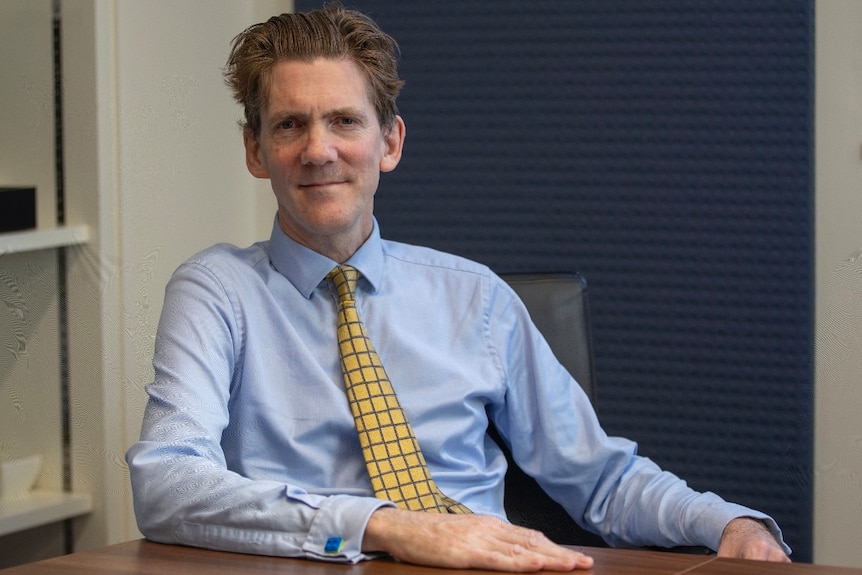
Andrew Hauser says the RBA will be monitoring the situation closely. (Supplied)
Rising inflation, rising interest rates
In recent weeks, senior Australian economists have warned about stagflation in Australia, as the world deals with the fallout from the Middle East war and the global energy shock it has set off.
Mr Hauser said it was not easy for central banks to manage the conflicting forces of rising inflation and slowing growth.
How a global energy crisis can lead to stagflation
He said one could see higher inflation pushing its way into the system right now, but the RBA was also concerned about what impact higher inflation could have on Australia’s economy over the medium term, so it was monitoring things closely.
Headline inflation in Australia is currently 3.7 per cent and the RBA wants to keep inflation averaging between 2 and 3 per cent.
Mr Hauser said inflation was already too high in Australia before the war broke out, and the RBA did not have “high confidence” that interest rates were at the right level yet.
He said the RBA would have to lift interest rates to a level that brings inflation back down to target, but it was also worth keeping things in perspective.
He said although inflation was too high, it wasn’t exceptionally high before the war broke out.
Why the oil crisis is about to worsen
“[It is] about 100 basis points above the midpoint of the target in core. That’s not very different to the core measures of many other G-20 countries,” he said.
“I don’t mean by that to say that we’re complacent. But on the other hand, the intensity of the policy debate in Australia, which I welcome, sometimes slightly loses touch with that point that inflation in Australia is not out of the range of the inflation seen in other countries.
“We all face a pretty similar challenge I think,” he said.
He said the RBA would also be watching to see if Australian businesses tried to exploit the coming era of rising inflation to push through higher price rises.
“There are some models … that say that a shock of this kind, which is very visible and very obviously a shock in a country like Australia to pretty much every company’s cost base, that that gives you an opportunity to put price rises through that you might otherwise have found difficult to push through,” he said.
“If that’s the case, well, we’ll have to react to that. But I don’t know if we’ve seen enough yet to be sure,” he said.
Consumer confidence plummets in April
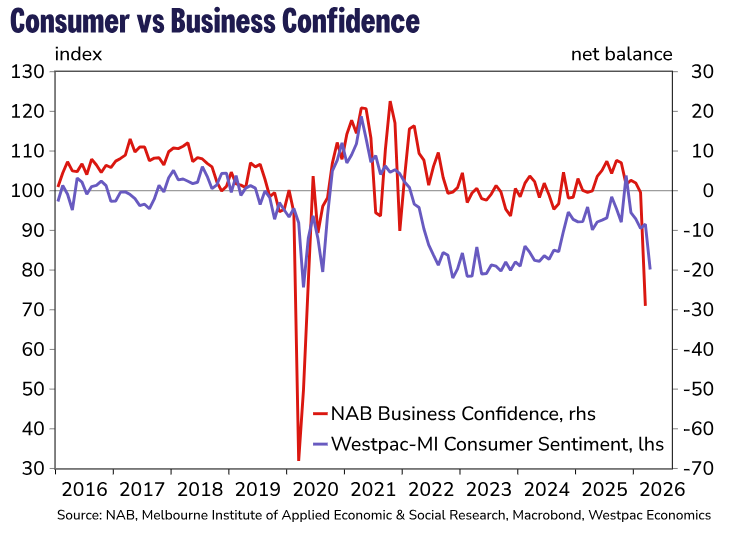
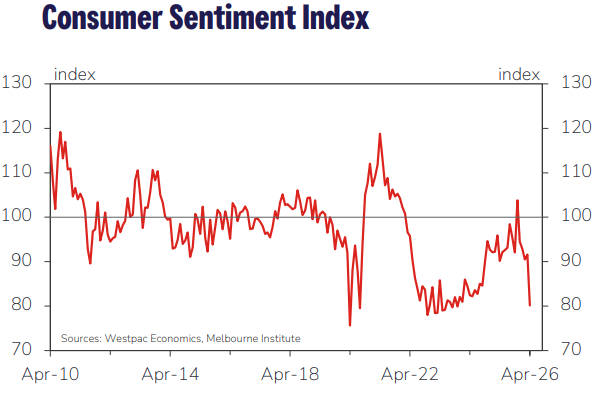
On Tuesday, the latest monthly Westpac-Melbourne Institute Consumer Sentiment survey showed sentiment fell significantly in April.
The index fell by 12.5 per cent (from 91.6 points in March to 80.1 points in April) as spiking fuel prices and rising interest rates triggered the biggest monthly fall in the survey since COVID.
Job loss fears have jumped to a five-and-a-half year high, as rising inflation and interest rates create another “cost of living” shock.
“A sharp deterioration in expectations suggests consumers are bracing for a return to the extended period of weakness seen during the 2022–24 inflation fight,” said Westpac economist Matthew Hassan.
“The April sentiment drop is the biggest monthly decline since the onset of the COVID pandemic.
“At 80, the Index is back near historical lows, albeit above the extremes seen at the onset of the pandemic and during the recessions of the early 1990s and 1980s,” he said.
Business confidence collapses
Also on Tuesday, the latest NAB business confidence survey showed business confidence collapsed in March.
It found that business conditions in Australia held steady at +6 index points in March, but business confidence fell by 29 points from a neutral reading to -29 index points.
The huge decline in confidence was the second-largest fall in the survey’s history, with falls of this magnitude only seen in the global financial crisis (2007-2009) and the onset of COVID in 2020.
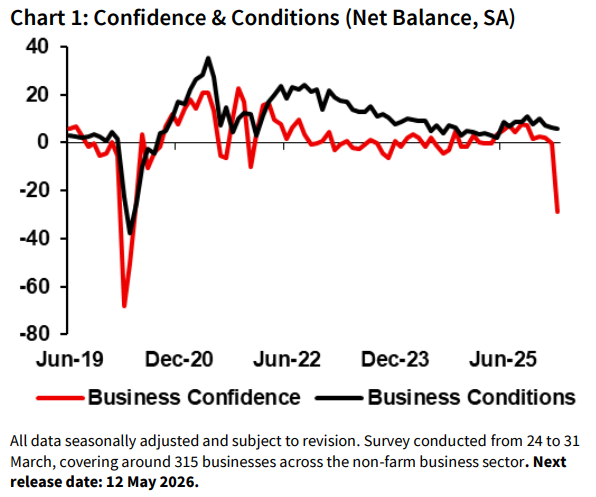
Tom Ryan from JP Morgan said the large spread that has opened up between business conditions and business confidence was an “ominous sign” for business conditions.
“Particularly large spreads imply businesses perceive a looming shock,” he warned.
“We expect business conditions to deteriorate from here if global commodity supply constraints persist.”
Westpac economist Luka Belobrajdic said NAB’s business survey provided the first complete read on business conditions and confidence since the outbreak of the Middle East conflict, the subsequent surge in fuel prices, and dual rate hikes from the RBA.
He said cost pressures intensified sharply in March. Purchase cost growth saw its largest monthly increase on record, to 3 per cent, although labour cost growth was flat, at 1.5 per cent.
“Confidence now sits 34 points below its long‑run average,” he said.
He said when combining both surveys (consumer sentiment and business confidence), it shows how sensitive sentiment is to evolving policy and geopolitical events at the moment.