
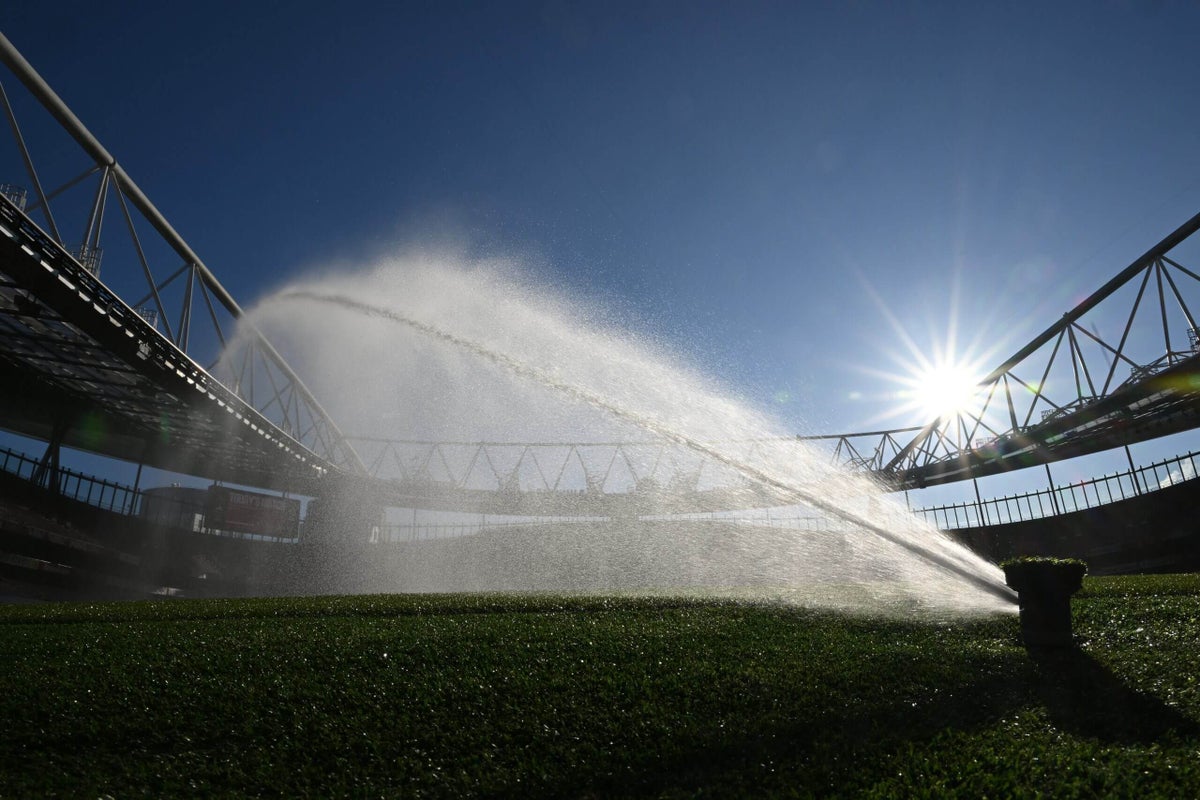
In the moments after Arsenal’s 2-1 defeat against Bournemouth on Saturday, Viktor Gyokeres cited the pitch’s condition as a contributing factor.
The Swedish striker mentioned he felt the grass was “a bit dry” towards the end of the game, adding that it “didn’t help” the goalscoring chances Mikel Arteta’s side created. You could be forgiven for thinking he was talking about Bournemouth’s turf — gamesmanship around football pitches is nothing new — but the dry pitch he was discussing was at the Emirates Stadium, where Arsenal have only lost twice all season.
“They (Bournemouth) have good players and made some good combinations,” Gyokeres told the BBC’s Match of the Day after the defeat, which gave Manchester City more than a sliver of hope that the Premier League title race is on. “But we need to do better. We had some chances in the end. The pitch was a bit dry, which didn’t help. I’m very confident. We don’t need to get stuck too much on what happened today. We need to look forward and be positive.”
Whether it’s views on wetness or grass height, the condition of a pitch can be contentious — as Xavi found out when a meme was made of him. The former Barcelona head coach is called a jardinero, or a gardener, by some opposing fans and Madrid-based media outlets.
Manchester City manager Pep Guardiola and his old nemesis Jose Mourinho would often have opposing views on how a pitch should be prepared.
“Experience will also tell you that if you ask 10 players if the pitch is wet enough, five of them would say yes and the other half would say no,” Lee Jackson, Sheffield Wednesday’s head groundsman, who is talking generally, tells The Athletic. “It is trying to get that balance.
“It is always the same for both teams. As the home team, you always prepare it how your team wants it and that doesn’t always suit the away team. It can be quite subjective when a player says if it was wet or dry enough.
“We always say as groundsmen that the pitch is the easiest thing to blame because it can’t answer back, whereas if you are blaming an individual for a mistake, then there is a right of reply. If you are trying to blame 7,500 square metres of grass, it isn’t going to shout back.”
But how wet or dry should a soccer pitch be? And what difference does it actually make?

Viktor Gyokeres mentioned the dryness of the pitch after Saturday’s match (Marc Atkins/Getty Images)
“The defining factor in that is how wet you can get it because you want it where the grass leaf itself is wet, but the pitch not too wet to make it heavy,” Jackson, who worked at Manchester City, adds.
“The difficulty from a groundsman’s perspective is you only have a 10-minute window from the end of the warm-up to the teams coming out and then you only have 10-12 minutes at half-time.”
Jackson notes the coaches as being the “best people” for a groundsman to liaise with, saying they act as a “mouthpiece” for the players, but concedes, due to myriad reasons including the climate and time, that there is “never a one-size-fits-all approach”.
Although the International Football Association Board (IFAB), the game’s lawmaker, does not have a specific mandate on the length of grass, the general rule of thumb is that it should not exceed 30mm and it must be cut evenly. This is mandated by the Premier League and UEFA.
When it comes to watering the surface, however, it is a different story.
In the Premier League, the home team is not required to water the pitch, whereas in the Champions League, UEFA requires the home team to lay out their watering schedule at an organisational meeting before the fixture.
European football’s governing body also mandates that the turf has to be watered evenly and it should be finished an hour before kick-off. The pitch-watering schedule must be communicated by the home club at the organisational meeting and the regulations require it to be watered evenly and not only in certain areas.
Additionally, the home team can also opt to water it again between five and 10 minutes before kick-off and during half-time for a maximum of five minutes.
Another experienced groundsman noted to The Athletic how this is always a difficult time of the year to perfect the pitch’s water levels.
It is getting warmer, which means the grass leaf can dry incredibly quickly — in some cases, within 15 minutes of kick-off — and the 12.30pm kick-offs, such as Arsenal’s match on Saturday, only add to the climate-related complications.
“We are at the time of year when pitches are going to dry up very quickly, so getting it wet and keeping it wet is always difficult,” Jackson explains.
“You could throw on as much water as you want and get it to a level where the coaches and players would be happy with it, but one thing you can’t control is once that water has been turned off and the game starts, from minute one to 45, it is not going to be consistently wet.
“It is such a complicated yet uncontrollable balance you are trying to achieve because of the consistency required in the modern game.”