
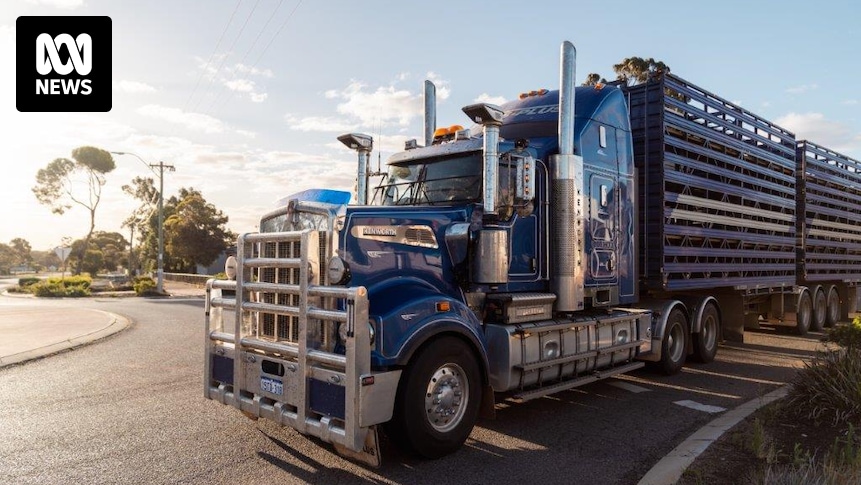
A survey released by the peak body representing Australia’s trucking industry shows 75 per cent of operators believe they will not survive beyond six months if the current fuel situation continues.
The National Road Transport Association (NatRoad) survey of nearly 200 operators nationally found owner-operators with small businesses were more vulnerable, and without urgent assistance would run out of cash soon.
NatRoad chief executive Warren Clark has called on the federal government to urgently implement the $1 billion Economic Resilience Program it announced on April 2.

NatRoads chief executive Warren Clark has called for urgent action. (Supplied: NatRoad)
“The federal government came out on the second of April promising this economic resilience program, and to date we’re still waiting to see the details,” he said.
“Implementation of this program needs to happen within days, not weeks or months.”
Prime Minister Anthony Albanese announced the fund in his address to the nation, stating $1 billion would be made available in interest-free loans for “manufacturing and fuel businesses dealing with the economic cost of this conflict”.
At the time he said “truckies, freight companies – and fuel and fertiliser producers” would be eligible.
“These firms are not just being affected by this global crisis, they are essential to Australia getting through this crisis,” he said.
Mr Clark said it was not clear when the loans would be made available, and without a system his members, particularly smaller family run operators, would no longer be able to operate.
“If you can’t get money to fill your truck up, then that truck is stopping,” he said.
“And if you look at the small operator, let’s say their fuel bill has gone from $50,000 to $100,000 for the month, how do you fund it?
“Most of the freight gets moved by the smaller operators.”
Fuel costs force end of family business
A family truck operator from the NSW southern highlands supplying sawdust to 96 local horse owners said he had just closed his supply business because he could no longer meet the fuel costs.
Geoff ‘Curly’ Charlwood, from Curly’s Compost in Penrose, last year moved to a South Australian supplier because his local sawmill closed down and he could not source what he needed in NSW.
He runs two trucks, with the cost of a load jumping from $440 to $770 when he changed supplier, but he said the current spike in prices put the cost of a load up to $1,100.
Because of that, he had to close a business that was generating $300,000 in income per year.

Curly and Margie Charlwood had to close their sawdust transport and delivery business due to fuel costs. (Supplied)
“Two weeks ago we had to make the decision to shut the shop,” he said.
“We were bringing the [sawdust] out of Mount Gambier in South Australia in B-doubles.
“We used to get a B-double every fortnight.”
Mr Charlwood said his customers had stayed with the business through the initial cost increase, but then the fuel price went through the roof.
“We wouldn’t do it to our customers. They weren’t just customers, they were friends, and I have dealt with them for a lot of years,” he said.
“Our sawdust business was the biggest part of our business and we started it all from scratch. We had a good business, a very good business and now it’s gone, done and dusted.”
Mr Charlwood said he had fallen back on work as a blacksmith and compost supplier, but they were less profitable businesses.
Mr Clark said NatRoad has a meeting scheduled with a government representative this week to discuss funding options.
“We need these meetings. We have got one this week. We will push hard on it to get it established,” he said.
A spokesperson for the National Resilience Fund’s Economic Resilience Program (ERP) said details of the program were being finalised.
The National Reconstruction Fund declined an interview but a spokesperson said the fund would open for applications “in the coming days”.