
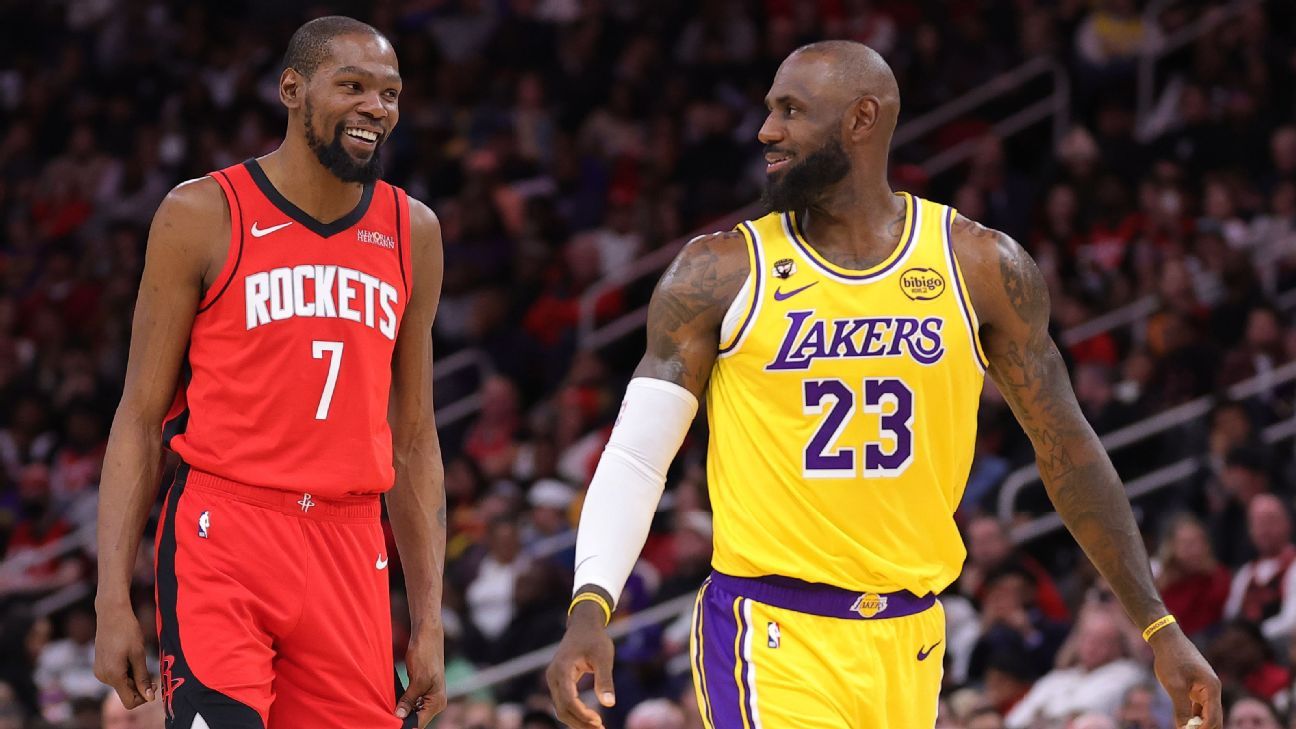
Two of the defining superstars of this NBA era in LeBron James and Kevin Durant are set to collide once more, but this time under far different circumstances.
In a Western Conference first-round showdown in the 2026 NBA playoffs, the fourth-seeded Los Angeles Lakers enter the series shorthanded — leaning heavily on the 41-year old James as injuries sideline key contributors — while the fifth-seeded Houston Rockets arrive surging behind the 37-year old Durant and a roster that closed the regular season on a strong run.
Game 1 of the series tips off on April 19 at 8:30 a.m. PHT, streaming live on Disney+ Philippines.
NBA on Disney + In The Philippines

Disney+ is the new home of the NBA in the Philippines. Watch live on Disney+
Beyond the nostalgic battle that they will have, this series carries a different kind of weight with both teams trying to bounce from first-round exits last season.
Here are some storylines and aspects of the Rockets and Lakers to look at.
Does James still have enough in the tank?
At this stage of his career, it’s less about what James can do in spurts and more about whether he can sustain it over a full playoff series.
The flashes are still elite, like his 30-point performance on 13-of-14 shooting in their final encounter against the Rockets in the regular season — showing he can still pick his spots, punish mismatches, and control tempo in halfcourt sets.
Even in his 40s, his efficiency and decision-making remain among the elite in the league.
But the chess match shifts in a seven-game series.
Without the spacing and on-ball creation of Luka Dončić and Austin Reaves consistently beside him, Houston can load up early by crowding on drives, shrinking the floor, and forcing the ball out of his hands.
That plays directly into the Rockets’ identity: a top-six defense with a 112.1 defensive rating, built on length, switchability, and multiple bodies to throw at primary creators. Over time, that kind of coverage can wear even a player like James down.
X-factor for the Lakers: The return of Dončić
When the Lakers were rolling in March, it wasn’t just about wins and also about how they were generating offense.
Editor’s Picks
2 Related
During their 15-2 stretch with a top-five net rating at +9.8, the Lakers consistently bent defenses through high-usage pick-and-rolls, early offense, and shot creation at multiple levels.
And if there was one player responsible for that, it was Dončić, who played like the MVP of the league for that stretch.
His 37.5 points, 8.0 rebounds and 7.4 assists on 62.9 TS% weren’t just numbers — they reflected complete control of the offense. With a +13.1 net rating in his 594 minutes, he dictated pace, manipulated coverages, and created advantages in almost every possession.
If he returns mid-series, that changes everything structurally.
Instead of James initiating every set, the Lakers regain a dual-creator system, which forces Houston to defend deeper into the clock and opening up cleaner looks for role players. In a tight series, that kind of offensive balance can be the difference.
Can Durant produce more in this series?
Durant’s baseline in terms of scoring is as good as anyone that has graced the league with efficient isolation scoring, shot-making over contests, and low-turnover offense. Against the Lakers, he maintained that efficiency: 20.3 points per game on 67.2 true shooting, while shooting at least 50% in all three meetings.
But playoff basketball often demands more than efficiency: it also requires volume and control.
The Rockets went 0-3 against the Lakers in the regular season, suggesting that — while Durant got his numbers — it didn’t fully tilt the game.
In a series where possessions slow down and execution tightens, Houston will need Durant to be more aggressive as a primary initiator – whether that’s hunting mismatches, forcing switches, or creating earlier in the shot clock.
X-factor for the Rockets: Amen Thompson as the secondary scorer
Houston’s edge in this matchup could come from their ability to generate paint pressure, and Amen Thompson has become a key piece in that.
In April, he averaged 23.2 points on 64.3% shooting – numbers that highlight his efficiency as a downhill attacker.
From a basketball standpoint, his role is clear: collapse the defense. With the Rockets’ size advantage, Thompson’s ability to attack gaps, push in transition, and finish through contact forces rotations and opens up kick-out opportunities.
If he consistently looks for his offense instead of deferring, he gives Houston a second layer beyond Durant — something that becomes critical against a Lakers defense that will likely be locked in on the first option.