Australia’s unemployment rate remained at 4.3 per cent in March, the same as February, in seasonally adjusted terms.
Employment increased by 17,900 people and unemployment decreased by 3,700 people.
Ben Udy, lead economist for Oxford Economics Australia, said the labour force survey was conducted in the first half of March so it likely preceded any economic impact from the conflict in Iran and higher fuel prices.
IMF releases world economic outlook
Westpac economist Ryan Wells said the data may, therefore, represent the “calm before the storm”.
“It is too early to expect flow-on effects from the Middle East shock or from recent interest rate rises to be appearing in labour market measures,” he said.
“Instead, today’s data provides us with a picture of the starting point for the labour market before these forces impact.”
The Australian Bureau of Statistics data show growth in employment in March was driven by full-time workers, which rose by 53,000 people. That was partly offset by a fall in part-time employment of 35,000 people.
The underemployment rate remained steady at 5.9 per cent, while the participation rate slipped by 0.1 percentage points to 66.8 per cent.
In trend terms, which smooths out seasonal volatility, the unemployment rate was also 4.3 per cent, as it was in February.
Geopolitics, inflation, and the implications for interest rates
Callam Pickering, APAC economist at Indeed, said the employment data was “rather uneventful in March,” compared to the overall geopolitical environment.
But he said Australia’s labour market would probably come under “increased pressure” in coming months as the Middle East conflict drags on.
“The job market is holding on, continuing to be resilient, which means it won’t be a major discussion point when the RBA meets in May,” Mr Pickering said.
Stagflation is a ‘central banker’s nightmare’, says RBA deputy governor
“That meeting will be dominated by discussions on inflation and the ongoing conflict in the Middle East.
“There isn’t much the RBA can do about overseas supply-chain disruptions and a surge in petrol prices. However, they are faced with broad-based and domestically-driven inflationary pressure that still needs to be addressed.”
Abhijit Surya, senior APAC economist at Capital Economics, said the employment data would reinforce the Reserve Bank’s assessment that upside risks to inflation were greater than downside risks to the labour market right now.
“Granted, the labour market is downstream of economic activity, and it could take a while for cracks to show up,” he said.
“[But] with inflation on track to approach 5 per cent by mid-year and inflation expectations rising in tandem, the case for further policy tightening remains compelling,” he said.
When will the unemployment rate start rising?
Westpac economist Ryan Wells said it could take a few months for Australia’s employment data to reflect the current global price shock.
He said price shocks took time to work through household spending to profit margins and business decisions about investment and staffing.
He said new hiring decisions might be quickly put on hold, but businesses tended to be slower to shed staff due to the difficulty and costs involved in securing and training new staff if the decision needed to be reversed.
That meant the labour market tended to be a “lagging indicator” of the economy, especially when entering a slowdown, he said.
“As such, any flow-through from higher fuel prices or global uncertainty is more likely to show up later in the year,” he said.
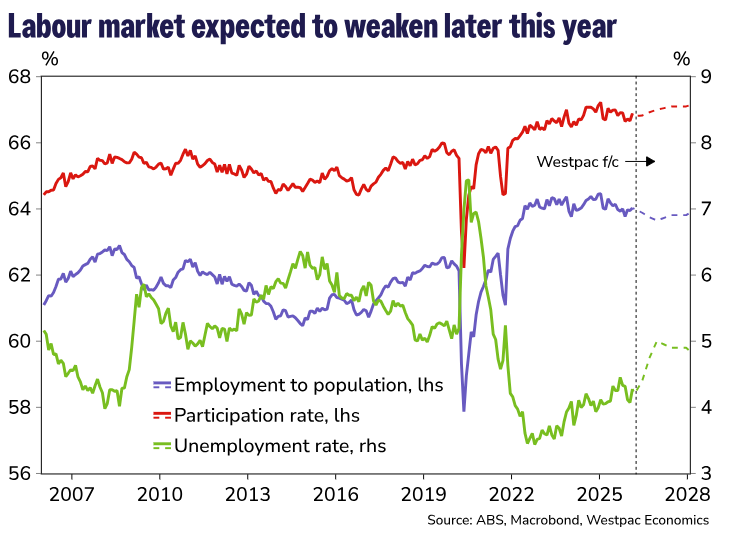
He said the bulk of the softening in Australia’s labour market would probably occur in the second half of this year, when the unemployment rate was expected to average about 4.9 per cent (up from 4.3 per cent currently).
He said he expected it to stay at that level through 2027, after the impact of the Reserve Bank’s interest rate hikes.
But also, he said, the recent collapse in consumer and business sentiment to pandemic-era lows could complicate things.
See Westpac’s unemployment rate forecast visualised below.