
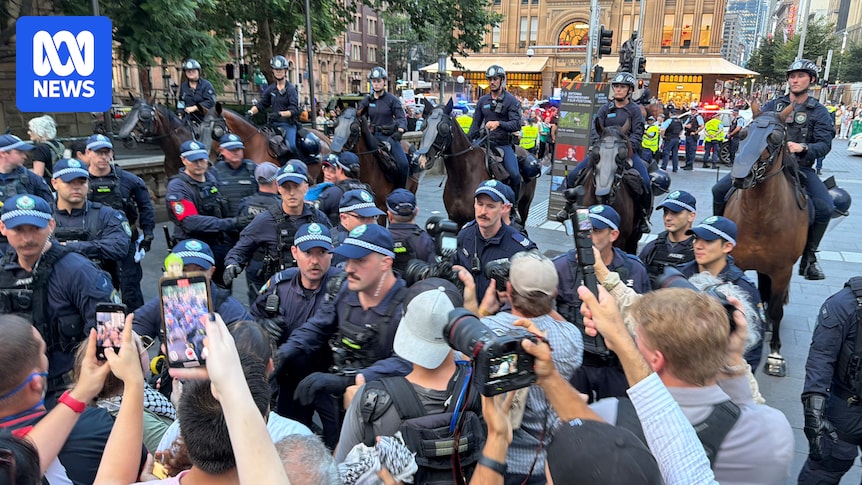
Controversial laws to restrict protests in New South Wales following the Bondi Beach terrorist attack have been struck down by the state’s top court.
The Court of Appeal accepted arguments by protest groups that the expanded police powers were unconstitutional, in a judgment handed down on Thursday afternoon.
The laws passed on Christmas Eve during an emergency sitting of parliament were used to purportedly prevent authorised public assemblies in parts of Sydney for almost two months.
The laws were ruled to have “impermissibly burdened” the implied right to freedom of political communication under Australia’s constitution in a joint judgment by Chief Justice Andrew Bell, Justice Julie Ward and Justice Stephen Free.
There were hushed cheers and hugs inside the Banco Court in Sydney, the state’s largest, as supporters draped in keffiyeh scarves watched on.
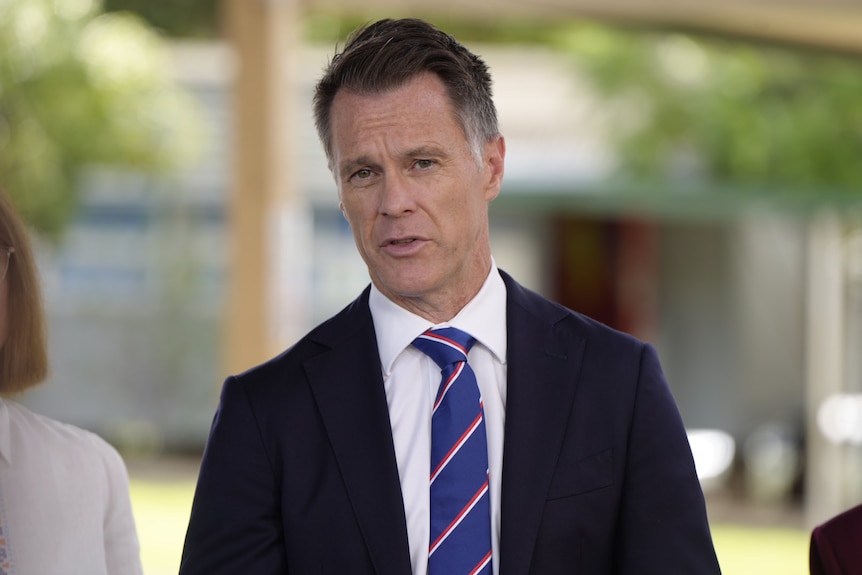
Premier Chris Minns urged his parliamentary colleagues to push through the laws on Christmas Eve in the wake of the Bondi Beach terror attack. (ABC News: Abubakr Sajid)
The laws in question gave police the power to make a declaration preventing the authorisation of public assemblies in certain areas.
Within hours of the provisions entering the statute books on Christmas Eve, the police commissioner made a declaration restricting protests throughout Greater Sydney.
The declaration, which lasted for 14 days at a time, was extended on four occasions and did not lapse until February 17.
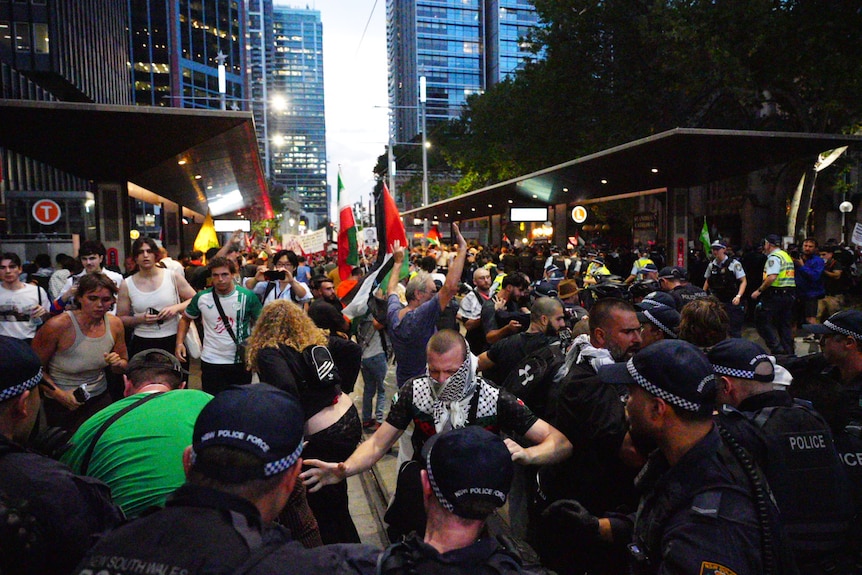
Tensions flared at a rally against visiting Israeli President Isaac Herzog as police enacted the expanded powers. (ABC News: Abubakr Sajid)
The subject area, however, was reduced in January to the eastern suburbs and CBD, with a carve out for Hyde Park to allow for protests on Australia Day.
The restrictions remained in place for Israeli President Isaac Herzog’s visit in February, which drew large protests.
Laws had ‘chilling effect’ on speech
The plaintiffs, Elizabeth Jarrett of the Blak Caucus, Joshua Lees of the Palestine Action Group, and Michelle Berkon from Jews against the Occupation ’48, launched the challenge in early January.
They argued the provisions had a “chilling effect” on speech and “impermissibly burdened” the implied right to freedom of political communication under Australia’s Constitution.
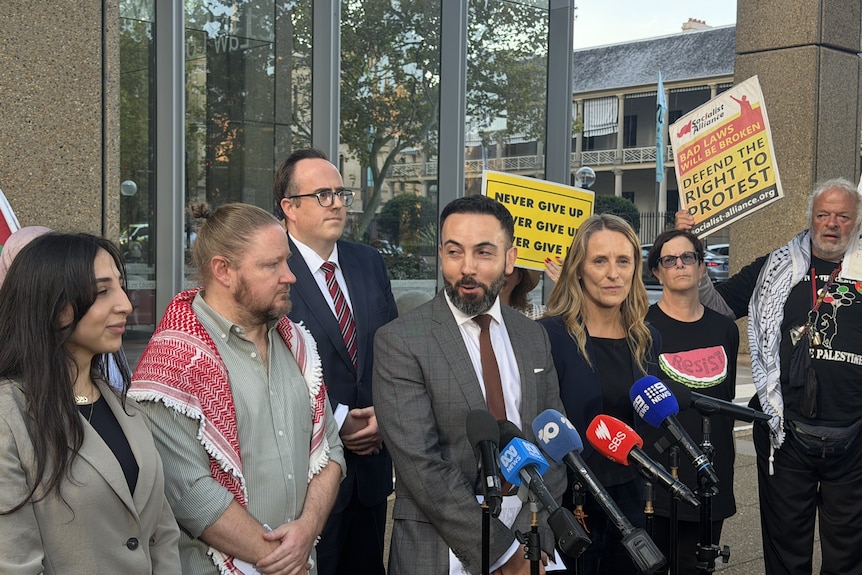
The verdict was celebrated by the plaintiffs outside court. (ABC News: Pablo Vinales)
According to their written submissions, the thresholds for exercising the power were low and that the restrictions could be invoked by reasons unrelated to a terrorist act.
The State of New South Wales argued the laws had effect only in “tightly confined circumstances” and had the “legitimate purpose” of “protecting the community and enhanc[ing] social cohesion” in response to the Bondi attack.
The government argued the burden this placed on freedom of political communication was “reasonably appropriate and adapted” to achieving that end.
It pointed to ASIO assessment that found “heightened community tensions” over the conflict in the Middle East had translated into “some incidents of violence connected to protest activity”.
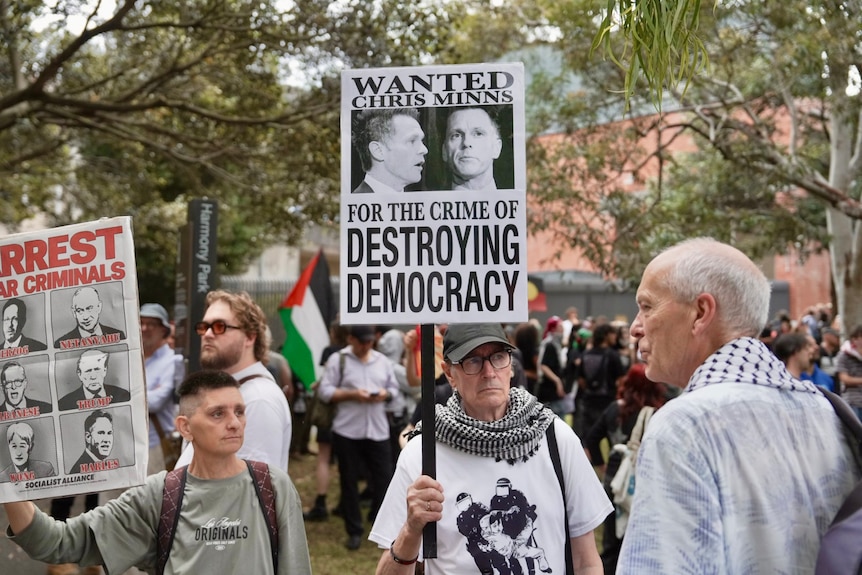
The restrictions remained in place for the Israeli president’s visit in February, which drew large protests. (ABC News: Jack Fisher)
The state argued it was rational to give police the power to act in response to “intimidation, harassment and fear” even where the conduct does not pose a serious safety risk.
Premier defends protest laws
In a statement, Premier Chris Minns said the government was disappointed by the ruling but stood by its decision to introduce the legislation.
“This was in the aftermath of the worst terrorist attack our country has seen, in which 15 innocent lives were lost,” Mr Minns said.
“We believe it was necessary and important for Sydney at the time.”
How tight is the right to protest?
Outside court, Mr Lees said it was a “resounding win”.
“As our wonderful barristers argued, this was like using a sledgehammer to crack a walnut,” Mr Lees said.
Mr Lees called on Mr Minns to resign, saying he has been warned by MPs and legal experts the laws were unconstitutional.
“He needs to end his war on democracy in New South Wales,” Mr Lees said.
NSW Police in a statement said it was reviewing the judgment.