
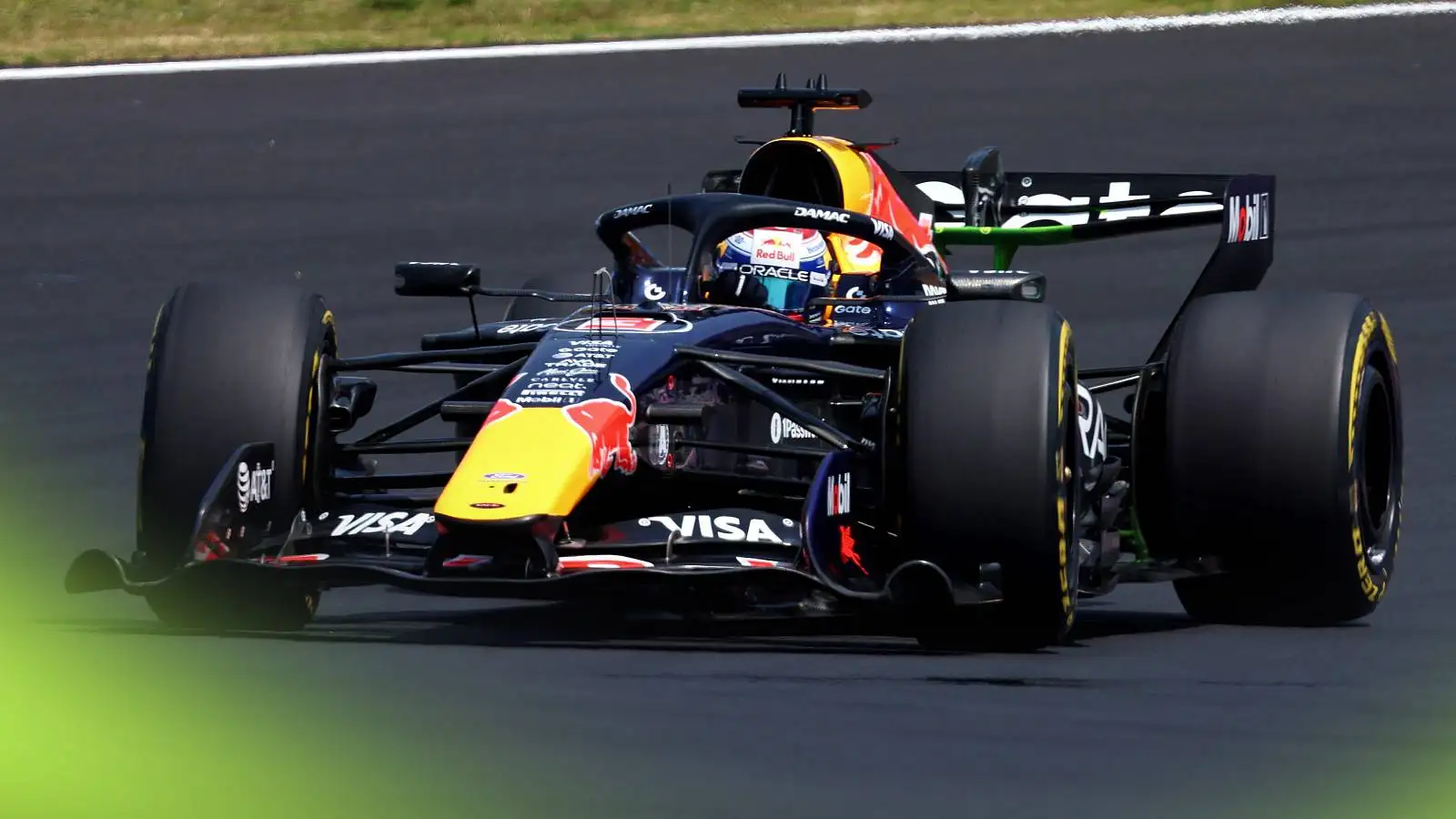
Red Bull has brushed itself off after a tumultuous 2025, but shows no signs that it remains the front-running team it’s been for so long.
With Red Bull forcing itself into a leadership succession scenario without any transitional overlap, the team has slipped back in the pack; can Laurent Mekies turn things around at Milton Keynes?
Laurent Mekies faces Red Bull rebuild challenge
Want more PlanetF1.com coverage? Add us as a preferred source on Google to your favourites list for news you can trust.
F1 2026 was always going to be a line in the sand for Red Bull, with all the momentum from the previous leadership regime disappearing as the old regulation set was discarded after Abu Dhabi ’25.
All of the machinations, design philosophies, and tendrils that connected the final weeks of 2025 with the start of the previous regulation cycle in 2022 have been ripped apart, and it’s a very different Red Bull that stands before us at the start of this chapter of its history; visibly weakened from its previous iteration.
The big-name losses are numerous: Rob Marshall and Jonathan Wheatley in 2023 and ’24, Adrian Newey in 2024, Christian Horner and Helmut Marko in 2025, and Will Courtenay in early 2026 after handing in his notice over a year ago in order to pursue a bigger job at McLaren.
Under Horner’s leadership, the longevity of these relationships meant they had seen it all and done it all, as long-standing colleagues across two separate spells of domination: Newey, Marshal, and Wheatley joined Red Bull in ’06, while Courtenay was already working at Milton Keynes, having joined Jaguar before Red Bull’s purchase.
In mid-2022, the team was on a roll. Newey, together with technical director Pierre Waché, had created the potent RB18 that saw Max Verstappen follow up on his maiden title with a convincingly dominant sprint to a successful defence, having overcome Ferrari’s initially strong start.
But, in the background, the dynamic began to change following the death of team founder Dietrich Mateschitz. The Austrian had always taken a hands-off approach to his racing team, leaving the autonomy in the hands of Horner and Marko, two old-school racers with a long-standing working relationship. Marko was Mateschitz’s right-hand man, bridging the gap between Horner’s clear leadership and the parent company’s interests.
Mateschitz’s death meant the leadership structure on the Austrian shareholders’ side changed. Control of the parent company was spread across three CEOs: Franz Watzlawick on the drinks side, Alexander Kirchmayr as chief financial officer, and Oliver Mintzlaff as the CEO of corporate projects and investments, such as sporting enterprises like football and ice hockey teams, and, at the top of the tree, the Formula 1 teams.
With Red Bull GmbH taking a greater interest in how the senior F1 team operated and was marketed, it meant Horner’s position was always likely to come under scrutiny if and when performance ever slipped away. But those were concerns for another day as, throughout 2023, Horner’s squad utterly crushed everything in its path as Red Bull produced the most dominant season in F1 history to mark Verstappen’s third consecutive title.
The last 18 months of Horner’s tenure are, by now, well-documented. Cleared of any wrongdoing by two separate external investigations into allegations of his behaviour, the continued faith shown in him by Red Bull‘s shareholders steadied the ship after a tumultuous period in which disharmony had clearly descended. Not only had the relationship between Horner and Marko clearly soured, but Jos Verstappen publicly called for Horner’s job.
It was during this time that Wheatley and Newey departed. Wheatley pursued an upward opportunity at Audi after realising that he could never be team boss at Red Bull while Horner remained, while Newey’s departure came about as a consequence of the excessive noise around the team, as Marko explained Mateschitz’s death had played a key role in that decision.
“[Dietrich] was basically the only leader. He made quick decisions,” Marko told Austria’s ORF.
“He was a charismatic entrepreneur who also had a lot of foresight and was willing to take risks with the racing team.
“And all of that, of course, now… The company and everything else has to be set up differently, because you can’t find another individual like that, and he can’t be replaced by just one person. That can also be part of the change.
“I think that was the main reason for Newey’s decision to look for a new challenge.”
No official reason has ever been given for Horner’s eventual axing, which came following a slide in Red Bull’s performance that saw McLaren clearly move ahead by the time the British executive was removed in unceremonious fashion. There were no sentimental goodbyes, and no chance to say farewell to the team and personnel he had assembled and empowered over the course of two decades of triumph, as was so candidly laid bare in the episode of Netflix’s Drive to Survive covering this period.
With the affable Laurent Mekies taking over Horner’s roles, his arrival coincided with a dramatic upturn in the car’s competitiveness. At the very next race, in Belgium, Verstappen won the Sprint, and, from two races later, Verstappen never finished off the podium again. It was a remarkable turnaround following the introduction of upgrades signed off on during Horner’s last weeks.
Mekies’s arrival brought with it some peace and lowered the noise around the team, but, despite positive attributions from Marko and Verstappen, the Frenchman was reluctant to claim any of the credit for the turnaround, instead pointing to the talent inherent in the ranks for making it happen.
Marko may have felt he had won the internal battle for control of the team and set about making some unilateral decisions of his own, not reading the room that the parent company wanted a more clinical, corporate approach. Just four months after Horner, Marko too was gone, having been given the option to walk away on his own terms before a less palatable exit would be forced.
It’s meant that Red Bull has entered F1’s new era in 2026 with the Austrian parent company’s hegemony evident, and facing a major rebuild job, overseen by an enthusiastic, if unproven, Mekies: the French engineer’s most senior role in competition prior to his brief spell as team principal at Racing Bulls was as Ferrari’s racing director between 2021 and ’23.
But, ultimately, Mekies is facing a very different challenge from what Horner faced 20 years ago. Where Horner was given autonomy under Mateschitz, a position that only solidified year-on-year as his impact proved positive alongside Red Bull’s clearly upward momentum, Mekies is reporting to a much more hands-on Mintzlaff, with Red Bull GmbH having taken back marketing control of the team that had been relinquished under Horner.
There’s also pressure to immediately succeed. Red Bull is no longer the youthful disruptor, but rather the establishment, and one that is already uncertain of retaining its star employee in Max Verstappen – a driver who clearly does not want a long-term project.
The RB22 is the first Red Bull without any Adrian Newey influence or DNA since the RB1 in 2005, with Waché taking over the technical lead. What is evident from the opening three races of F1 2026 is that the car’s performance has slipped dramatically, meaning Red Bull is starting this new regulation cycle as an upper-midfield team rather than a frontrunner.
Having emerged as a positive surprise over the winter, the Red Bull Powertrains project – conceived, pushed, and led by Horner over five years – has delivered a potent and competitive unit that is thought to be the only non-Mercedes power unit which won’t qualify for any ADUO assistance at this point; a remarkable achievement for a first-time effort from a non-automotive manufacturer.
But there have been precious few other positives to take away, as Isack Hadjar explained after Suzuka.
“The only positive right now is that we can drive the car fast, but we have no lead on how we can make a fast one,” he said.
“We have a good power unit. The engine’s good. It is just the chassis side is terrible, just slow in the corners.”
Mekies explained that Red Bull has started “scratching its head” over what to do to unlock more performance.
“So at first we left Melbourne thinking that we were one second off Mercedes and half a second off Ferrari,” he said. “The biggest difference in Melbourne was that McLaren looked in reach there, and actually, Max came back from P20 to bump into Norris.
“Then we see that gap largely increasing in China, and you have seen us starting to scratch our heads there about car balance and car characteristics.
“And then [in Japan], also, it didn’t look good at all on Friday, Saturday, and certainly, there is nothing to be happy about [in the race].
“That’s the reality, and I think it’s a combination of underlying performance and a layer of us not being able to extract enough from the package and to give something Max and Isack can push with.
“I’m not suggesting that it’s set up tuning, I’m just saying there is something we are wrestling with that car that adds to our underlying lack of performance.
“Now, trying to solve this sort of complex issues and trying to understand complex limitations is our core business. So as much as it feels bad when you are at the back of the top teams right now, that’s precisely what the whole company is set up to do, to get to the bottom of complex limitations like that, and bring development that can mitigate them and improve.
“It feels bad now, but I have full confidence that that’s exactly what our team is very good at.”
Alongside the car’s slip in performance, it’s also become evident that the reset of the team into Red Bull 2.0 hasn’t yet finished, with more personnel departures since the end of 2025.
Included amongst them is the car’s chief designer, Craig Skinner, as well as the high-profile decision of GianPiero Lambiase to leave Max Verstappen’s side of the garage after 10 years in order to pursue a new opportunity at McLaren by 2028.
Front-end mechanic Ole Schack has resigned after never missing a race since the start of 2005, while the high-profile Caller twins have also moved on; Matt has moved onto Audi, while Jon’s destination is unclear.
Team sources have indicated that as many as six mechanics have left or handed in their notice, citing a change in atmosphere since Horner’s axing. It’s said that concerns voiced by the mechanics to senior management have been “railroaded over” in what has been deemed “an increasingly downbeat environment”.
Not only are experienced names leaving, but changes in such quick succession also create an experience gap in the structure of the race team.
Red Bull’s communications personnel have remained tight-lipped about the staff changes, with no indications as to the experience or skills of the personnel slotting in to replace the departing names. It is the usual modus operandi to highlight the strength in depth upon internal promotions as teams bid to downplay the impact of any departure.
Of course, this department itself has had its own changes to deal with. Senior communications manager Alice Hedworth was one of four top-level administrative staff to leave the team in January, six months on from the firing of former group director of communications and social, Paul Smith, while the head of HR, the group marketing director, the director of partnerships, and group chief marketing and commercial officer have also been released in what, externally, looks like the clearing out of those with loyalties to the old guard.
Is it possible that Red Bull’s parent company underestimated the true extent of the apparent loyalty within the ranks towards Horner, and wasn’t cognisant that the brutal nature of his sudden axing has shaken the faith of many long-standing employees?
Multiple sources in and around the team have suggested that more departures can’t be ruled out. Certainly, speculation has already started about the team’s strategy chief, Hannah Schmitz, linking her with a leap to Ferrari. Although that is understood to be wide of the mark, her expertise and proven track record mark her out as a leading commodity that any team would be interested in.
Ferrari is also said to have been eyeing up Waché as a potential target for when he becomes available; the amiable designer’s prowess having been proven across multiple cars in recent years.
Waché, along with fellow senior technical staff Paul Monaghan, Ben Waterhouse, and Enrico Balbo, is understood to be under contract at Red Bull until 2028, having signed long-term contract extensions during 2024.
But, even assuming Lambiase and Schack are the last of the trackside personnel to depart, it’s clear that a long rebuild path awaits Red Bull as it moves on from the lingering ghost of Horner’s presence. Such experience is not easily replaced, and there are no signs yet of any high-profile names jumping in to fill the breaches that have been created in the months since. Contrast that with the litany of names that McLaren has signed, many of whom have come from Red Bull.
The slump in performance means that Verstappen is likely to be contractually able to leave after 2026, should he be outside the top two in the Drivers’ Championship by the summer break, should he wish to. How difficult will it be for him not to have his head turned by Mercedes or McLaren when even a podium finish appears out of reach at this moment?
There are some grounds for optimism. The continued development of the RB21 until late in the season will likely have answered some questions about correlation, while the new wind tunnel isn’t too far away, although it’s realistically 2028 at the earliest before its impact will be noticeable, and Red Bull will have more wind tunnel hours than McLaren and Mercedes under the aero testing restrictions reset for 2026.
If Verstappen does depart, then precious little of the team’s winning DNA will remain at the top of the Red Bull Racing organisation, an outfit that is essentially starting afresh while being held up for comparison against a version of the team that, only quite recently, has ceased to exist.
What is evident is that the succession plan for a post-Horner team has proven wanting, with the fallout continuing… for how long will this uncertainty keep going?
Red Bull may have gained back its corporate control of the team since Mateschitz’s death, but, in doing so, has cast aside, or lost, a sizeable chunk of the core top-level talent that made it all possible.
With Red Bull now an Ailing Bull, the big question is whether the slide can be arrested and whether Mekies and Mintzlaff have the ability to rescue the situation and, in the short term, convince Verstappen that the team still has the know-how to succeed.
Want to be the first to know exclusive information from the F1 paddock? Join our broadcast channel on WhatsApp to get the scoop on the latest developments from our team of accredited journalists.
You can also subscribe to the PlanetF1 YouTube channel for exclusive features, hear from our paddock journalists with stories from the heart of Formula 1 and much more!
Read Next: Adrian Newey faces brutal Aston Martin reality as AMR26 reliability crisis bites early