
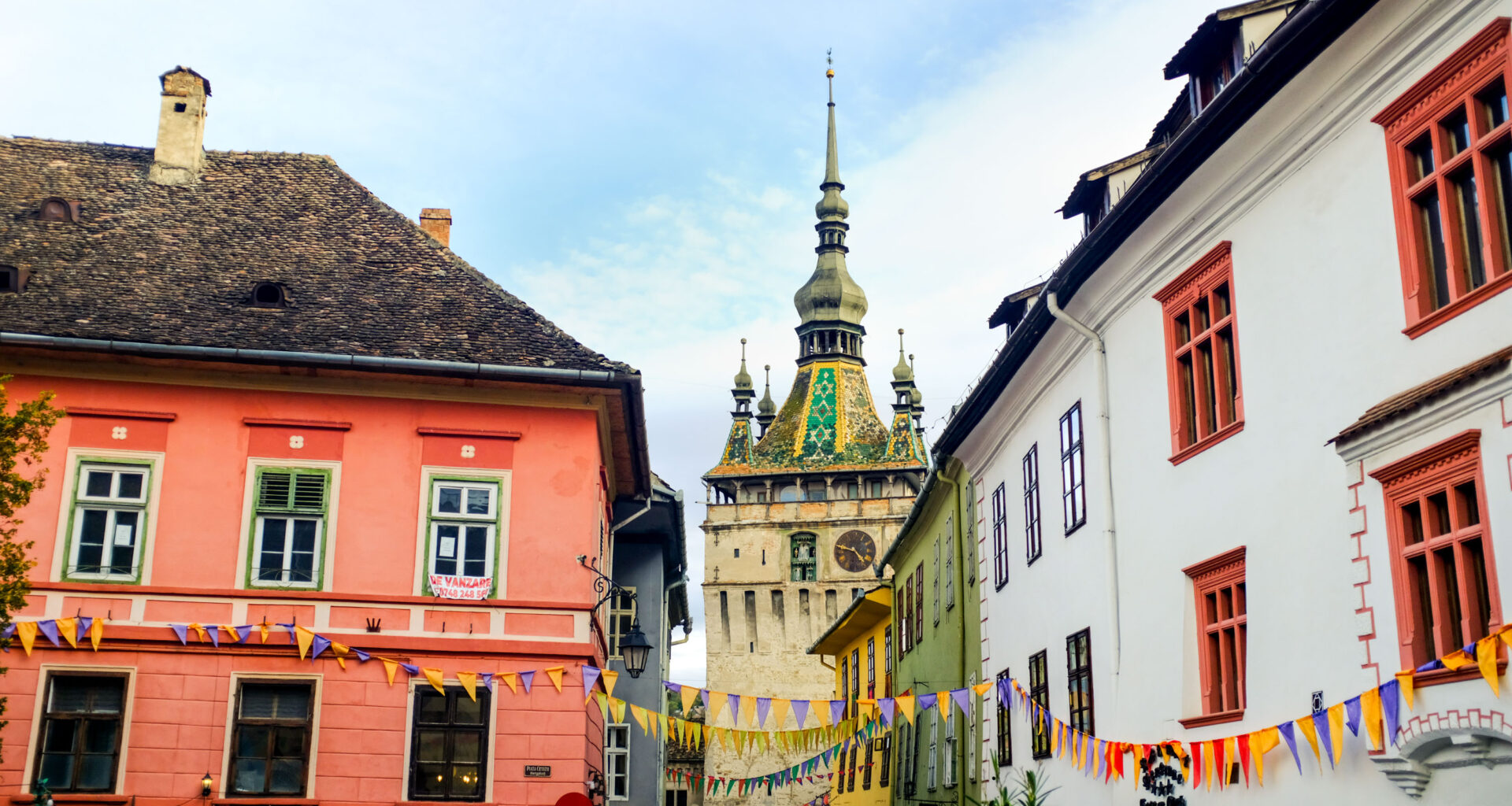
Transylvania has 180 remaining fortified churches, one of which author William Blacker is currently restoring.
Elsewhere, we climb through fortified churches that rise unexpectedly from the landscape, their thick walls and watchtowers speaking to a more defensive past. Romania has the highest concentration of these structures in Europe: once there were more than 230, now around 180 remain. From their upper levels, reached via narrow wooden ladders, the view stretches across a patchwork of hay meadows, orchards and villages, their rooftops fading softly into the hills.
One day, we knock at the door of a Saxon household and are welcomed by an eccentric Englishman, who offers us a tour of the 15th-century church at the heart of his home village. The building is crumbling, with detritus from years of abandonment clogging the courtyard. But on the walls, lit by a dust-mote-filled ray of sunlight, is a faded fresco: the head of a king.
William Blacker, our guide and the author of Transylvanian travelogue, Along the Enchanted Way, tells us it dates from 1440. “I was here when they uncovered it,” he says. “The king’s head appeared out of the whitewash, looking into the light.”
“Visiting Romania is like visiting eight different countries,” Lori tells us. “Different dress, different food.” Different histories, too – layered and interwoven, like Maria’s textiles.
There’s little sense of performance here – just food cooked as it always has been, and shared generously.
That sense of multiplicity reveals itself most clearly at the table. Meals are hearty and deeply rooted in place: polenta with sheep’s cheese, fizzy, sour soups, paprika-rich goulash, forest mushrooms gathered that afternoon. Hungarian influences sit comfortably alongside Romanian ones, the result of centuries of shifting rule. There’s little sense of performance here – just food cooked as it always has been, and shared generously.
We move slowly through all of this, and yet cover unexpected ground – not in distance, but in understanding. The further we travel, the less Transylvania feels like a fixed place on a map and more like a collection of lived traditions, held in the hands of the people we meet along the way.
There is a wildness here that resists easy definition. I think back to our first night, when, after a stomach-curdling drive through swooping lanes, we arrived in the village of Copșa Mare and dined heartily in the kitchen of our first guesthouse. As I left the long, convivial dinner and stepped out into the dark in search of the village house where my bedroom for the night was located, our host called after me: “Close the door behind you, or the animals come in.”
A practical warning, but one that lingers. In a landscape where wilderness still presses close, and where ways of life have endured through centuries of change, time moves differently. And in slowing down to meet it, you begin – just briefly – to move differently, too.
How to do it
Five-night tours in Transylvania with theslowcyclist.com start from £3,195, and include e-bike and helmet hire, two guides and hosts, all transfers, accommodation, food and drink, and organised activities.