
Anthony Albanese says petrol production has fallen 40% at one of Australia’s two remaining oil refineries but the damage caused by fire at the Geelong facility will not lead to fuel restrictions.
Petrol prices have fallen below $2.10 a litre and diesel below $3 a litre in most cities, as a price spike predicted to follow the refinery shutdown failed to materialise on Friday.
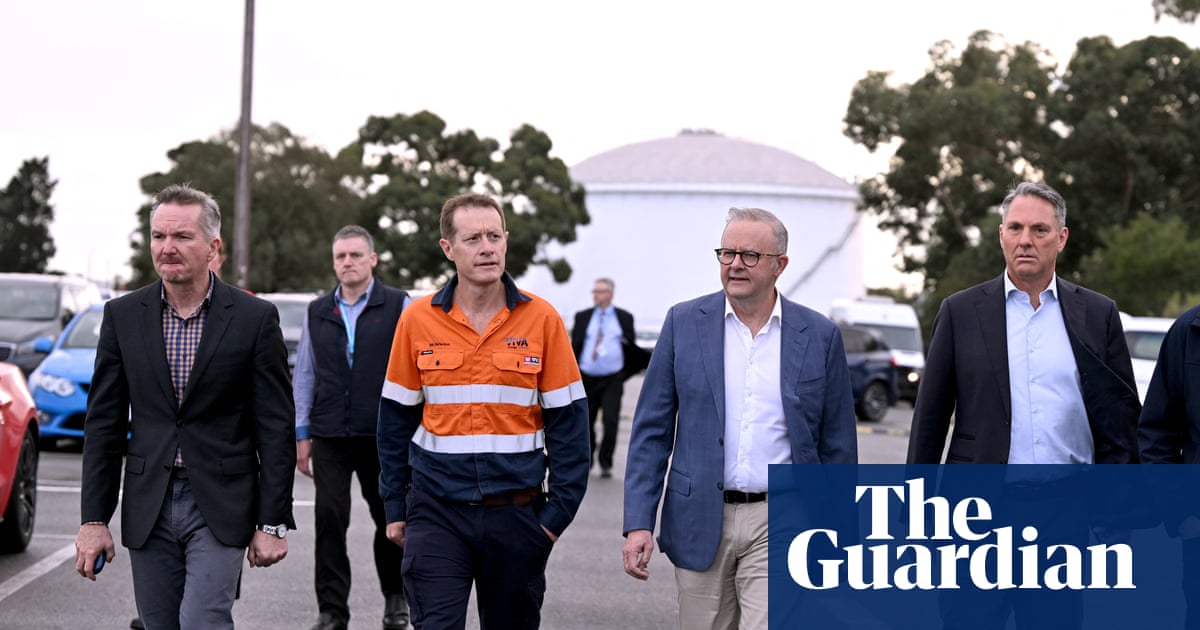
The prime minister spoke on Friday morning outside the Viva Energy refinery – which had been supplying about half of Victoria’s fuel before a massive fire burned for 13 hours until noon Thursday – and said the facility was also producing less diesel and aviation fuel.
“The advice that we have received today is that 80% of diesel production is continuing, [and] 80% of aviation fuel is continuing,” Albanese said.
“It has been slowed down just slightly because of the circumstances which are there, but 60% of petrol production [is] proceeding today as well.
“We hope that … ramps up over the coming period.”
Albanese did not give a timeline on when production would return to normal.
The temporary cuts to production had prompted predictions of less supply to terminals in Victoria and soaring petrol prices, but the Melbourne terminal price, charged to wholesalers, continued to fall on Friday.
Wholesale unleaded was below 191 cents a litre in Melbourne, Sydney, Brisbane, Adelaide and Perth, the Australian Institute of Petroleum reported. Diesel wholesale prices fell nearly 10 cents across the country from Thursday, to sit at less than 265 cents a litre in all cities except Darwin – their lowest point in a month.
Pump prices have fallen accordingly, with unleaded petrol averaging less than 210 cents a litre in every capital except Brisbane and Darwin, according to MotorMouth
Diesel was averaging less than 300 cents a litre in every capital except Hobart, at 300 cents, and in Brisbane, at 303.2. Geelong’s prices also fell, to 210.8 cents a litre for unleaded and 299 cents for diesel.
Graph of petrol prices for imports, wholesale and retail
The blaze at the Viva Energy facility, in the Geelong suburb of Corio, began on Wednesday night, with Fire Rescue Victoria alerted to the blaze by multiple calls to triple zero reporting explosions and flames.
Sign up for the Breaking News Australia email
According to the Viva Energy website, the refinery can process about 120,000 barrels of oil each day. Last month the company said it was able to maintain supplies despite the war in Iran.
The company said there was no “immediate impact” to fuel supply from the fire, and it expected to replace any lost production through its fuel import program.
Energy experts on Thursday warned more fuel restrictions could be needed and the government could have to move to the next stage of its fuel security plan, as Australia grows more dependent on imports.
Albanese flew home early from his fuel diplomacy mission in south-east Asia on Thursday night in the wake of the fire.
He said the blaze was “regrettable”, especially given the timing, but it would not push the country into “stage 3” of the national fuel plan.
Announced late last month, the plan has four levels:
Plan and prepare
Keeping Australia moving
Taking targeted action
Protecting critical services for all Australians
Australia has been at level 2, with fuel supply continuing notwithstanding periods of localised supply disruptions.
Under this setting, motorists are encouraged to “only buy the fuel you need”. The plan says making voluntary choices will use less fuel and help consumers avoid the impact of higher fuel prices.
Levels 3 and 4 include tougher conditions designed to prioritise fuel supply to the regions and critical industries.
“The government’s put in place the four stages in order to plan, and in order to prepare for circumstances which are predominantly impacted by global events, not by events here,” Albanese said on Friday.
“The event here will not lead to any change – we will give an update tomorrow about fuel supplies that are on hand.
“The fact that 60% of petrol production is continuing is actually very positive, given the circumstances people have seen … we all saw the visuals of what was a serious fire.”
On Thursday, Bill Patterson, Viva Energy’s executive general manager of energy and infrastructure, said while the cause of the fire was still being investigated there was no indication it had occurred because of maintenance issues or an increase in production at the site.
He said the affected area was part of the refinery responsible for combining LPG into gasoline-type molecules, which were later used in fuel blending and specialty products.