
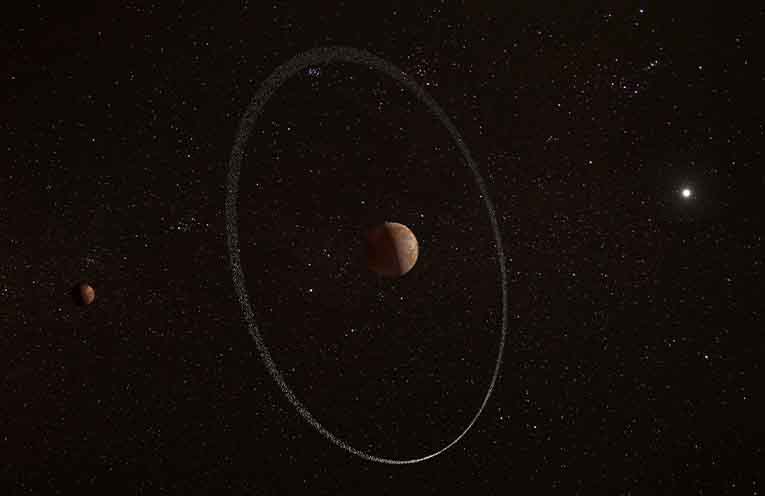
MOONEE amateur astronomer Jonathan Bradshaw has been honoured by the Astronomical Society of Australia (ASA) after discovering a giant ring rotating 4,000 km above the dwarf planet Quaoar.
Mr Bradshaw was awarded the Page Medal by Professor Fred Watson AM at the National Australian Convention of Amateur Astronomers in Tamworth on Saturday 4 April.

He and fellow amateur astronomers Renato Langersek and John Broughton, were recognised for discoveries that have guided humanity’s big telescopes.
In 2021, the three astronomers – situated in Samford, Brisbane and the Gold Coast – were watching as Quaoar passed in front of a distant star.
“The star blinked before and after Quaoar passed in front of it,” Mr Bradshaw said.
“Renato, John and I all saw it, so we knew it wasn’t a glitch.
“The best explanation was that there was a ring.
“It was an enigma because it is much further from Quaoar than expected by the ‘Roche Limit’.”
Rings are usually found inside the Roche Limit, where the planet’s tidal forces stop rings and debris from forming into a moon.
Quaoar is roughly half the size of Pluto and takes 288 years to orbit the Sun.
It is now known to have a moon and two rings.
Following their discovery, Mr Bradshaw co-authored a report for “Nature” detailing their discovery and subsequent observations of Quaoar.
“It’s exciting to be part of a discovery that has rocked the astrophysics world,” he told News Of The Area.
“It’s an honour to be part of a trio of amateurs who came along and spoiled what had, until that time, been a perfectly sound theory.
“It was a proper ‘what the…’ moment and I am super proud to receive notifications almost every week from other scientists using our published results to further their own understanding.”
Professor Richard McDermid, President of the Astronomical Society of Australia and Director of AAO (Australian Astronomical Optics) at Macquarie University, described the trio as “remarkable astronomers” who demonstrate that dedicated amateurs can make significant contributions to our understanding of the cosmos.
Dr Tanya Hill, ASA prizes coordinator and astronomer at the Melbourne Planetarium, added, “These ‘backyard astronomers’ remind us that everyone can look at the night sky and observe.
“Their observations can guide the work of billion-dollar telescopes.”
Meanwhile, back in Moonee, Mr Bradshaw says he is searching for his next discovery.
By Andrea FERRARI