
Digging into strong pitching performances is often one of the most valuable activities for evaluators of all types this time of the year. When it comes to evaluating pitchers, checking data and watching video can often provide clues for future success based on improved pitch mixes, mechanics and execution. And, unlike with hitting, pitching data can standardize in terms of stuff and locations fairly quickly, so early-season numbers can be particularly useful.
With that in mind, today we’ll be examining six pitching prospects who have stood out for their underlying data and ERA estimators over their first few starts of 2026.
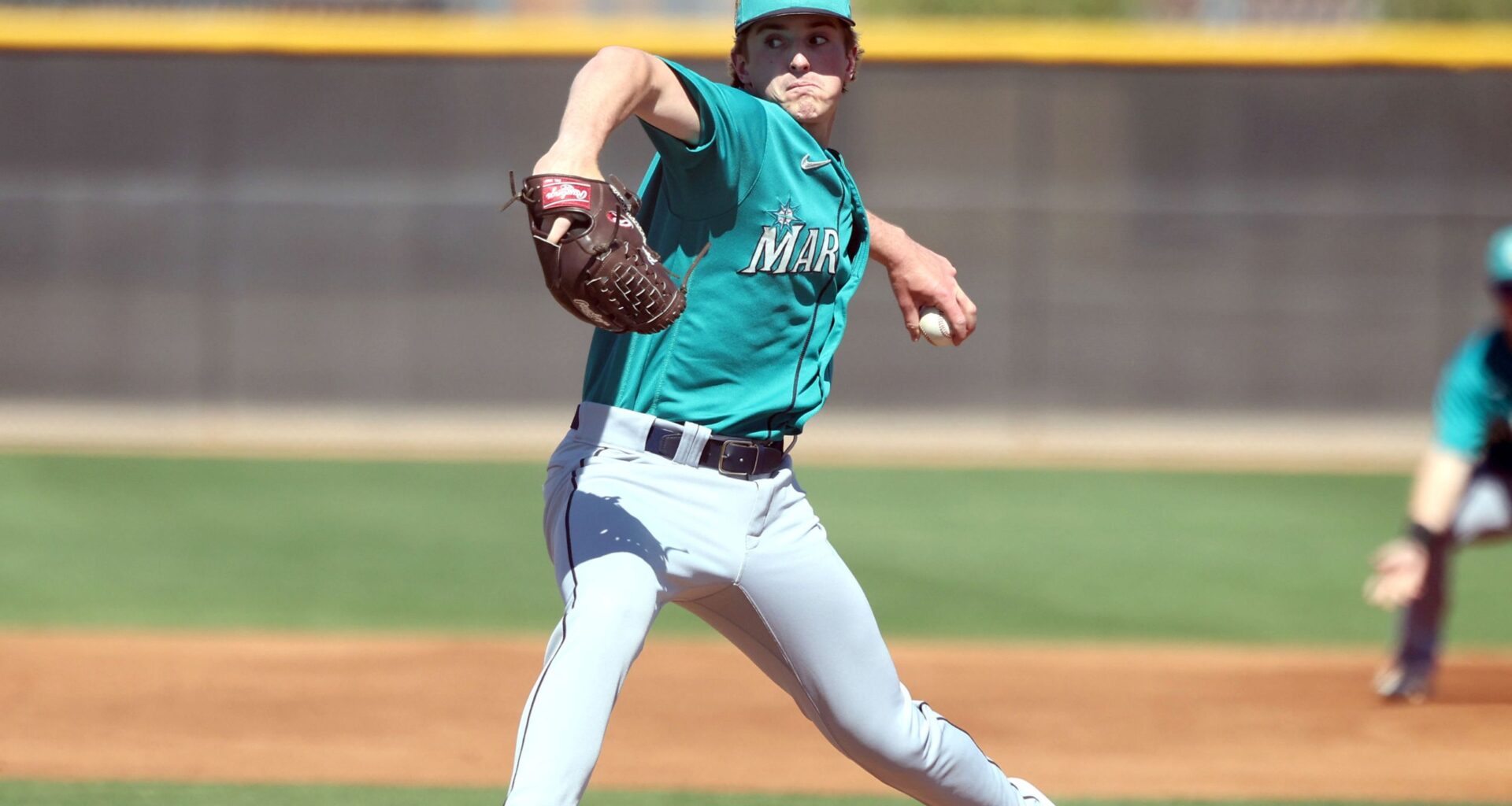
Kade Anderson, LHP, Mariners
The top pitcher in last July’s draft, Anderson is off to an impressive start with Double-A Arkansas and even nabbed the top spot in this week’s Hot Sheet. Over his first two starts, Anderson has yet to allow a run, striking out 17 batters to three walks and five hits.
Under the hood, Anderson looks very similar to what we saw at LSU. His 18 inches of ride and nine inches of run have so far matched his college data nearly one-for-one. He’s added a little velocity but not enough to say he’s trending upward based on early-season starts that are typically truncated compared to college starts by a Friday night ace. His slider, curveball and changeup all have nearly identical metrics to his LSU data, too, showing none of the deterioration in stuff we see typically going from college to pro ball.
For Anderson, the real challenge will come when he makes the jump to Triple-A and pitches with the MLB-sized ball.
PITCH TYPEAVG VELOIVBHBEXTVAASPINFour-seam93.8 mph18.79.26.5-4.62,197Slider86.3 mph-1.7-56.1-8.12,762Curveball81.3 mph-13.9-9.76.1-9.62878Changeup85.6 mph7.514.16.5-7.11,579
Tyson Hardin, RHP, Brewers
One of my favorite pop-up names from the 2025 season, I’m not sure that the industry has fully caught up to how good Hardin can be. After spending two seasons primarily as a reliever at Mississippi State, Hardin converted to starting almost immediately after being drafted by the Brewers in the 2024 12th round.
Following a good 2025 season, he has returned to Double-A Biloxi. While the early production has been bad on the surface, he is missing bats and showing improved stuff. Hardin’s fastball is up nearly 1 mph on average, his sinker is showing a more defined shape and he’s throwing his cutter harder.
Hardin is a low-launch fastball outlier with a -3.6 degree vertical approach angle and the ability to spin his breaking balls at spin rates north of 2,700 rpm.
PITCH TYPEAVG VELOIVBHBEXTVAASPINFour-seam94.4 mph14.5-9.46.3-3.62,543Sinker93.6 mph9.8-15.46.4-5.32,367Cutter89.3 mph3.71.56.4-6.12,658Slider82.4 mph-0.214.46.5-7.82,453Changeup88.8 mph-1.4-9.36.5-7.51,682
Luis Gutierrez, LHP, Padres
Coming into the season, Gutierrez ranked 26th on the Padres Top 30 prospects list on the heels of a solid 2025 in which he made a start at each full-season level.
After one Double-A start in 2025, Gutierrez has returned to the level to begin the season. His stuff looks to be way up so far, as his fastball is sitting 94.8 mph on average compared to 91-94 a year ago. The movement profile has also improved, though it’s still fairly underwhelming with 14-15 inches of ride and 11-12 inches of run from a six-foot release height. He’s also added spin to his slider, and his changeup is getting significantly better vertical separation off his fastball.
It’s not a high-end profile, but there are data-driven reasons for Gutierrez’s early success.
PITCH TYPEAVG VELOIVBHBEXTVAASPINFour-seam94.8 mph14.411.75.7-4.92,037Slider83.6 mph-4.8-7.55.7-8.32,535Changeup88.6 mph5.35.35.7-7.62,001
Josh Trentadue, LHP, Rangers
Drafted in the 14th round in 2023 out of Southern Idaho JC, Trentadue put his name on the map with a strong 2025 season. While he doesn’t currently rank on the Rangers’ Top 30, he likely will later this season if things continue to trend upward.
Trentadue’s surface-level stats to date have not been good, as he’s currently the owner of an ugly ERA, but the under-the-hood aspects are better. The 24-year-old lefty has added velocity and is now sitting 94-95 mph while generating more movement on his fastball with an approach angle that has flattened. He’s been very fastball- and slider-heavy in the early going, only mixing in two changeups over his first two starts. His slider shape has changed, as well, as it’s now more of a cut-slider than the baby sweeper he threw last season.
Trentadue creates interesting angles and, as a player with a 40-man roster decision looming this offseason, he could move to the majors quickly if the performance matches the stuff.
PITCH TYPEAVG VELOIVBHBEXTVAASPINFour-seam94.4 mph16.4126.2-4.32,343Slider84 mph-0.1-4.96-6.82,482
JT Quinn, RHP, Orioles
Quinn, another name high up on this week’s Hot Sheet, has been one of the buzziest names on the backfield and in the early part of the season. Drafted last July out of Georgia, Quinn has looked phenomenal in April, striking out 16 and walking two batters over nine innings.
After working as a swingman starter in college, the Orioles have deployed Quinn as a starter in 2026. Over the last two seasons, he has continued to tick up in terms of velocity and movement across his arsenal. He’s a short-strider, and the movement profile on the fastball is below average, but he’s throwing hard and hitting his spots with feel for a trio of secondaries.
PITCH TYPEAVG VELOIVBHBEXTVAASPINFour-seam96.5 mph13.8-5.26-62,074Changeup90.2 mph1.3-10.65.7-8.11,561Slider86.1 mph-5.16.86-9.82,481Curveball79.2 mph-13.213.96-11.42,646Sinker96.4 mph10.9-12.46-6.82,028
Mason Peters, LHP, Mariners
After two seasons at Temple College JC (Texas), Peters spent one season at Dallas Baptist working primarily as a reliever. The Mariners plucked him in the fourth round of last year’s draft and have run him out as a starter so far this season with Low-A Inland Empire.
Over two starts, Peters has struck out 14 batters to two walks over eight innings, allowing three earned runs. He’s shown four pitches, led by an absolute hammer curveball. The pitch sits 78-80 mph with serious two-plane depth and high spin rates. So far in 2026, whenever Peters declares it to be “hammer time,” hitters simply can’t touch this pitch.
Peters’ four-seam fastball, meanwhile, has fairly underwhelming cut-ride shape and will need to add a few ticks to be an average pitch. Both his slider and splitter give him pitches that move dynamically to both sides of the plate. It’s an interesting pitch mix and one that could take off with added power.
PITCH TYPEAVG VELOIVBHBEXTVAASPINCurveball78.5 mph-14.1-16.25.5-9.92,841Four-seam92.8 mph13.12.96.3-5.12,323Slider84.7 mph3.6-115.5-6.82,628Splitter86.8 mph1.213.46.7-8.11,093