
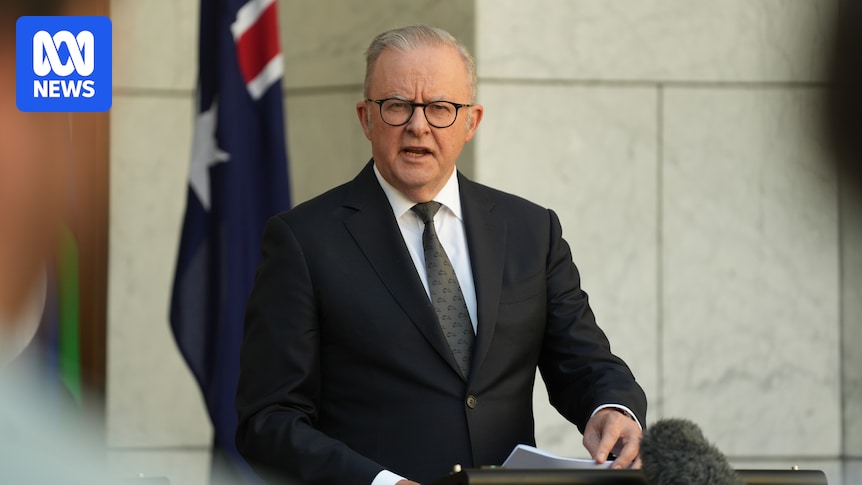
Prime Minister Anthony Albanese has joined a virtual meeting of world leaders tonight to discuss how to secure the Strait of Hormuz, once conflict in the region has ended.
About 40 leaders attended the summit, chaired jointly by the United Kingdom and France.
Iran war live updates: For the latest news on the Middle East crisis, read our blog
The United States did not attend.
At the summit, Mr Albanese was expected to highlight the need for de-escalation, the rapid resumption of negotiations and a swift resolution to the conflict.
Before the meeting the prime minister stressed the need for coordinated international diplomacy and said the conflict had far-reaching consequences.
“Australia and our Indo-Pacific partners are experiencing first-hand the impact of unprecedented disruptions to energy supply chains and impact on oil and fuel prices,” he said.
“Here, in Australia, we are working around the clock to shield Australians from the worst of the impacts.
“Australia is calling for the Strait of Hormuz to be fully reopened for all countries.”
US President Donald Trump has criticised allies for not joining the US blockade of Iran, which is aimed at allowing non-Iranian shipping through the vital trade route.
Trump repeats he is ‘not happy with Australia’
Mr Trump also said this morning he was “not happy” with Australia because it was “not there” in helping in the Strait of Hormuz.
But both the UK and France have already ruled out joining the blockade, arguing doing so would mean joining the conflict with Iran.
Instead, both countries have pointed to these multi-national talks about how the strait can be secured once the war is over.
Earlier this week, Defence Industry Minister Pat Conroy indicated Australia would also not join the blockade if asked by the US.
“Our position is that we are not party to this conflict, and we’ve got no intention to change that position,” he said.
Reuters has reported China has been invited to join the summit, but it was not clear if the invitation had been taken up.
Australia already has an E-7 Wedgetail surveillance aircraft deployed to the region, providing defensive support to the United Arab Emirates.
Ahead of the meeting, Foreign Minister Penny Wong was asked what more Australia might be willing to provide to secure the strait, but only after the conflict ended.
“We’ve made clear we want to be part of efforts, particularly diplomatic efforts, to ensure the Strait of Hormuz is open, that freedom of navigation occurs,” she told the ABC’s Afternoon Briefing.
“Obviously, there is a process of negotiation now between the United States and Iran.
“I think the focus of these discussions is really what happens next.”
She said a diplomatic solution to keeping the strait open would be significantly better than a military solution.
“It is very challenging to secure the strait militarily,” she said.
“Which is why diplomatic efforts, multilateral efforts, to get agreement for the strait to be open and to operate in accordance with international law are so important.”
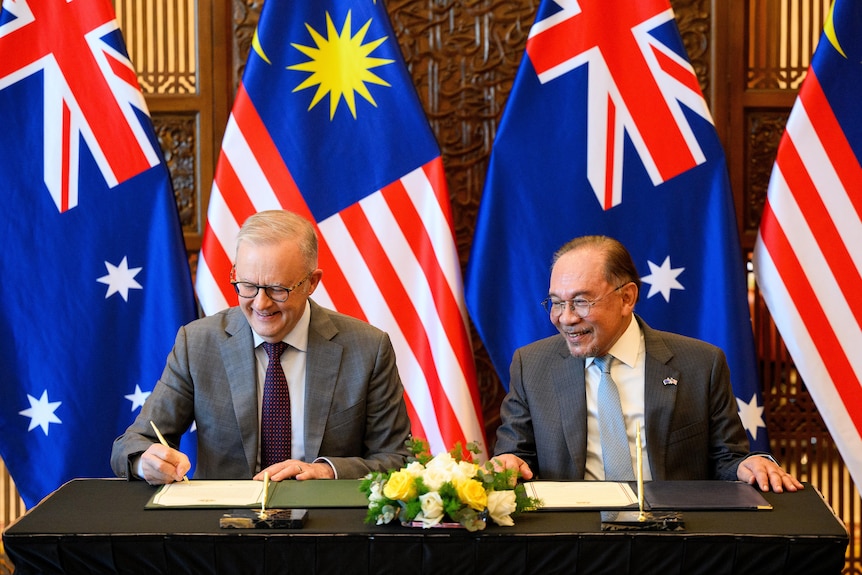
Over the past week Anthony Albanese has met with the leaders of Singapore, Brunei and Malaysia to shore up energy supply chains. (AAP: Bianca De Marchi)
The talks tonight follow a series of meetings between the prime minister and regional leaders in recent days.
Over the past week, Mr Albanese has met with heads of state in Singapore, Brunei and Malaysia, to lock in fuel supplies and for talks on maintaining energy supply chains.
As a result of the blaze, petrol production has dropped to 60 per cent of capacity and safety precautions meant diesel and jet fuel production were reduced to 80 per cent of normal levels.
Mr Albanese said the government would work with the company to restore operations at the refinery, which is one of two remaining in Australia.
“It has slowed down just slightly because of the circumstances that are there,” Mr Albanese told reporters outside the facility.
“We hope, of course, as does the company, that that ramps up over the coming period.”
He said the damage was not significant enough to trigger an escalation to the next stage of the government’s national fuel security plan.
Loading…