
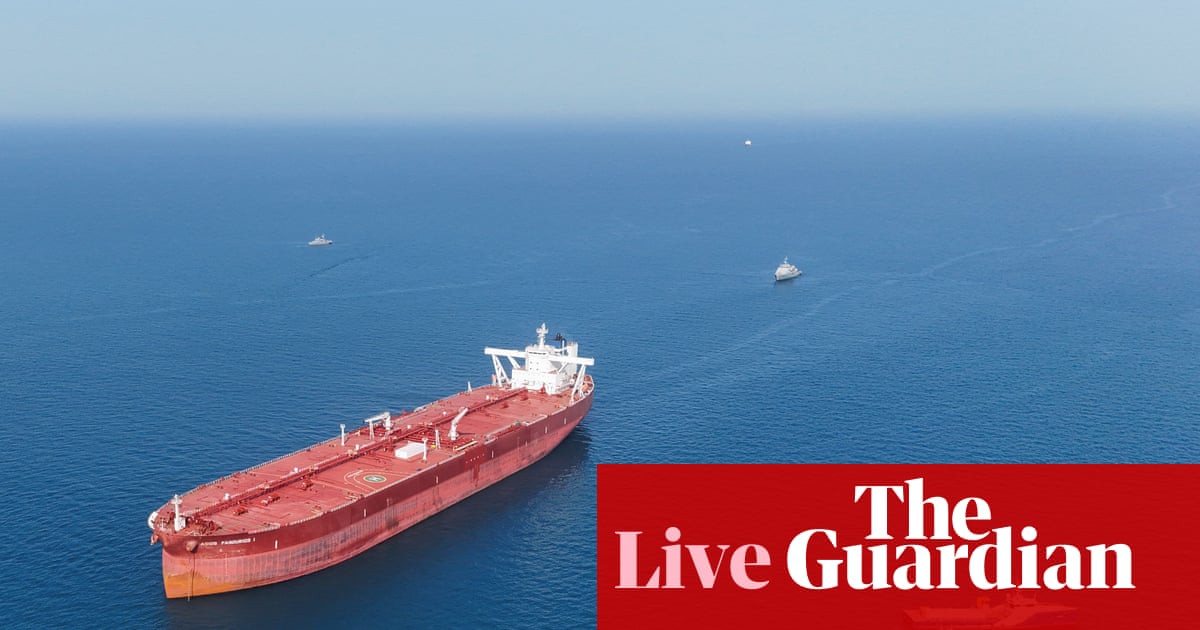
Iran says control of strait of Hormuz returns to ‘previous state’ due to US blockade
Iran announced control of the strait of Hormuz has “reverted to its previous state” over the continuing row with the US over its naval blockade of Iranian ports.
In a statement carried by Iranian media, the Iranian military’s operational command, Khatam Al-Anbiya, described the ongoing US blockade as “piracy”, saying: “For this reason, control of the strait of Hormuz has reverted to its previous state, and this strategic waterway is under the strict management and control of the armed forces.
“Until the US restores the complete freedom of navigation for vessels from an Iranian origin to a destination, and from a destination back to Iran, the situation in the strait of Hormuz will remain strictly controlled and in its previous state.”
This adds to the confusion over the status of the key waterway that carried a fifth of global oil supplies before the war. Yesterday Iran and Donald Trump announced the strait had reopened to shipping, but the US president said the US blockade “will remain in full force” until Tehran reaches a deal with Washington, including over its nuclear programme.
Updated at 04.43 EDT
Key events
Show key events only
Please turn on JavaScript to use this feature
As reports come in of Iranian gun boats firing at a tanker near the strait of Hormuz, Iran’s supreme leader, Mojtaba Khamenei, has issued a long statement on Telegram, praising his country’s military capabilities.
“In the same way that its [Iran’s] drones strike the US and the Zionist murderers like lightning, its valiant navy is also ready to inflict new bitter defeats on its enemies,” he said.
ShareTanker fired at by IRGC gun boats near strait of Hormuz, says UKMTO
The UK Maritime Trade Operations (UKMTO) said it has received a report of a tanker coming under fire near the strait of Hormuz by two gun boats linked to Iran’s Islamic Revolutionary Guard Corps (IRGC).
The incident happened 20 nautical miles northeast of Oman, UKMTO said, adding that the captain of the tanker reported the two gunboats opened fire without issuing a radio challenge.
In a warning issued today, the UKMTO said:
double quotation markUKMTO has received a report of an incident 20NM northeast of OMAN.
The Master of a Tanker reports being approached by 2 IRGC gun boats, no VHF challenge that then fired upon the tanker.
Tanker and crew are reported safe.
Authorities are investigating.
Updated at 07.03 EDT
Reuters has reported that at least two merchant vessels said they were hit by gunfire as they attempted to cross the strait of Hormuz today. That’s according to three maritime security and shipping sources, the news agency reported.
We will bring you more as we get it.
Iran’s deputy foreign minister, Saeed Khatibzadeh, said Donald Trump “talks too much” as he reacted to the US president’s threats that American forces would “start dropping bombs again” if no deal is reached between Washington and Tehran.
Speaking to reporters on the sidelines of the Antalya Diplomatic Forum in Turkey, Khatibzadeh said: “That’s president Trump talk, he talks too much, he said contradictory things within the same statement.”
Trump was asked by reporters aboard Air Force One yesterday whether he would extend the temporary ceasefire with Iran, which expires on Wednesday, if a deal is not reached before then. He replied: “I don’t know, maybe not, maybe I won’t extend it, but the blockade is going to remain … and unfortunately we’ll have to start dropping bombs again”.
The Egyptian foreign minister, Badr Abdelatty, said Egypt and Pakistan were working “very hard” to bring about “a final agreement between the US and Iran”, AFP reported.
Abdelatty, who attended the Antalya Diplomacy Forum in Turkey today, said: “We hope to do so (reach an agreement) in the coming days.”
He added: “We are pushing very hard in order to move forward.”
Egypt and Turkey, as well as Pakistan and Saudi Arabia, have been closely involved in diplomatic efforts to end the war in the Middle East, with their foreign ministers meeting regularly since the war began on 28 February.
Updated at 06.21 EDT
Six airports have reopened in Iran, including in the capital Tehran, according to Iranian media.
An official from the Iranian airlines association told Iran’s semi-official Tasnim news agency that airlines were preparing to operate domestic and international flights.
Two airports in Tehran have reopened, as well as airports in the cities of Mashhad, Birjand, Gorgan and Zahedan, the official said.
Iran’s civil aviation authority announced earlier today that the country’s airspace has partially reopened for international flights transiting through Iran.
The airspace had been closed since the start of the war on 28 February when the US and Israel launched attacks against Tehran.
In the US, top Senate Democrats have criticised the Trump administration for easing sanctions on Russian oil, after it issued a new waiver allowing the legal purchase of Russian oil already at sea.
The move yesterday came two days after US treasury secretary, Scott Bessent, said the Trump administration would not extend the earlier waiver that expired on 11 April.
In a joint statement, leading Senate Democrats, including Chuck Schumer of New York, Elizabeth Warren of Massachusetts, and Jeanne Shaheen of New Hampshire, condemned the “180-degree reversal” and described it as “shameful”.
They said:
double quotation markThis week, Putin launched the largest aerial attack of the year so far on Ukraine, killing 18 and the Administration’s response is to relax sanctions on the Kremlin yet again. What kind of message does this move send?
“Make no mistake, Putin has been one of the biggest beneficiaries of President Trump’s war against Iran, as Russia saw oil revenues nearly double in March. Enough is enough. President Trump needs to stop letting Putin play him for a fool and impose additional sanctions on Putin, who is clearly not feeling sufficient pressure from this President.
Meanwhile, a temporary ceasefire in Lebanon has continued to hold, with thousands more displaced families returning to their homes under the supervision of UN peacemakers. Here are some of latest images coming out of the country:
A boy holds a Lebanese flag as displaced people make their way back to their homes on a makeshift road, built at the site where the Qasmieh bridge was destroyed in Israeli strikes, in the southern Lebanese area of Qasmiyeh. Photograph: Mahmoud Zayyat/AFP/Getty ImagesA French contingent of the UN Interim Force in Lebanon (Unifil) patrols the Qasmiyeh area as displaced people waving yellow Hezbollah flags make their way back to their homes. Photograph: Mahmoud Zayyat/AFP/Getty ImagesUnifil peacekeepers watch as cars drive through Qasmiyeh. Photograph: Mahmoud Zayyat/AFP/Getty ImagesA displaced woman reacts after returning to her damaged home in Beirut’s southern suburbs. Photograph: Ibrahim Amro/AFP/Getty ImagesDisplaced people inspect the damage as they return to their homes in Beirut’s southern suburbs. Photograph: Ibrahim Amro/AFP/Getty ImagesShareIran says control of strait of Hormuz returns to ‘previous state’ due to US blockade
Iran announced control of the strait of Hormuz has “reverted to its previous state” over the continuing row with the US over its naval blockade of Iranian ports.
In a statement carried by Iranian media, the Iranian military’s operational command, Khatam Al-Anbiya, described the ongoing US blockade as “piracy”, saying: “For this reason, control of the strait of Hormuz has reverted to its previous state, and this strategic waterway is under the strict management and control of the armed forces.
“Until the US restores the complete freedom of navigation for vessels from an Iranian origin to a destination, and from a destination back to Iran, the situation in the strait of Hormuz will remain strictly controlled and in its previous state.”
This adds to the confusion over the status of the key waterway that carried a fifth of global oil supplies before the war. Yesterday Iran and Donald Trump announced the strait had reopened to shipping, but the US president said the US blockade “will remain in full force” until Tehran reaches a deal with Washington, including over its nuclear programme.
Updated at 04.43 EDT
Turkey’s foreign minister, Hakan Fidan, has told the Antalya Diplomacy Forum that Israel was using security as a pretext to acquire “more land”.
“Israel is not after its own security, Israel is after more land,” he said at the annual conference on international diplomacy in the Turkish resort city of Antalya, AFP reported.
“Security is being used by the Netanyahu government as an excuse to occupy more land,” he added, referring to Israeli prime minister Benjamin Netanyahu.
“Israel has to know that the only way to live peacefully in the region … is to let the other countries enjoy their own security, and territorial integrity, and freedom, not to use power on those countries.”
Turkey, a Nato member bordering Iran, has positioned itself as a potential key mediator in the Middle East conflict, but its sometimes intense rhetoric against Israel has raised questions over its ability to remain neutral.
Updated at 04.09 EDT
The Trump administration issued a waiver yesterday permitting countries to buy sanctioned Russian oil and petroleum products at sea for about a month.
The move was an extension of an earlier sanctions waiver that expired on 11 April.
Following turmoil in energy markets triggered by the Middle East conflict, the Trump administration has attempted to reduce global oil prices by allowing countries to purchase vast quantities of crude oil that had earlier been prohibited under US restrictions.
In a Telegram post this morning, the Russian presidential special envoy, Kirill Dmitriev, said the waiver “will affect over 100m barrels of oil currently in transit”. That brings the total volume affected by both waivers to 200m barrels, Reuters reported.